• Produktbild: Tackling Wicked Problems
  • Produktbild: Tackling Wicked Problems
- 19%

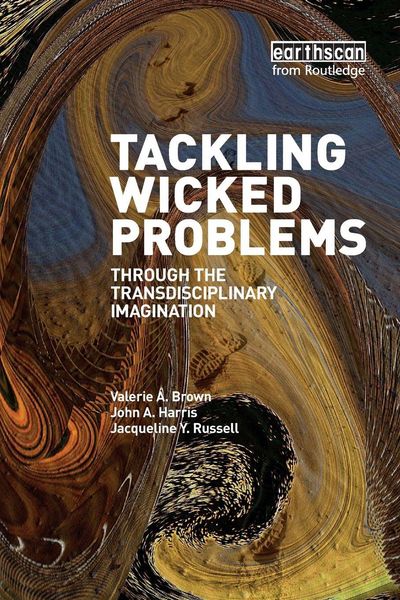
Tackling Wicked Problems Through the Transdisciplinary Imagination

19% sparen

75,99 € UVP 94,30 €

inkl. gesetzl. MwSt., Versandkostenfrei


Beschreibung

Produktdetails

Einband

Taschenbuch

Erscheinungsdatum

25.06.2010

Herausgeber

John Harris + weitere

Verlag

Taylor & Francis

Seitenzahl

332

Maße (L/B/H)

23,4/15,6/1,8 cm

Gewicht

508 g

Sprache

Englisch

ISBN

978-1-84407-925-4

Beschreibung

Rezension

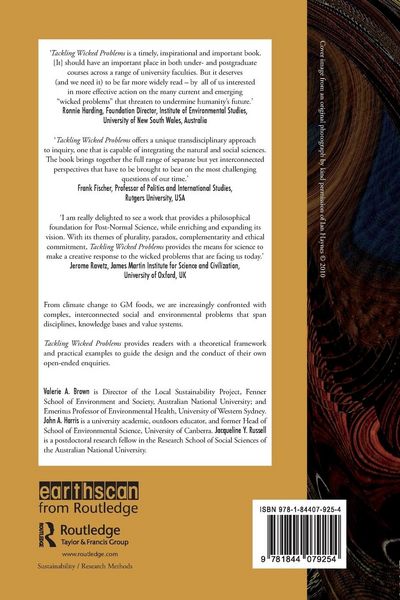
'Tackling Wicked Problems is a timely volume that deserves a wide, global readership.' Nature 'I am really delighted to see a work that provides a philosophical foundation for Post-Normal Science, while enriching and expanding its vision. Valerie Brown and her colleagues - really comrades - have achieved the new synthesis for a scientific practice that is so necessary for the current age. At last there is a statement for science that leaves behind the linear logic and truncated self-awareness that was the heritage of Descartes. With its themes of plurality, paradox, complementarity and ethical commitment, Tackling Wicked Problems provides the means for science to make a creative response to the challenges of our time.' Jerome Ravetz, James Martin Institute for Science and Civilization, University of Oxford, UK 'Tackling Wicked Problems is a timely, inspirational and important book. Complex and 'wicked problems', are common and growing - within societies, regions, locally and globally. They are found in relation to many issues including environmental, human health, urban planning and transport. Importantly, the cross-connections between issues are typically part of the complexity. So far our decision-making processes have not served us well in addressing these issues. Yet the need for more effective decision-making processes is urgent, with anthropogenic climate change perhaps the prime example of a wicked problem in need of urgent action. This book provides an excellent analysis of the inadequacies of our current approaches and the benefits of frameworks based on open transdisciplinary inquiry for addressing 'wicked problems'. It complements this theoretical basis with a strong set of practical examples of open transdisciplinary inquiry by 15 authors from across the natural and social sciences, the humanities, environmental and public sector management, political science and community activism. Tackling Wicked Problems should have an important place in both under and post-graduate courses across a range of University faculties. But it deserves (and we need) it to be far more widely read - by decision-makers in both the public and private sectors and all of us interested in more effective action on the many current and emerging 'wicked problems' that threaten to undermine humanity's future.' Ronnie Harding, Foundation Director, Institute of Environmental Studies, University of NSW, Australia 'One of the critical questions posed by the ecological crisis concerns the nature of the knowledge we need to deal with it. Tackling Wicked Problems tackles the problem by offering a unique transdisciplinary approach to inquiry, one that is capable of integrating the natural and social sciences. Integrating both empirical and normative investigation, it offers a framework that is at the same time theoretical, epistemological and practical. The book brings together the full range of separate but yet interconnected perspectives that have to be brought to bear on the most challenging questions of our time.' Frank Fischer, Professor of Politics and International Studies, Rutgers University, USA 'You owe it to yourself to read the book for your answer.' Gail Purvis, Compute Scotland. 'Tackling Wicked Problems is a timely, inspirational and important book..it deserves...to be far more widely read - by decision-makers in both the public and private sectors ' Ronnie Harding, Designophy. 'Tackling Wicked Problems takes a bold path to show that there are different ways- which remain more faithful to embodied reality - of making knowledge work for us.' Mike Hulme, ECOS

Produktdetails

Einband

Taschenbuch

Erscheinungsdatum

25.06.2010

Herausgeber

Verlag

Taylor & Francis

Seitenzahl

332

Maße (L/B/H)

23,4/15,6/1,8 cm

Gewicht

508 g

Sprache

Englisch

ISBN

978-1-84407-925-4

Herstelleradresse

Libri GmbH
Europaallee 1
36244 Bad Hersfeld
DE

Email: gpsr@libri.de

Kundinnen und Kunden meinen

0 Bewertungen

Informationen zu Bewertungen

Zur Abgabe einer Bewertung ist eine Anmeldung im Konto notwendig. Die Authentizität der Bewertungen wird von uns nicht überprüft. Wir behalten uns vor, Bewertungstexte, die unseren Richtlinien widersprechen, entsprechend zu kürzen oder zu löschen.

Die Bewertungen sind nach Format, Anzahl Sterne und Datum sortiert.

Verfassen Sie die erste Bewertung zu diesem Artikel

Helfen Sie anderen Kund*innen durch Ihre Meinung

Kundinnen und Kunden meinen

0 Bewertungen filtern

Die Leseprobe wird geladen.
  • Produktbild: Tackling Wicked Problems
  • Produktbild: Tackling Wicked Problems
  • Foreword

    Acknowledgements

    Part I: The Ideas

    1. Towards a Just and Sustainable Future

    2. Beyond Disciplinary Confinement to Imaginative Transdisciplinarity

    3. A Philosophical Framework for an Open and Critical Transdisciplinary Inquiry

    4. Collective Inquiry and Its Wicked Problems

    5. Ignorance and Uncertainty

    Part II: The Practice
    Overview

    6. Conducting an Imaginative Transdisciplinary Inquiry

    7. Specialized Inquiry
    7a 'Now I'm Not an Expert in Anything'
    7b Global Inequalities in Research
    7c Applying Specialized Knowledge

    8. Community-based Inquiry
    Overview
    8a Inclusive Governance for Sustainability
    8b Fences and Windows
    8c Calculating Community Risk

    9. Organisational Inquiry
    Overview
    9a Embedded Scales
    9b Adaptiveness and Openness
    9c Truth, Knowledge and Data

    10. Individual-focused Inquiry
    Overview
    10a Making Their Way
    10b White Skin, Black Masks
    10c Exploring the Doctoral Interface

    11. Holistic Inquiry
    Overview
    11a Designerly Ways of Knowing
    11b Rethinking Change
    11c All Knowledge Is Indigenous

    Part III: The Future
    Overview

    12. Human Ecology and Open Transdisciplinary Inquiry

    13. Can There Be a Community of Practice?

    Glossary

    Index