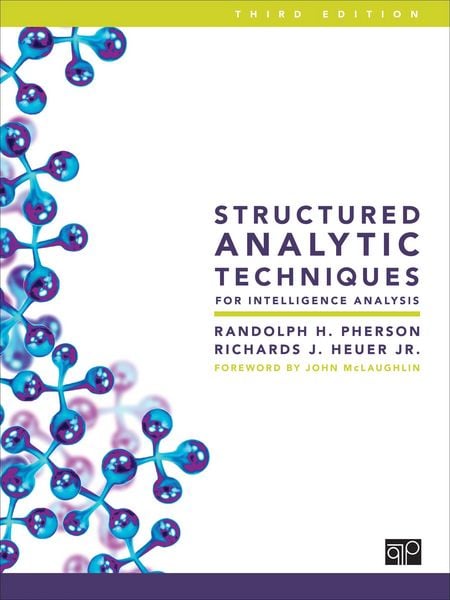
Produktbild: Structured Analytic Techniques for Intelligence Analysis

Structured Analytic Techniques for Intelligence Analysis 3rd Revised Edition

174,99 €

inkl. gesetzl. MwSt., Versandkostenfrei


Beschreibung

Produktdetails

Einband

Taschenbuch

Erscheinungsdatum

01.05.2020

Abbildungen

mit Illustrationen

Verlag

Sage Publications

Seitenzahl

384

Maße (L/B/H)

20,3/18,2/3,3 cm

Gewicht

620 g

Auflage

3rd edition. Revised

Sprache

Englisch

ISBN

978-1-5063-6893-1

Beschreibung

Produktdetails

Einband

Taschenbuch

Erscheinungsdatum

01.05.2020

Abbildungen

mit Illustrationen

Verlag

Sage Publications

Seitenzahl

384

Maße (L/B/H)

20,3/18,2/3,3 cm

Gewicht

620 g

Auflage

3rd edition. Revised

Sprache

Englisch

ISBN

978-1-5063-6893-1

Herstelleradresse

Libri GmbH
Europaallee 1
36244 Bad Hersfeld
DE

Email: gpsr@libri.de

Kundinnen und Kunden meinen

0 Bewertungen

Informationen zu Bewertungen

Zur Abgabe einer Bewertung ist eine Anmeldung im Konto notwendig. Die Authentizität der Bewertungen wird von uns nicht überprüft. Wir behalten uns vor, Bewertungstexte, die unseren Richtlinien widersprechen, entsprechend zu kürzen oder zu löschen.

Die Bewertungen sind nach Format, Anzahl Sterne und Datum sortiert.

Verfassen Sie die erste Bewertung zu diesem Artikel

Helfen Sie anderen Kund*innen durch Ihre Meinung

Kundinnen und Kunden meinen

0 Bewertungen filtern

  • Produktbild: Structured Analytic Techniques for Intelligence Analysis
  • Figures
    Foreword by John McLaughlin
    Preface
    Chapter 1 ¿ Introduction and Overview
    1.1 Our Vision
    1.2 Role of Structured Analytic Techniques
    1.3 History of Structured Analytic Techniques
    1.4 The Expanding Use of Structured Analytic Techniques
    1.5 Selection of Techniques for This Book
    1.6 Quick Overview of Chapters
    Chapter 2 ¿ The Role of Structured Techniques
    2.1 Two Types of Thinking
    2.2 Developing a Taxonomy of Structured Analytic Techniques
    2.3 Dealing with Cognitive Limitations
    2.4 Matching Cognitive Limitations to Structured Techniques
    2.5 Combating Digital Disinformation
    Chapter 3 ¿ Choosing the Right Technique
    3.1 The Six Families
    3.2 Core Techniques
    3.3 Selecting the Right Technique
    3.4 Projects Using Multiple Techniques
    3.5 Common Errors in Selecting Techniques
    3.6 Making a Habit of Using Structured Techniques
    Chapter 4 ¿ Practitioner's Guide to Collaboration
    4.1 Social Networks and Analytic Teams
    4.2 Dividing the Work
    4.3 Value of Collaborative Processes
    4.4 Common Pitfalls with Small Groups
    4.5 Benefiting from Diversity
    4.6 Advocacy versus Objective Inquiry
    4.7 Leadership and Training
    Chapter 5 ¿ Getting Organized
    5.1 Sorting
    5.2 Ranking, Scoring, and Prioritizing
    5.3 Matrices
    5.4 Process Maps
    5.5 Gantt Charts
    Chapter 6 ¿ Exploration Techniques
    6.1 Simple Brainstorming
    6.2 Cluster Brainstorming
    6.3 Nominal Group Technique
    6.4 Circleboarding(TM)
    6.5 Starbursting
    6.6 Mind Maps and Concept Maps
    6.7 Venn Analysis
    6.8 Network Analysis
    Chapter 7 ¿ Diagnostic Techniques
    7.1 Key Assumptions Check
    7.2 Chronologies and Timelines
    7.3 Cross-Impact Matrix
    7.4 Multiple Hypothesis Generation
    7.5 Diagnostic Reasoning
    7.6 Analysis of Competing Hypotheses
    7.7 Inconsistencies Finder(TM)
    7.8 Deception Detection
    7.9 Argument Mapping
    Chapter 8 ¿ Reframing Techniques
    8.1 Cause and Effect Techniques
    8.2 Challenge Analysis Techniques
    8.3 Conflict Management Techniques
    Chapter 9 ¿ Foresight Techniques
    9.1 Key Drivers Generation(TM)
    9.2 Key Uncertainties Finder(TM)
    9.3 Reversing Assumptions
    9.4 Simple Scenarios
    9.5 Cone of Plausibility
    9.6 Alternative Futures Analysis
    9.7 Multiple Scenarios Generation
    9.8 Morphological Analysis
    9.9 Counterfactual Reasoning
    9.10 Analysis by Contrasting Narratives
    9.11 Indicators Generation, Validation, and Evaluation
    Chapter 10 ¿ Decision Support Techniques
    10.1 Opportunities Incubator(TM)
    10.2 Bowtie Analysis
    10.3 Impact Matrix
    10.4 SWOT Analysis
    10.5 Critical Path Analysis
    10.6 Decision Trees
    10.7 Decision Matrix
    10.8 Force Field Analysis
    10.9 Pros-Cons-Faults-and-Fixes
    10.10 Complexity Manager
    Chapter 11 ¿ The Future of Structured Analytic Techniques
    11.1 Limits of Empirical Analysis
    11.2 Purpose of Structured Techniques
    11.3 Projecting the Trajectory of Structured Techniques
    11.4 Role of Structured Techniques in 2030