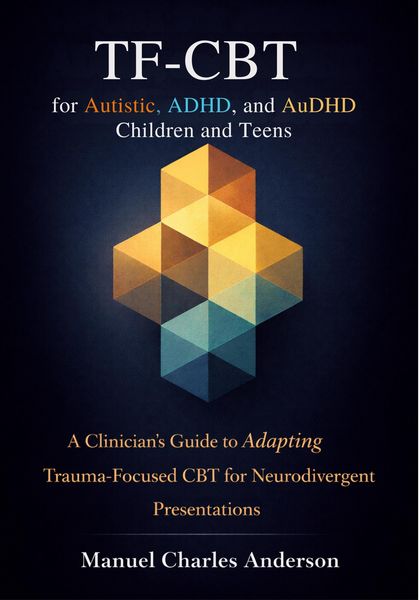
TF-CBT for Autistic, ADHD, and AuDHD Children and Teens A Clinician's Guide to Adapting Trauma-Focused CBT for Neurodivergent Presentations
-
- Einzelkauf Download ausgewählt
-
Sprache:Englisch
8,62 €
inkl. gesetzl. MwSt.Beschreibung
Produktdetails
Format
ePUB 3
Kopierschutz
Nein
Family Sharing
Ja
Text-to-Speech
Ja
Erscheinungsdatum
10.03.2026
Verlag
NeuroKindred BooksSeitenzahl
281 (Printausgabe)
Dateigröße
1636 KB
Sprache
Englisch
EAN
6610001180805
The Clinical Gap That Has Harmed Thousands of Children
More than 70 percent of children referred for trauma treatment carry a neurodevelopmental diagnosis. Autism, ADHD, and the co-occurring profile known as AuDHD alter how a child experiences trauma, expresses distress, tolerates therapeutic activation, and responds to standard clinical approaches. Trauma-Focused CBT remains the most evidence-supported trauma treatment for children and adolescents. Yet its standard delivery assumes neurotypical communication, emotional expression, and sensory tolerance. The result is a clinical mismatch that leaves neurodivergent children underserved, misdiagnosed, or prematurely discharged from treatment.
A Systematic Framework for Modification
This clinical guide provides a complete, research-grounded framework for adapting every component of TF-CBT's PRACTICE sequence for autistic children, children with ADHD, and those carrying both neurological profiles simultaneously. The modifications address psychoeducation, relaxation, affective regulation, cognitive coping, trauma narrative, in vivo mastery, conjoint sessions, and safety planning. Each adaptation is grounded in the neurological and sensory realities of neurodivergent development, not in simplified protocols or general symptom management techniques.
Evidence-Based and Neurodiversity-Affirming
Drawing on current research in autistic trauma, ADHD and PTSD overlap, and AuDHD presentations, this framework rejects the normalization model entirely. Neurodivergent differences are treated as permanent features requiring clinical accommodation, not deficits to be corrected through treatment. Masking, sensory processing differences, alexithymia, rejection sensitive dysphoria, demand avoidance, and augmentative communication needs are each addressed with specific clinical guidance backed by peer-reviewed evidence.
Population-Specific Profiles and Practical Tools
Separate clinical profiles for autistic children, children with ADHD, and AuDHD children ground each modification decision in population-specific neuroscience and clinical reality. A complete differential assessment framework addresses the significant symptom overlap between autism, ADHD, and PTSD. Twenty reproducible clinical tools are included for immediate use, covering session schedule templates, regulation menus, narrative planning worksheets, safety planning adaptations, caregiver handouts, and a clinician self-reflection guide for examining neurotypical bias in trauma practice.
Case Studies Across Four Presentations
Four detailed composite case studies demonstrate the clinical framework across a range of ages, communication profiles, and trauma types, including an AAC-using autistic child, a child with ADHD and domestic violence exposure, a teen with AuDHD and bullying-related PTSD, and a late-diagnosed autistic adolescent with seven years of misdiagnosis history. Each case illustrates the specific accommodation decisions, clinical pivots, and treatment outcomes the adapted framework produces.
This is a clinical reference for therapists, psychologists, social workers, and counselors committed to delivering effective trauma treatment to every child who needs it, regardless of neurological profile.
Kundinnen und Kunden meinen
Verfassen Sie die erste Bewertung zu diesem Artikel
Helfen Sie anderen Kund*innen durch Ihre Meinung
Kurze Frage zu unserer Seite
Vielen Dank für Ihr Feedback
Wir nutzen Ihr Feedback, um unsere Produktseiten zu verbessern. Bitte haben Sie Verständnis, dass wir Ihnen keine Rückmeldung geben können. Falls Sie Kontakt mit uns aufnehmen möchten, können Sie sich aber gerne an unseren Kund*innenservice wenden.
zum Kundenservice