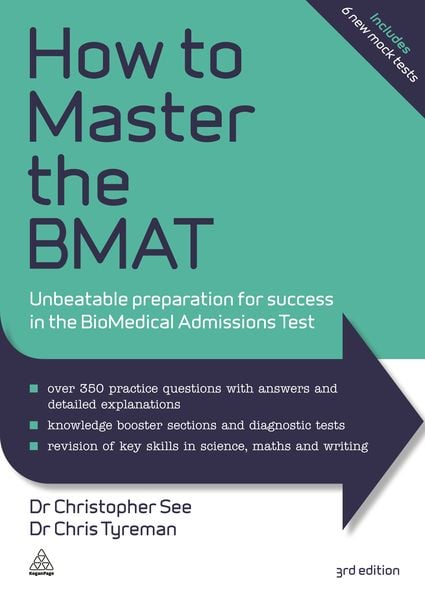
Produktbild: How to Master the Bmat

How to Master the Bmat Unbeatable Preparation for Success in the Biomedical Admissions Test

39,99 €

inkl. gesetzl. MwSt., Versandkostenfrei


Beschreibung

Produktdetails

ISBN

978-0-7494-7187-3

Auflage

3

Erscheinungsdatum

03.04.2015

Bundesländer

Baden-Württemberg + weitere

Einband

Taschenbuch

Verlag

Kogan Page Ltd

Seitenzahl

304

Maße (L/B/H)

24,4/17/1,7 cm

Gewicht

520 g

Sprache

Englisch

Beschreibung

Produktdetails

ISBN

978-0-7494-7187-3

Auflage

3

Erscheinungsdatum

03.04.2015

Bundesländer

  • Baden-Württemberg
  • Bayern
  • Berlin
  • Brandenburg
  • Bremen
  • Hamburg
  • Hessen
  • Mecklenburg-Vorpommern
  • Niedersachsen
  • Nordrhein-Westfalen
  • Rheinland-Pfalz
  • Saarland
  • Sachsen
  • Sachsen-Anhalt
  • Schleswig-Holstein
  • Thüringen

Einband

Taschenbuch

Verlag

Kogan Page Ltd

Seitenzahl

304

Maße (L/B/H)

24,4/17/1,7 cm

Gewicht

520 g

Sprache

Englisch

Herstelleradresse

Libri GmbH
Europaallee 1
36244 Bad Hersfeld
DE

Email: gpsr@libri.de

Kundinnen und Kunden meinen

0 Bewertungen

Informationen zu Bewertungen

Zur Abgabe einer Bewertung ist eine Anmeldung im Konto notwendig. Die Authentizität der Bewertungen wird von uns nicht überprüft. Wir behalten uns vor, Bewertungstexte, die unseren Richtlinien widersprechen, entsprechend zu kürzen oder zu löschen.

Die Bewertungen sind nach Format, Anzahl Sterne und Datum sortiert.

Verfassen Sie die erste Bewertung zu diesem Artikel

Helfen Sie anderen Kund*innen durch Ihre Meinung

Kundinnen und Kunden meinen

0 Bewertungen filtern

Weitere Artikel finden Sie in

  • Produktbild: How to Master the Bmat
  • Introduction

    PART ONE

    Reviews

    1. Aptitude and skills review

    A1. Understanding argument 1: basic aspects

    A2. Understanding argument 2: flaws; types of questions

    A3. Understanding argument 3: example argument

    A4. Critical thinking: Venn diagrams and logic statements

    A5. Shape symmetry

    Aptitude review questions

    2. Maths review

    M1. Mental arithmetic review 1: basic operations

    M2. Mental arithmetic review 2: further operations

    M3. Fractions 1: basic arithmetic

    M4. Fractions 2: improper fractions; ratios

    M5. Decimals 1: fraction/decimal conversions and basic arithmetic

    M6. Decimals 2: rounding (decimal place, significant figure) and standard form

    M7. Per cent (%)

    M8. Time and clocks

    M9. Areas, perimeters, volumes and surface area

    M10. Algebra 1: substitution and re-arranging

    M11. Algebra 2: simultaneous and quadratic equations

    M12. Averages: mean, median, mode; weighted

    M13. Pie and bar charts, line and scatter graphs, tables

    M14. Cumulative frequency, box and whisker plots

    M15. Geometry 1: angles and lines, triangles, other shapes

    M16. Geometry 2: Pythagoras and trigonometric functions

    M17. Circle theorems

    M18. Inequalities

    M19. Probability 1: basic concepts

    M20. Probability 2: tree diagrams

    M21. Permutations and combinations

    Maths review questions

    3. Physics review
    P1. Measurements and prefixes

    P2. Conventions for units, symbols and numbers

    P3. SI base units for length, volume, mass

    P4. Equations of motion

    P5. Graphs of motion

    P6. Projectile motion

    P7. Force and motion (Newton)

    P8. Force, work, power and energy

    P9. Universal gravitation, satellites and escape velocity

    P10. Force, momentum and impulse

    P11. Force, stress and strain

    P12. Moments, mechanical advantage, levers and pulleys

    P13. Pressure, buoyancy and flow

    P14. Gas laws

    P15. Heat and energy

    P16. Waves (light and sound)

    P17. Electrostatics, capacitance and electricity

    P18. Kirchhoff's circuit laws, resistors and capacitors

    P19. Electromagnetism and electromagnetic induction

    P20. Radioactive decay

    Physics review questions

    4. Chemistry review

    C1. Atoms, electron configuration and valency

    C2. Periodic table

    C3. Bonding: electrovalent (ionic), covalent and metallic

    C4. The mole and balancing chemical equations (reactions)

    C5. Types of chemical reaction

    C6. Concentration and pH; reaction rates

    C7. Exothermic and endodermic reactions; Le Chatelier's principle

    C8. Solids, liquids, gases; changes of state; thermochemistry

    C9. Electrochemistry, reactivity series and electrolysis

    C10. Carbon (organic) chemistry; fractional distillation

    Chemistry review questions

    5. Biology review

    B1. Digestive system

    B2. Respiratory system

    B3. Circulatory system

    B4. Nervous system

    B5. Endocrine system; menstrual cycle hormones

    B6. Urinary system

    B7. DNA (deoxyribonucleic acid), genes and cell division

    B8. Patterns of inheritance

    Biology review questions

    6. Writing task review

    W1. Choice of question

    W2. Preparation

    W3. The four-paragraph approach

    W4. Composing the essay

    W5. Sources and resources

    W6. The final check

    Instructions for mock tests

    PART TWO

    Tests and answers

    7. Mock tests

    Mock Test 1: Aptitude and skills

    Mock Test 2: Scientific knowledge and applications

    Mock Test 3: Writing task

    Mock Test 4: Aptitude and skills

    Mock Test 5: Scientific knowledge and applications

    Mock Test 6: Writing task

    Mock Test 7: Aptitude and skills

    Mock Test 8: Scientific knowledge and applications

    Mock Test 9: Writing task

    Mock Test 10: Aptitude and skills

    Mock Test 11: Scientific knowledge and skills

    Mock Test 12: Writing task

    Mock Test 13: Aptitude and skills

    Mock Test 14: Scientific knowledge and applications

    Mock Test 15: Writing task

    8. Answers and explanations

    Answers to review questions

    Answers to mock tests