• Produktbild: Advances in Independent Component Analysis
  • Produktbild: Advances in Independent Component Analysis

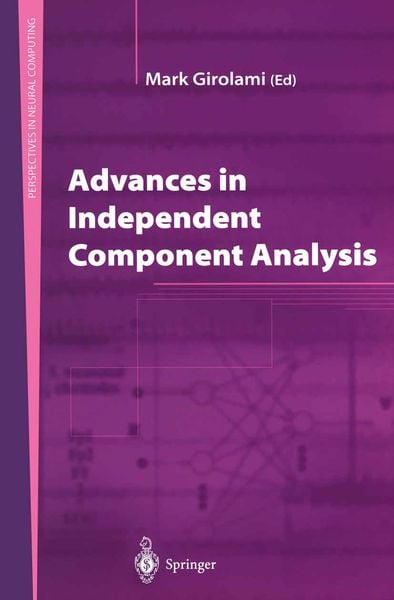
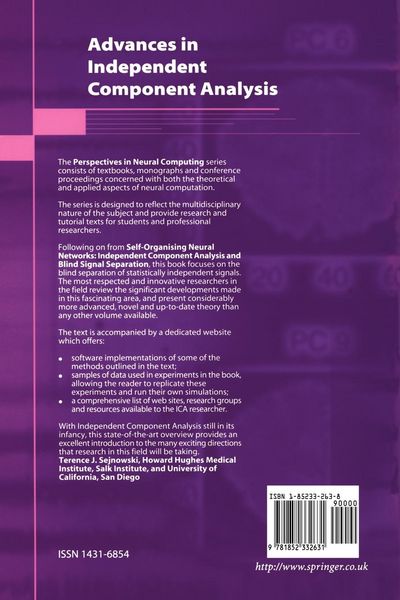
Advances in Independent Component Analysis

175,99 €

inkl. gesetzl. MwSt., Versandkostenfrei


Beschreibung

Produktdetails

Einband

Taschenbuch

Erscheinungsdatum

17.07.2000

Herausgeber

Mark Girolami

Verlag

Springer London

Seitenzahl

284

Maße (L/B/H)

23,5/15,5/1,6 cm

Gewicht

458 g

Auflage

2000

Sprache

Englisch

ISBN

978-1-85233-263-1

Beschreibung

Produktdetails

Einband

Taschenbuch

Erscheinungsdatum

17.07.2000

Herausgeber

Mark Girolami

Verlag

Springer London

Seitenzahl

284

Maße (L/B/H)

23,5/15,5/1,6 cm

Gewicht

458 g

Auflage

2000

Sprache

Englisch

ISBN

978-1-85233-263-1

Herstelleradresse

Springer-Verlag GmbH
Tiergartenstr. 17
69121 Heidelberg
DE

Email: ProductSafety@springernature.com

Kundinnen und Kunden meinen

0 Bewertungen

Informationen zu Bewertungen

Zur Abgabe einer Bewertung ist eine Anmeldung im Konto notwendig. Die Authentizität der Bewertungen wird von uns nicht überprüft. Wir behalten uns vor, Bewertungstexte, die unseren Richtlinien widersprechen, entsprechend zu kürzen oder zu löschen.

Die Bewertungen sind nach Format, Anzahl Sterne und Datum sortiert.

Verfassen Sie die erste Bewertung zu diesem Artikel

Helfen Sie anderen Kund*innen durch Ihre Meinung

Kundinnen und Kunden meinen

0 Bewertungen filtern

  • Produktbild: Advances in Independent Component Analysis
  • Produktbild: Advances in Independent Component Analysis
  • I Temporal ICA Models.- 1 Hidden Markov Independent Component Analysis.- 1.1 Introduction.- 1.2 Hidden Markov Models.- 1.3 Independent Component Analysis.- 1.3.1 Generalised Exponential Sources.- 1.3.2 Generalised Autoregressive Sources.- 1.4 Hidden Markov ICA.- 1.4.1 Generalised Exponential Sources.- 1.4.2 Generalised Autoregressive Sources.- 1.5 Practical Issues.- 1.5.1 Initialisation.- 1.5.2 Learning.- 1.5.3 Model Order Selection.- 1.6 Results.- 1.6.1 Multiple Sinewave Sources.- 1.6.2 Same Sources, Different Mixing.- 1.6.3 Same Mixing, Different Sources.- 1.6.4 EEG Data.- 1.7 Conclusion.- 1.8 Acknowledgements.- 1.9 Appendix.- 2 Particle Filters for Non-Stationary ICA.- 2.1 Introduction.- 2.2 Stationary ICA.- 2.3 Non-Stationary Independent Component Analysis.- 2.3.1 Source Model.- 2.4 Particle Filters.- 2.4.1 Source Recovery.- 2.5 Illustration of Non-Stationary ICA.- 2.6 Smoothing.- 2.7 Temporal Correlations.- 2.8 Conclusion.- 2.8.1 Acknowledgement.- 2.9 Appendix: Laplace’s Approximation for the Likelihood.- II The Validity of the Independence Assumption.- 3 The Independence Assumption: Analyzing the Independence of the Components by Topography.- 3.1 Introduction.- 3.2 Background: Independent Subspace Analysis.- 3.3 Topographic ICA Model.- 3.3.1 Dependence and Topography.- 3.3.2 Defining Topographic ICA.- 3.3.3 The Generative Model.- 3.3.4 Basic Properties of the Topographic ICA Model.- 3.4 Learning Rule.- 3.5 Comparison with Other Topographic Mappings.- 3.6 Experiments.- 3.6.1 Experiments in Feature Extraction of Image Data.- 3.6.2 Experiments in Feature Extraction of Audio Data.- 3.6.3 Experiments with Magnetoencephalographic Recordings.- 3.7 Conclusion.- 4 The Independence Assumption: Dependent Component Analysis.- 4.1 Introduction.- 4.2 Blind Source Separation by DCA.- 4.3 The “Cyclone” Algorithm.- 4.4 Experimental Results.- 4.5 Higher-Order Cyclostationary Signal Separation.- 4.6 Conclusion.- 4.7 Appendix: Proof of ACF Property 3.- III Ensemble Learning and Applications.- 5 Ensemble Learning.- 5.1 Introduction.- 5.2 Posterior Averages in Action.- 5.3 Approximations of Posterior PDF.- 5.4 Ensemble Learning.- 5.4.1 Model Selection in Ensemble Learning.- 5.4.2 Connection to Coding.- 5.4.3 EM and MAP.- 5.5 Construction of Probabilistic Models.- 5.5.1 Priors and Hyperpriors.- 5.6 Examples.- 5.6.1 Fixed Form Q.- 5.6.2 Free Form Q.- 5.7 Conclusion.- References.- 6 Bayesian Non-Linear Independent Component Analysis by Multi-Layer Perceptrons.- 6.1 Introduction.- 6.2 Choosing Among Competing Explanations.- 6.3 Non-Linear Factor Analysis.- 6.3.1 Definition of the Model.- 6.3.2 Cost Function.- 6.3.3 Update Rules.- 6.4 Non-Linear Independent Factor Analysis.- 6.5 Experiments.- 6.5.1 Learning Scheme.- 6.5.2 Helix.- 6.5.3 Non-Linear Artificial Data.- 6.5.4 Process Data.- 6.6 Comparison with Existing Methods.- 6.6.1 SOM and GTM.- 6.6.2 Auto-Associative MLPs.- 6.6.3 Generative Learning with MLPs.- 6.7 Conclusion.- 6.7.1 Validity of the Approximations.- 6.7.2 Initial Inversion by Auxiliary MLP.- 6.7.3 Future Directions.- 6.8 Acknowledgements.- 7 Ensemble Learning for Blind Image Separation and Deconvolution.- 7.1 Introduction.- 7.2 Separation of Images.- 7.2.1 Learning the Ensemble.- 7.2.2 Learning the Model.- 7.2.3 Example.- 7.2.4 Parts-Based Image Decomposition.- 7.3 Deconvolution of Images.- 7.4 Conclusion.- 7.5 Acknowledgements.- References.- IV Data Analysis and Applications.- 8 Multi-Class Independent Component Analysis (MUCICA) for Rank-Deficient Distributions.- 8.1 Introduction.- 8.2 The Rank-Deficient One Class Problem.- 8.2.1 Method I: Three Blocks.- 8.2.2 Method II: Two Blocks.- 8.2.3 Method III: One Block.- 8.3 The Rank-Deficient Multi-Class Problem.- 8.4 Simulations.- 8.5 Conclusion.- References.- 9 Blind Separation of Noisy Image Mixtures.- 9.1 Introduction.- 9.2 The Likelihood.- 9.3 Estimation of Sources for the Case of Known Parameters.- 9.4 Joint Estimation of Sources, Mixing Matrix, and Noise Level.- 9.5 Simulation Example.- 9.6 Generalization and the Bias-Variance Dilemma.- 9.7 Application to Neuroimaging.- 9.8 Conclusion.- 9.9 Acknowledgments.- 9.10 Appendix: The Generalized Boltzmann Learning Rule.- 10 Searching for Independence in Electromagnetic Brain Waves.- 10.1 Introduction.- 10.2 Independent Component Analysis.- 10.2.1 The Model.- 10.2.2 The FastICA Algorithm.- 10.3 Electro- and Magnetoencephalography.- 10.4 On the Validity of the Linear ICA Model.- 10.5 The Analysis of EEG and MEG Data.- 10.5.1 Artifact Identification and Removal from EEG/MEG.- 10.5.2 Analysis of Multimodal Evoked Fields.- 10.5.3 Segmenting Auditory Evoked Fields.- 10.6 Conclusion.- 11 ICA on Noisy Data: A Factor Analysis Approach.- 11.1 Introduction.- 11.2 Factor Analysis and ICA.- 11.2.1 Factor Analysis.- 11.2.2 Factor Analysis in Preprocessing.- 11.2.3 ICA as Determining the Rotation Matrix.- 11.3 Experiment with Synthesized Data.- 11.4 MEG Data Analysis.- 11.4.1 Experiment with Phantom Data.- 11.4.2 Experiment with Real Brain Data.- 11.5 Conclusion.- 11.6 Acknowledgements.- 12 Analysis of Optical Imaging Data Using Weak Models and ICA.- 12.1 Introduction.- 12.2 Linear Component Analysis.- 12.3 Singular Value Decomposition.- 12.3.1 SVD Applied to OI Data Set.- 12.4 Independent Component Analysis.- 12.4.1 Minimisation Routines.- 12.4.2 Application of sICA to OI Data.- 12.5 The Weak Causal Model.- 12.5.1 Weak Causal Model Applied to the OI Data Set.- 12.5.2 Some Remarks on Significance Testing.- 12.6 The Weak Periodic Model.- 12.7 Regularised Weak Models.- 12.8 Regularised Weak Causal Model Applied to OI Data.- 12.9 Image Goodness and Multiple Models.- 12.10 A Last Look at the OI Data Set.- 12.11 Conclusion.- References.- 13 Independent Components in Text.- 13.1 Introduction.- 13.1.1 Vector Space Representations.- 13.1.2 Latent Semantic Indexing.- 13.2 Independent Component Analysis.- 13.2.1 Noisy Separation of Linear Mixtures.- 13.2.2 Learning ICA Text Representations on the LSI Space.- 13.2.3 Document Classification Based on Independent Components.- 13.2.4 Keywords from Context Vectors.- 13.2.5 Generalisation and the Bias-Variance Dilemma.- 13.3 Examples.- 13.3.1 MED Data Set.- 13.3.2 CRAN Data Set.- 13.4 Conclusion.- 14 Seeking Independence Using Biologically-Inspired ANN’s.- 14.1 Introduction.- 14.2 The Negative Feedback Network.- 14.3 Independence in Unions of Sources.- 14.3.1 Factor Analysis.- 14.3.2 Minimal Overcomplete Bases.- 14.4 Canonical Correlation Analysis.- 14.4.1 Extracting Multiple Correlations.- 14.4.2 Using Minimum Correlations to Extract Independent Sources.- 14.4.3 Experiments.- 14.5 ?-Insensitive Hebbian Learning.- 14.5.1 Is this a Hebbian Rule?.- 14.5.2 Extraction of Sinusoids.- 14.5.3 Noise Reduction.- 14.6 Conclusion.- References.