• Produktbild: Random and Quasi-Random Point Sets
  • Produktbild: Random and Quasi-Random Point Sets
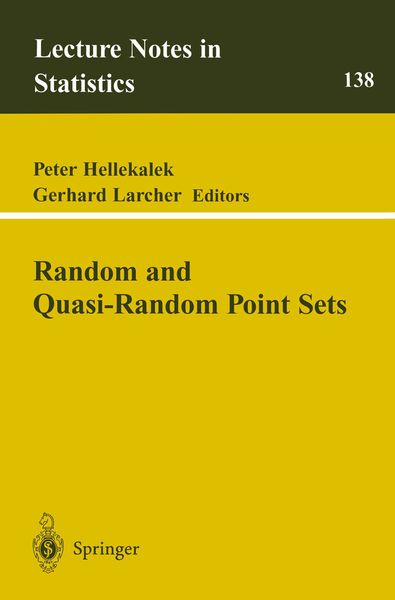
Band 138

Random and Quasi-Random Point Sets

97,99 €

inkl. gesetzl. MwSt., Versandkostenfrei


Beschreibung

Produktdetails

Einband

Taschenbuch

Erscheinungsdatum

09.10.1998

Herausgeber

Peter Hellekalek + weitere

Verlag

Springer Us

Seitenzahl

334

Maße (L/B/H)

23,5/15,5/1,8 cm

Gewicht

528 g

Auflage

Softcover reprint of the original 1st ed. 1998

Sprache

Englisch

ISBN

978-0-387-98554-1

Beschreibung

Produktdetails

Einband

Taschenbuch

Erscheinungsdatum

09.10.1998

Herausgeber

Verlag

Springer Us

Seitenzahl

334

Maße (L/B/H)

23,5/15,5/1,8 cm

Gewicht

528 g

Auflage

Softcover reprint of the original 1st ed. 1998

Sprache

Englisch

ISBN

978-0-387-98554-1

Herstelleradresse

Springer-Verlag GmbH
Tiergartenstr. 17
69121 Heidelberg
DE

Email: GPSR Kontakt

Kundinnen und Kunden meinen

0 Bewertungen

Informationen zu Bewertungen

Zur Abgabe einer Bewertung ist eine Anmeldung im Konto notwendig. Die Authentizität der Bewertungen wird von uns nicht überprüft. Wir behalten uns vor, Bewertungstexte, die unseren Richtlinien widersprechen, entsprechend zu kürzen oder zu löschen.

Die Bewertungen sind nach Format, Anzahl Sterne und Datum sortiert.

Verfassen Sie die erste Bewertung zu diesem Artikel

Helfen Sie anderen Kund*innen durch Ihre Meinung

Kundinnen und Kunden meinen

0 Bewertungen filtern

  • Produktbild: Random and Quasi-Random Point Sets
  • Produktbild: Random and Quasi-Random Point Sets
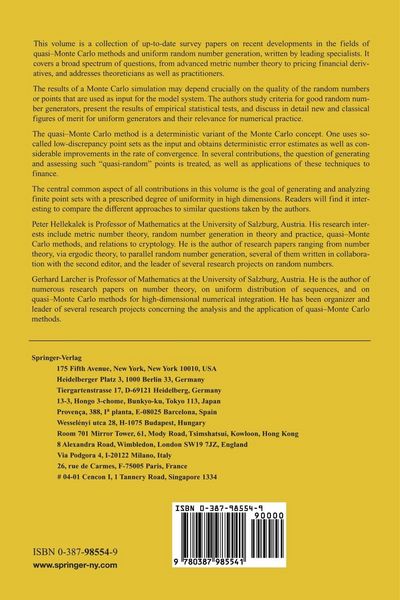
  • From Probabilistic Diophantine Approximation to Quadratic Fields.- 1 Part I: Super Irregularity.- 2 Part II: Probabilistic Diophantine Approximation.- 2.1 Local Case: Inhomogeneous Pell Inequalities - Hyperbolas.- 2.2 Beyond Quadratic Irrationals.- 2.3 Global Case: Lattice Points in Tilted Rectangles.- 2.4 Simultaneous Case.- 3 Part III: Quadratic Fields and Continued Fractions.- 3.1 Cesaro Mean of % MathType!MTEF!2!1!+-
    % feaagCart1ev2aaatCvAUfeBSjuyZL2yd9gzLbvyNv2CaerbuLwBLn
    % hiov2DGi1BTfMBaeXatLxBI9gBaerbd9wDYLwzYbItLDharqqtubsr
    % 4rNCHbGeaGqiVu0Je9sqqrpepC0xbbL8F4rqqrFfpeea0xe9Lq-Jc9
    % vqaqpepm0xbba9pwe9Q8fs0-yqaqpepae9pg0FirpepeKkFr0xfr-x
    % fr-xb9adbaqaaeGaciGaaiaabeqaamaabaabaaGcbaaeaaaaaaaaa8
    % qadaaeabqaamaacmaabaGaamOBaiabeg7aH9aadaahaaWcbeqaa8qa
    % caaIXaGaai4laiaaikdaaaaakiaawUhacaGL9baaaSqabeqaniabgg
    % HiLdaaaa!3F6B!$$ \sum {\left\{ {n{\alpha ^{1/2}}} \right\}} $$ and Quadratic Fields.- 3.2 Hardy-Littlewood Lemma 14.- 4 Part IV: Class Number One Problems.- 4.1 An Attempt to Reduce the Yokoi’s Conjecture to a Finite Amount of Computation.- 5 Part V: Cesaro Mean of % MathType!MTEF!2!1!+-
    % feaagCart1ev2aaatCvAUfeBSjuyZL2yd9gzLbvyNv2CaerbuLwBLn
    % hiov2DGi1BTfMBaeXatLxBI9gBaerbd9wDYLwzYbItLDharqqtubsr
    % 4rNCHbGeaGqiVu0Je9sqqrpepC0xbbL8F4rqqrFfpeea0xe9Lq-Jc9
    % vqaqpepm0xbba9pwe9Q8fs0-yqaqpepae9pg0FirpepeKkFr0xfr-x
    % fr-xb9adbaqaaeGaciGaaiaabeqaamaabaabaaGcqaaaaaaaaaWdbe
    % aadaaeqaWdaeaapeWaaeWaa8aabaWdbmaacmaapaqaa8qacaWGUbGa
    % eqySdegacaGL7bGaayzFaaGaeyOeI0IaaGymaiaac+cacaaIYaaaca
    % GLOaGaayzkaaaal8aabaWdbiaad6gaaeqaniabggHiLdaaaa!42C9!$$ \sum\nolimits_n {\left( {\left\{ {n\alpha } \right\} - 1/2} \right)} $$.- 6 References.- On the Assessment of Random and Quasi-Random Point Sets.- 1 Introduction.- 2 Chapter for the Practitioner.- 2.1 Assessing RNGs.- 2.2 Correlation Analysis for RNGs I.- 2.3 Correlation Analysis for RNGs II.- 2.4 Theory vs. Practice I: Leap-Frog Streams.- 2.5 Theory vs. Practice II: Parallel Monte Carlo Integration.- 2.6 Assessing LDPs.- 2.7 Good Lattice Points.- 2.8 GLPs vs. (tms)-Nets.- 2.9 Conclusion.- 3 Mathematical Preliminaries.- 3.1 Haar and Walsh Series.- 3.2 Integration Lattices.- 4 Uniform Distribution Modulo One.- 4.1 The Definition of Uniformly Distributed Sequences.- 4.2 Weyl Sums and Weyl’s Criterion.- 4.3 Remarks.- 5 The Spectral Test.- 5.1 Definition.- 5.2 Properties.- 5.3 Examples.- 5.4 Geometric Interpretation.- 5.5 Remarks.- 6 The Weighted Spectral Test.- 6.1 Definition.- 6.2 Examples and Properties.- 6.3 Remarks.- 7 Discrepancy.- 7.1 Definition.- 7.2 The Inequality of Erdös-Turán-Koksma.- 7.3 Remarks.- 8 Summary.- 9 Acknowledgements.- 10 References.- Lattice Rules: How Well Do They Measure Up?.- 1 Introduction.- 2 Some Basic Properties of Lattice Rules.- 3 A General Approach to Worst-Case and Average-Case Error Analysis.- 3.1 Worst-Case Quadrature Error for Reproducing Kernel Hilbert Spaces.- 3.2 A More General Worst-Case Quadrature Error Analysis.- 3.3 Average-Case Quadrature Error Analysis.- 4 Examples of Other Discrepancies.- 4.1 The ANOVA Decomposition.- 4.2 A Generalization ofP?(L) with Weights.- 4.3 The Periodic Bernoulli Discrepancy — Another Generalization ofP?(L).- 4.4 The Non-Periodic Bernoulli Discrepancy.- 4.5 The Star Discrepancy.- 4.6 The Unanchored Discrepancy.- 4.7 The Wrap-Around Discrepancy.- 4.8 The Symmetric Discrepancy.- 5 Shift-Invariant Kernels and Discrepancies.- 6 Discrepancy Bounds.- 6.1 Upper Bounds forP?(L).- 6.2 A Lower Bound onDF,?,1(P).- 6.3 Quadrature Rules with Different Weights.- 6.4 Copy Rules.- 7 Discrepancies of Integration Lattices and Nets.- 7.1 The Expected Discrepancy of Randomized (0ms)-Nets.- 7 2 Infinite Sequences of Embedded Lattices.- 8 Tractability of High Dimensional Quadrature.- 8.1 Quadrature in Arbitrarily High Dimensions.- 8.2 The Effective Dimension of an Integrand.- 9 Discussion and Conclusion.- 10 References.- Digital Point Sets: Analysis and Application.- 1 Introduction.- 2 The Concept and Basic Properties of Digital Point Sets.- 3 Discrepancy Bounds for Digital Point Sets.- 4 Special Classes of Digital Point Sets and Quality Bounds.- 5 Digital Sequences Based on Formal Laurent Series and Non-Archimedean Diophantine Approximation.- 6 Analysis of Pseudo-Random-Number Generators by Digital Nets.- 7 The Digital Lattice Rule.- 8 Outlook and Open Research Topics.- 9 References.- Random Number Generators: Selection Criteria and Testing.- 1 Introduction.- 2 Design Principles and Figures of Merit.- 2.1 A Roulette Wheel.- 2.2 Sampling from ?t.- 2.3 The Lattice Structure of MRG’s.- 2.4 Equidistribution for Regular Partitions in Cubic Boxes.- 2.5 Other Measures of Divergence.- 3 Empirical Statistical Tests.- 3.1 What are the Good Tests?.- 3.2 Two-Level Tests.- 3.3 Collections of Empirical Tests.- 4 Examples of Empirical Tests.- 4.1 Serial Tests of Equidistribution.- 4.2 Tests Based on Close Points in Space.- 5 Collections of Small RNGs.- 5.1 Small Linear Congruential Generators.- 5.2 Explicit Inversive Congruential Generators.- 5.3 Compound Cubic Congruential Generators.- 6 Systematic Testing for Small RNGs.- 6.1 Serial Tests of Equidistribution for LCGs.- 6.2 Serial Tests of Equidistribution for Nonlinear Generators.- 6.3 A Summary of the Serial Tests Results.- 6.4 Close-Pairs Tests for LCGs.- 6.5 Close-Pairs Tests for Nonlinear Generators.- 6.6 A Summary of the Close-Pairs Tests Results.- 7 How Do Real-Life Generators Fare in These Tests?.- 8 Acknowledgements.- 9 References.- Nets, (ts)-Sequences, and Algebraic Geometry.- 1 Introduction.- 2 Basic Concepts.- 3 The Digital Method.- 4 Background on Algebraic Curves over Finite Fields.- 5 Construction of (ts)-Sequences.- 6 New Constructions of (tms)-Nets.- 7 New Algebraic Curves with Many Rational Points.- 8 References.- Financial Applications of Monte Carlo and Quasi-Monte Carlo Methods.- 1 Introduction.- 2 Monte Carlo Methods for Finance Applications.- 2.1 Preliminaries for Derivative Pricing.- 2.2 Variance Reduction Techniques.- 2.3 Caveats for Computer Implementation.- 3 Speeding Up by Quasi-Monte Carlo Methods.- 3.1 What are Quasi-Monte Carlo Methods?.- 3.2 Generalized Faure Sequences.- 3.3 Numerical Experiments.- 3.4 Discussions.- 4 Future Topics.- 4.1 Monte Carlo Simulations for American Options.- 4.2 Research Issues Related to Quasi-Monte Carlo Methods.- 5 References.