• Produktbild: Control and Instrumentation for Wastewater Treatment Plants
  • Produktbild: Control and Instrumentation for Wastewater Treatment Plants

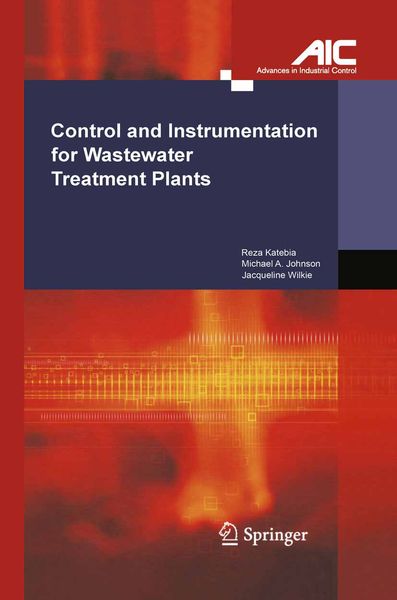
Control and Instrumentation for Wastewater Treatment Plants

97,99 €

inkl. gesetzl. MwSt., Versandkostenfrei


Beschreibung

Produktdetails

Einband

Taschenbuch

Erscheinungsdatum

24.03.1999

Verlag

Springer London

Seitenzahl

275

Maße (L/B/H)

23,5/15,5/1,6 cm

Gewicht

475 g

Auflage

Softcover reprint of the original 1st ed. 1999

Sprache

Englisch

ISBN

978-1-85233-054-5

Beschreibung

Rezension

From the reviews:


"This book makes a much needed connection between fuzzy control and plants that can readily be modeled as queuing systems … . The strengths of the book are its systematic approach to structuring control problems and its emphasis on the construction of fuzzy models for various queuing systems. … the book is unique in linking queuing theory with fuzzy control, making it a valuable reference." (IEEE Control Systems Magazine, June, 2005)


"The book provides a number of results in queuing control from the point of view of fuzzy logic. The authors consider fuzzy control as an effective approach in nonlinear or large-scale systems control … . The material of the book can be useful to advanced undergraduate and graduate students. Also, researchers and practitioners in the field of queuing control, systems analysis, manufacturing, and communications may benefit from it." (Oleg K. Zakusilo, Zentralblatt MATH, Vol. 1064, 2005)

Produktdetails

Einband

Taschenbuch

Erscheinungsdatum

24.03.1999

Verlag

Springer London

Seitenzahl

275

Maße (L/B/H)

23,5/15,5/1,6 cm

Gewicht

475 g

Auflage

Softcover reprint of the original 1st ed. 1999

Sprache

Englisch

ISBN

978-1-85233-054-5

Herstelleradresse

Springer-Verlag GmbH
Tiergartenstr. 17
69121 Heidelberg
DE

Email: ProductSafety@springernature.com

Kundinnen und Kunden meinen

0 Bewertungen

Informationen zu Bewertungen

Zur Abgabe einer Bewertung ist eine Anmeldung im Konto notwendig. Die Authentizität der Bewertungen wird von uns nicht überprüft. Wir behalten uns vor, Bewertungstexte, die unseren Richtlinien widersprechen, entsprechend zu kürzen oder zu löschen.

Die Bewertungen sind nach Format, Anzahl Sterne und Datum sortiert.

Verfassen Sie die erste Bewertung zu diesem Artikel

Helfen Sie anderen Kund*innen durch Ihre Meinung

Kundinnen und Kunden meinen

0 Bewertungen filtern

  • Produktbild: Control and Instrumentation for Wastewater Treatment Plants
  • Produktbild: Control and Instrumentation for Wastewater Treatment Plants
  • 1 Process Modelling and Simulation Methods.- 1.1 Process Review.- 1.1.1 Preliminary and Primary Treatment Processes.- 1.1.2 Secondary Treatment Processes.- 1.1.3 Tertiary Processes.- 1.2 Modelling Preliminary and Primary Processes.- 1.3 Modelling the Activated Sludge Process.- 1.3.1 Introduction.- 1.3.2 The Aeration Tank Process.- 1.3.3 Clarifier Tank Model.- 1.3.4 Interim Conclusions.- 1.4 Uses of the Model.- 1.4.1 Sub-Unit Studies.- 1.4.2 Process Train Studies.- 1.4.3 On-line Process Control.- 1.5 Modelling Principles.- 1.5.1 Process Control and the Modelling Activity.- 1.5.2 Modelling from Physical Principles.- 1.5.3 Black Box Modelling Methods.- 1.5.4 Hierarchical System Modelling and Simulation.- 1.6 Conclusions.- 1.7 Further Reading.- 2 Process Control Structures.- 2.1 The Actuator — Plant and — Measurement Sequence.- 2.1.1 A Tank Level Process.- 2.1.2 The Measurement Device.- 2.1.3 Summary: Component Transfer Functions.- 2.2 A Unified Actuator — Plant — Measurement Processes.- 2.3 Process Disturbances.- 2.3.1 Supply and Load Disturbances.- 2.3.2 Noise Disturbances.- 2.3.3 Summary Conclusions.- 2.4 Open Loop Control.- 2.4.1 The Basic Principle.- 2.4.2 The Problems with Open Loop Control.- 2.5 The Feedback Control Loop.- 2.5.1 A Simple Feedback Loop.- 2.5.2 Some Definitions.- 2.5.3 The Feedback Loop Analysis.- 2.5.4 Feedback Control Objectives: A Full List.- 2.6 On-Off Control.- 2.6.1 Basic Principles.- 2.6.2 Performance Assessment in a Wastewater Application.- 2.7 Three Term Controllers.- 2.7.1 PID Controller Technology.- 2.7.2 Basic PID Control Properties.- 2.7.3 Industrial PID Controller Features.- 2.7.4 PID Controller Tuning.- 2.7.5 Process Reaction Curve Method.- 2.7.6 Sustained Oscillation PID Tuning Method.- 2.7.7 Autotune PID Control.- 2.7.8 PID Control Performance.- 2.8 Cascade Control Loops.- 2.8.1 Cascade Control Example.- 2.8.2 General Cascade Control Principles.- 2.8.3 Cascade Control Loop Tuning.- 2.9 Ratio Control.- 2.10 Feedforward Control.- 2.10.1 The Feedforward/Feedback Control Structure.- 2.10.2 Example in the Waste Water Industry.- 2.11 Inferential Control.- 2.11.1 Inferential Control in the Wastewater Industry.- 2.12 Advanced Control Features: Methods of Controller Adaptation.- 2.12.1 Gain Scheduling.- 2.12.2 On-line Self-Tuning Control.- 2.13 Conclusions.- 2.14 Further Reading.- 3 Supervisory Control and Data Acquisition Systems and Virtual Instrumentation.- 3.1 Introduction.- 3.2 Economic Benefits.- 3.3 A Classification For Supervisory Control Problems.- 3.4 Technological Background.- 3.4.1 Centralised Architecture.- 3.4.2 The Distributed Architecture.- 3.4.3 Supervisory Control System For Wastewater Treatment Plants.- 3.5 Distributed Control System Technology.- 3.5.1 Generic Functional Modules.- 3.5.2 Real-time Data Highway.- 3.5.3 Host Computer Interfaces and PLC Gateways.- 3.5.4 Power Distribution System.- 3.6 Functionality of the DCS.- 3.6.1 Data Acquisition and Processing.- 3.6.2 Low Level Process Control.- 3.6.3 Sequencing.- 3.6.4 Alarm Management.- 3.6.5 Operator Real-time Displays.- 3.6.6 Data Logging.- 3.6.7 Plant Performance Assessment.- 3.7 On Designing Supervisory Control.- 3.8 Virtual Instrumentation (VI) and a Design Exercise.- 3.8.1 Introduction.- 3.8.2 Virtual Versus Real Instrumentation.- 3.8.3 VI and Intelligent Instruments.- 3.9 Conclusions.- 3.10 Further Reading.- 4 Quality Control For Dynamic Processes.- 4.1 Introduction.- 4.1.1 Understanding the Process.- 4.1.2 Flowcharting.- 4.2 Data Collection and Presentation.- 4.2.1 Data Presentation: Histograms, Charts and Graphs.- 4.3 Elementary Statistical Measures.- 4.4 Process Variations.- 4.5 Process Control.- 4.5.1 Mean Chart.- 4.5.2 Range Chart.- 4.6 Assessment of Process Stability.- 4.7 Process Capability Indices.- 4.8 Example.- 4.9 Conclusions.- 4.10 Further Reading.- 5 Sensors and Actuators.- 5.1 Physical Measurement: Level.- 5.1.1 Ultrasonic Level Sensor.- 5.1.2 Capacitance Level Sensor.- 5.2 Physical Measurement: Flow.- 5.2.1 Weirs and Flumes.- 5.3 Flumes.- 5.3.1 Magnetic Flowmeters.- 5.3.2 Ultrasonic Flow Measurement.- 5.4 Analytical Measurement: Ion Selective Electrodes.- 5.4.1 Ion Selective Electrodes.- 5.4.2 Example of an Ion Selective Electrode: pH Measurement.- 5.5 Analytical Measurement: Dissolved Oxygen (DO).- 5.5.1 Amperometric DO Sensor.- 5.5.2 Equilibrium DO Sensor.- 5.6 Analytical Measurement: Turbidity and Suspended Solids.- 5.6.1 Light Absorption Techniques.- 5.6.2 Scattered Light Technique.- 5.7 ‘Self-Cleaning’ Sensors.- 5.8 Actuators: Pumps.- 5.8.1 Centrifugal Pumps.- 5.8.2 Positive Displacement Pumps.- 5.9 Conclusions.- 5.10 Further Reading.- 6 Data Communications.- 6.1 Introduction.- 6.2 Dumb Terminals and Smart Sensors.- 6.3 Digital Communication.- 6.3.1 Communication Medium.- 6.3.2 Data Transfer.- 6.3.3 Serial Interface Standards: RS-232, RS-422 and RS-485.- 6.3.4 Protocols.- 6.4 The ISO 7-Layer Model.- 6.5 Distributed Communication Systems.- 6.5.1 Network Topologies.- 6.5.2 Local Area Networks (LANs).- 6.6 HART Communication System.- 6.7 Fieldbus.- 6.7.1 Different Standards.- 6.7.2 The Current Status.- 6.8 Examples of WWTP Communications.- 6.9 Conclusions.- 6.10 Further Reading.- 7 Knowledge-Based Systems.- 7.1 Expert Systems in Process Control.- 7.1.1 Expert System Components.- 7.1.2 Expert Systems For Condition Monitoring and Fault Detection.- 7.1.3 Expert Systems in the Wastewater Industry.- 7.2 Modelling of Complex Process Using Neural Nets.- 7.2.1 The Neuron and the Neural Network.- 7.2.2 Training the Neural Net (NN).- 7.3.3 Neural Network Application Development.- 7.3.4 Possibilities for Neural Networks in the Wastewater Industry.- 7.3 Fuzzy Logic Control.- 7.3.1 The Fuzzy Logic Controller (FIC).- 7.3.2 An Example of Fuzzy Logic Control.- 2.3.3 Applications in Wastewater Treatment Plants.- 7.4 Conclusions.- 7.5 References.- 8 Wastewater Treatment Plants: An Exercise.- 8.1 Introduction.- 8.2 Control Systems.- 8.2.1 Flow Balancing and Control.- 8.2.2 DO Control.- 8.2.3 Return Activated Sludge (RAS).- 8.3 Alarms.- 8.4 Data Display.- 8.5 Fault Monitoring.- 8.6 DO Control Using LabVIEW.- 8.6.1 Model Description.- 8.7 Further Reading.- Appendix A: Modelling and Control Demonstrations.- Appendix B: Author Profiles.