Gutscheinbedingungen

Gültig bis 13.07.2026 | Gültig für Spielzeug (außer Tonieboxen & ausgewählte Tonies), Filme, Musik, Software, Games, Schreibwaren, Hörbücher und Hörbuch-Downloads (außer Abo & Shelfies), gebrauchte Bücher, nicht preisgebundene Bücher und Kalender | Einlösbar unter osiander.de und in der Osiander App | Click & Collect nur mit Online-Zahlung (Paypal/Kreditkarte) vorab | Einzelne Artikel können ausgeschlossen sein | Nicht kombinierbar mit anderen Gutscheinen oder Preisaktionen | Nur einmal pro Einkauf einlösbar | Gutschein wird auf max. 500€ Bestellwert angerechnet | Keine Barauszahlung | Digitale Hörbücher nur für Android | Nicht gültig für preisgebundene Artikel (aufgrund der Buchpreisbindung sind Gutscheine nicht auf Bücher, eBooks, Presse einlösbar), tolino eReader & Zubehör, Elektronik, Geschenke & Trends, Abonnements & Flatrates, Geschenkkarten, Versandkosten und Services

  • Produktbild: Bargaining over Time Allocation
  • Produktbild: Bargaining over Time Allocation

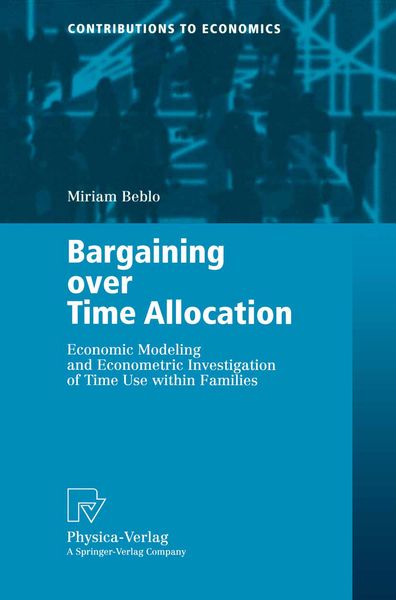
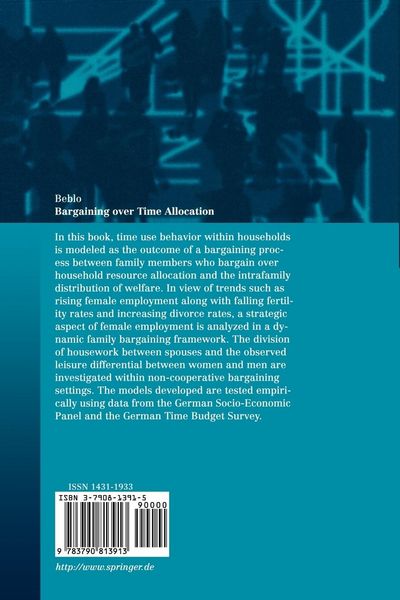
Bargaining over Time Allocation Economic Modeling and Econometric Investigation of Time Use within Families

48,99 €

inkl. gesetzl. MwSt., Versandkostenfrei


Beschreibung

Produktdetails

Einband

Taschenbuch

Erscheinungsdatum

24.04.2001

Verlag

Physica

Seitenzahl

139

Maße (L/B/H)

23,5/15,5/0,9 cm

Gewicht

242 g

Auflage

1. Auflage

Sprache

Englisch

ISBN

978-3-7908-1391-3

Beschreibung

Produktdetails

Einband

Taschenbuch

Erscheinungsdatum

24.04.2001

Verlag

Physica

Seitenzahl

139

Maße (L/B/H)

23,5/15,5/0,9 cm

Gewicht

242 g

Auflage

1. Auflage

Sprache

Englisch

ISBN

978-3-7908-1391-3

Herstelleradresse

Physica Verlag
Tiergartenstr. 17
69121 Heidelberg
DE

Email: ProductSafety@springernature.com

Noch keine Bewertungen vorhanden

Verfassen Sie die erste Bewertung zu diesem Artikel

Helfen Sie anderen Kundinnen und Kunden durch Ihre Meinung.

Kundinnen und Kunden meinen

Bewertungen (0)

  • Produktbild: Bargaining over Time Allocation
  • Produktbild: Bargaining over Time Allocation
  • 1 Introduction.- 1.1 Time allocation in a bargaining family.- 1.2 Time use.- 1.3 The family as an economic institution.- 1.4 A reader’s guide.- 2 Theories on intrafamily time allocation.- 2.1 The unitary model.- 2.2 Under critique.- 2.3 Bargaining models.- 2.3.1 Cooperative bargaining.- 2.3.2 Non-cooperative bargaining.- 2.3.3 Dynamic models.- 2.3.4 Summing up.- 3 Empirical evidence on intrafamily time allocation.- 3.1 Introduction.- 3.2 Testing for unitary income pooling.- 3.3 Testing for Slutsky symmetry.- 3.4 Testing for Pareto efficiency.- 3.5 Testing for the impact of EEPs and decision-making power.- 3.6 A starting point for further research.- 4 The strategic aspect of female labor supply.- 4.1 Introduction.- 4.2 A dynamic bargaining model.- 4.2.1 Implications.- 4.2.2 Discussion of the theoretical results.- 4.3 Empirical implementation of the bargaining effect of labor supply.- 4.3.1 The virtual conflict payoff.- 4.3.2 Data set and sample characteristics.- 4.3.3 Female labor force participation with virtual conflict payoffs.- 4.3.4 Bargaining variables.- 4.3.5 Estimation procedure.- 4.3.6 Empirical findings.- 4.4 Conclusions.- 4.5 Further research.- 5 A panel-econometric analysis of the division of housework time.- 5.1 Introduction.- 5.2 The time use of employed couples.- 5.3 Theoretical approaches to intrafamily time allocation.- 5.4 The division of housework time: estimation results.- 5.4.1 Pooled sample.- 5.4.2 Fixed effects.- 5.4.3 Random effects.- 5.4.4 Mixed specification.- 5.5 Conclusions.- 5.6 Appendix.- 6 Leisure — A model on private provision of family public goods.- 6.1 Introduction.- 6.2 The model.- 6.3 The Stackelberg game.- 6.4 Conclusions.- 7 The leisure gap between working parents.- 7.1 Introduction.- 7.2 Basic facts of intrafamily distribution of leisure.- 7.3 The distribution of leisure as an alternating offers game.- 7.3.1 The setting.- 7.3.2 The structure of the game.- 7.4 The distribution of leisure — estimation results.- 7.5 Conclusions.- 8 Resume.- 8.1 Principal findings.- 8.2 Policy implications.- 8.3 The next step: cooperative conflicts in a qualitative bargaining framework.- List of figures.- List of tables.- References.