• Produktbild: Trends, Techniques, and Problems in Theoretical Computer Science
  • Produktbild: Trends, Techniques, and Problems in Theoretical Computer Science
Band 281

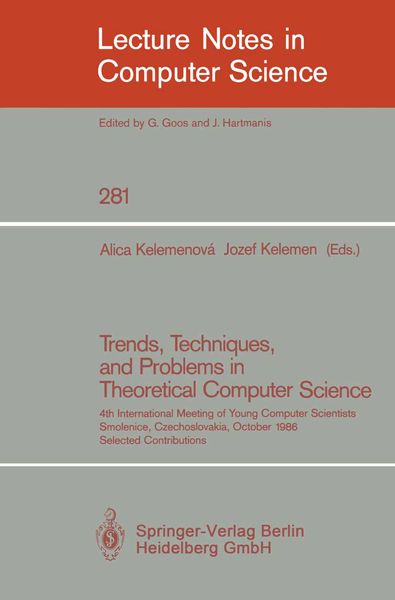
Trends, Techniques, and Problems in Theoretical Computer Science 4th International Meeting of Young Computer Scientists, Smolenice, Czechoslovakia, October 13-17, 1986. Proceedings

49,99 €

inkl. gesetzl. MwSt., Versandkostenfrei


Beschreibung

Produktdetails

Einband

Taschenbuch

Erscheinungsdatum

21.10.1987

Herausgeber

Alica Kelemenova + weitere

Verlag

Springer Berlin

Seitenzahl

220

Maße (L/B/H)

23,5/15,5/1,2 cm

Gewicht

353 g

Auflage

1987

Sprache

Englisch

ISBN

978-3-540-18535-2

Beschreibung

Produktdetails

Einband

Taschenbuch

Erscheinungsdatum

21.10.1987

Herausgeber

Verlag

Springer Berlin

Seitenzahl

220

Maße (L/B/H)

23,5/15,5/1,2 cm

Gewicht

353 g

Auflage

1987

Sprache

Englisch

ISBN

978-3-540-18535-2

Herstelleradresse

Springer-Verlag KG
Sachsenplatz 4-6
1201 Wien
AT

Email: GPSR Kontakt

Noch keine Bewertungen vorhanden

Verfassen Sie die erste Bewertung zu diesem Artikel

Helfen Sie anderen Kundinnen und Kunden durch Ihre Meinung.

Kundinnen und Kunden meinen

Bewertungen (0)

  • Produktbild: Trends, Techniques, and Problems in Theoretical Computer Science
  • Produktbild: Trends, Techniques, and Problems in Theoretical Computer Science
  • Lower bound techniques for VLSI algorithms.- The equivalence of mappings on languages.- Kleene's theorem revisited.- Some combinatorial problems concerning finite languages.- A connection between descriptional complexity of context-free grammars and grammar form theory.- Basic ideas of selective substitution grammars.- Some recent restrictions in the derivation of context-free grammars.- Recent results on the theory of homogeneous structures.- A note on the ratio function in DOL systems.- Models for multicellular development: Characterization, inference and complexity of L-systems.- A formal model of knowledge-based systems.- Basic complexity analysis of hypothesis formation.- Perspectives of logic programming.