• Produktbild: Parallel Problem Solving from Nature - PPSN III
  • Produktbild: Parallel Problem Solving from Nature - PPSN III
Band 866

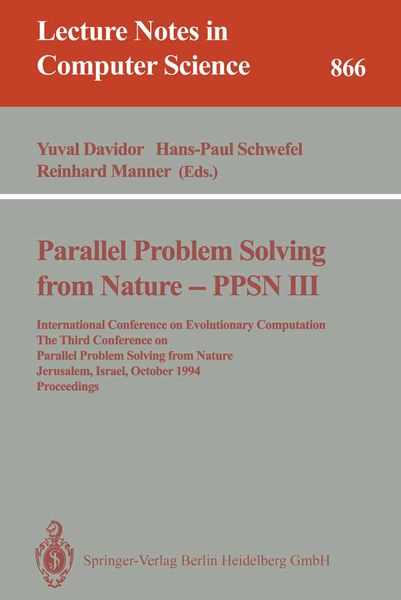
Parallel Problem Solving from Nature - PPSN III International Conference on Evolutionary Computation. The Third Conference on Parallel Problem Solving from Nature, Jerusalem, Israel, October 9 - 14, 1994. Proceedings

97,99 €

inkl. gesetzl. MwSt., Versandkostenfrei


Beschreibung

Produktdetails

Einband

Taschenbuch

Erscheinungsdatum

21.09.1994

Abbildungen

XVII, 647 p.

Herausgeber

Yuval Davidor + weitere

Verlag

Springer Berlin

Seitenzahl

647

Maße (L/B/H)

23,5/15,5/3,6 cm

Gewicht

990 g

Auflage

1994

Sprache

Englisch

ISBN

978-3-540-58484-1

Beschreibung

Produktdetails

Einband

Taschenbuch

Erscheinungsdatum

21.09.1994

Abbildungen

XVII, 647 p.

Herausgeber

Verlag

Springer Berlin

Seitenzahl

647

Maße (L/B/H)

23,5/15,5/3,6 cm

Gewicht

990 g

Auflage

1994

Sprache

Englisch

ISBN

978-3-540-58484-1

Herstelleradresse

Springer-Verlag KG
Sachsenplatz 4-6
1201 Wien
AT

Email: GPSR Kontakt

Noch keine Bewertungen vorhanden

Verfassen Sie die erste Bewertung zu diesem Artikel

Helfen Sie anderen Kundinnen und Kunden durch Ihre Meinung.

Kundinnen und Kunden meinen

Bewertungen (0)

  • Produktbild: Parallel Problem Solving from Nature - PPSN III
  • Produktbild: Parallel Problem Solving from Nature - PPSN III
  • Lamarckian evolution, the Baldwin effect and function optimization.- Control of parallel population dynamics by social-like behavior of GA-individuals.- Studying genotype-phenotype interactions: A model of the evolution of the cell regulation network.- A diploid genetic algorithm for preserving population diversity — Pseudo-Meiosis GA.- Co-evolutionary constraint satisfaction.- Towards a theory of ‘evolution strategies’: Results for (1 , + ?)-strategies on (nearly) arbitrary fitness functions.- Advanced correlation analysis of operators for the traveling salesman problem.- Genetic algorithms with multi-parent recombination.- On the mean convergence time of evolutionary algorithms without selection and mutation.- Estimating the heritability by decomposing the genetic variance.- Analyzing hyperplane synthesis in genetic algorithms using clustered schemata.- Convergence models of genetic algorithm selection schemes.- Optimal population size under constant computation cost.- An evolutionary algorithm for integer programming.- Long path problems.- Evolution strategies on noisy functions how to improve convergence properties.- Selection schemes with spatial isolation for genetic optimization.- A modified edge recombination operator for the Travelling Salesman Problem.- Step-size adaptation based on non-local use of selection information.- Strategy adaptation by competing subpopulations.- Controlling crossover through inductive learning.- Derivative operators for preference predicate evolution.- Adaptive crossover using automata.- Controlling dynamics of GA through filtered evaluation function.- A cooperative coevolutionary approach to function optimization.- A fuzzy classifier system using the Pittsburgh approach.- Q-learning in Evolutionary Rule Based Systems.- On thecomplexity of learning in classifier systems.- A representation scheme to perform program induction in a canonical genetic algorithm.- Genetic Programming with local hill-climbing.- Dynamic training subset selection for supervised learning in Genetic Programming.- Genotype-phenotype-mapping and neutral variation — A case study in Genetic Programming.- Genetic L-System Programming.- A genetic algorithm discovers particle-based computation in cellular automata.- Simulation of exaptive behaviour.- Artificial spacing patterns in a network of interacting celloids.- Diffuse pattern learning with Fuzzy ARTMAP and PASS.- Different learning algorithms for Neural Networks — A comparative study.- Program search with a hierarchical variable length representation: Genetic Programming, simulated annealing and hill climbing.- Problem-independent Parallel Simulated Annealing using selection and migration.- Parallel optimization of evolutionary algorithms.- Parallel simulated annealing and genetic algorithms: A space of hybrid methods.- ENZO-M — A hybrid approach for optimizing neural networks by evolution and learning.- Genetic lander: An experiment in accurate neuro-genetic control.- Effects of Occam's razor in evolving Sigma-Pi neural nets.- Designing neural networks by adaptively building blocks in cascades.- Hybrid adaptive heuristic critic architectures for learning in mazes with continuous search spaces.- Mutation operators for structure evolution of neural networks.- Implementation of standard genetic algorithm on MIMD machines.- Loosely coupled distributed genetic algorithms.- Applying Evolvable Hardware to autonomous agents.- Genetic Algorithms on LAN-message passing architectures using PVM: Application to the Routing problem.- Genetic algorithm based designoptimization of CMOS VLSI circuits.- Improving evolutionary timetabling with delta evaluation and directed mutation.- Genetic improvement of railway timetables.- Using a genetic algorithm to search for the representational bias of a collective reinforcement learner.- An evolutionary algorithm for the routing of multi-chip modules.- System design under uncertainty: Evolutionary optimization of the Gravity Probe-B spacecraft.- Soft selection in D-optimal designs.- The weighted graph bi-partitioning problem: A look at GA performance.- RPL2: A language and parallel framework for evolutionary computing.