• Produktbild: Methodologies for Intelligent Systems
  • Produktbild: Methodologies for Intelligent Systems
Band 869

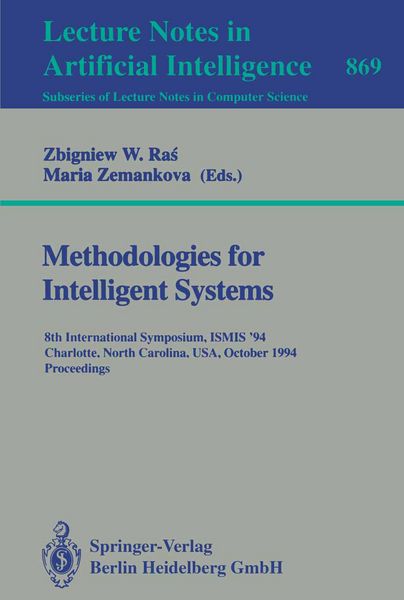
Methodologies for Intelligent Systems 8th International Symposium, ISMIS '94, Charlotte, North Carolina, USA, October 16 - 19, 1994. Proceedings

97,99 €

inkl. gesetzl. MwSt., Versandkostenfrei


Beschreibung

Produktdetails

Einband

Taschenbuch

Erscheinungsdatum

28.09.1994

Abbildungen

X, 622 p.

Herausgeber

Zbigniew W. Ras + weitere

Verlag

Springer Berlin

Seitenzahl

622

Maße (L/B/H)

23,5/15,5/3,4 cm

Gewicht

943 g

Auflage

1994

Sprache

Englisch

ISBN

978-3-540-58495-7

Beschreibung

Produktdetails

Einband

Taschenbuch

Erscheinungsdatum

28.09.1994

Abbildungen

X, 622 p.

Herausgeber

Verlag

Springer Berlin

Seitenzahl

622

Maße (L/B/H)

23,5/15,5/3,4 cm

Gewicht

943 g

Auflage

1994

Sprache

Englisch

ISBN

978-3-540-58495-7

Herstelleradresse

Springer-Verlag KG
Sachsenplatz 4-6
1201 Wien
AT

Email: GPSR Kontakt

Noch keine Bewertungen vorhanden

Verfassen Sie die erste Bewertung zu diesem Artikel

Helfen Sie anderen Kundinnen und Kunden durch Ihre Meinung.

Kundinnen und Kunden meinen

Bewertungen (0)

  • Produktbild: Methodologies for Intelligent Systems
  • Produktbild: Methodologies for Intelligent Systems
  • Distributed Earth science validation centers for Mission to Planet Earth.- Causal understanding in reasoning about the world.- How to make intelligent digital libraries.- “Some methodology and representation problems for the semantics of prosaic application domains”.- Recognizing credible experts in inaccurate databases.- Fuzzy logic or lukasiewicz logic: A clarification.- Logic systems for approximate reasoning: via rough sets and topology.- Signed formulas and fuzzy operator logics.- Rough mereology.- A new rule for updating evidence.- A global measure of ambiguity for classification.- Meta-level control of approximate reasoning: A decision theoretic approach.- Formal models of selection in genetic algorithms.- Genetic algorithms for the 0/1 knapsack problem.- On the weakening of fuzzy relational queries.- Transforming queries from a relational schema to an object schema: A prototype based on F-logic.- Knowledge discovery in databases: A rule-based attribute-oriented approach.- Case-based reasoning applied to a force generation decision aid.- A case-based reasoning approach for associative query answering.- Efficient execution of recursive queries through controlled binding propagation.- Towards a dynamic multi-agent organization.- parcPlan: a planning architecture with parallel actions, resources and constraints.- GAITS II: An intelligent system for computer-aided education.- The GLS discovery system: Its goal, architecture and current results.- Declarative semantics for contradictory modular logic programs.- LaTeR: a general purpose manager of temporal information.- Understanding a story with causal relationships.- Dealing with qualitative and quantitative temporal information concerning periodic events.- Distributed multi-agent probabilistic reasoning withBayesian networks.- Building bridges between knowledge representation and algebraic specification.- Turning an action formalism into a planner — Essentials of a case study.- Towards refinement of definite logic programs.- Amphion: Automatic programming for scientific subroutine libraries.- RUTH: an ILP theory revision system.- Dynamic reducts as a tool for extracting laws from decisions tables.- Learning first order theories.- Evaluation and enhancement of Bayesian rule-sets in a genetic algorithm learning environment for classification tasks.- Traps and pitfalls when learning logical definitions from relations.- DBROUGH: A rough set based knowledge discovery system.- Restructuring rule bases to improve performance.- Learning heuristics for ordering plan goals through static operator analysis.- Learning problem-oriented decision structures from decision rules: The AQDT-2 system.- Towards full automation of the discovery of heuristics in a nuclear engineering project: Integration with a neural information language.- Concept hierarchies: a restricted form of knowledge derived from regularities.- A data-driven approach to feature construction.- Reasoning about action and time with epistemic conditionals.- The semantics of propositional contexts.- The generalized logic of only knowing (GOL) that covers the notion of epistemic specifications.- Reasoning about the safety of information: from logical formalization to operational definition.- Classical methods in nonmonotonic reasoning.- Partial evaluation and relevance for approximations of the stable semantics.- Circumscribing features and fluents: A fluent logic for reasoning about action and change.- Paraconsistency and beyond: A new approach to inconsistency handling.- BDDs and automated deduction.- A possibility-basedpropositional logic of conditionals.- Incremental processing of logic database relations.- On the relationship between assumption-based framework and autoepistemic logic.- Computing queries from prioritized default theories.- Beliefs and bilattices.- Fast termination of the deductive process in resolution proof systems for non-classical logics.