
Band 1661
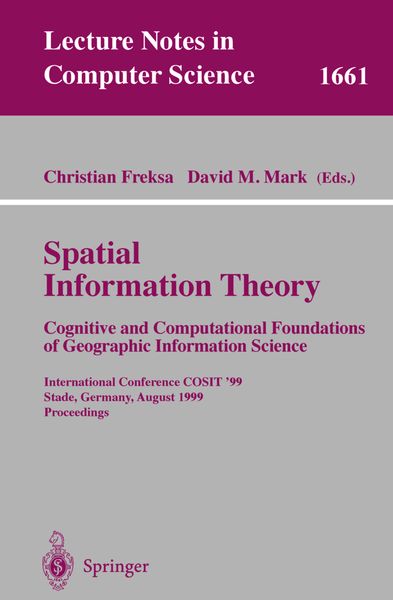
Spatial Information Theory. Cognitive and Computational Foundations of Geographic Information Science International Conference COSIT'99 Stade, Germany, August 25-29, 1999 Proceedings
Aus der Reihe
Lecture Notes in Computer Science
-
- Englisch ausgewählt
49,99 €
inkl. gesetzl. MwSt.,
Beschreibung
Produktdetails
Einband
Taschenbuch
Erscheinungsdatum
11.08.1999
Herausgeber
Christian Freksa + weitereVerlag
Springer BerlinSeitenzahl
486
Maße (L/B/H)
23,5/15,5/2,7 cm
Gewicht
750 g
Auflage
1999
Sprache
Englisch
ISBN
978-3-540-66365-2
The Conference on Spatial Information Theory – COSIT – grew out of a series of workshops / NATO Advanced Study Institutes / NSF specialist meetings concerned with cognitive and applied aspects of representing large-scale space, particularly geographic space. In these meetings, the need for a well-founded theory of spatial information processing was identified. The COSIT conference series was established in 1993 as a biennial interdisciplinary European conference on the representation and processing of information about large-scale space, after a successful international conference on the topic had been organized by Andrew Frank et al. in Pisa, Italy, in 1992 (frequently referred to as ‘COSIT zero’). After two successful European conferences with strong North-American participation (COSIT ’93, held on the Island of Elba, Italy; COSIT ’95, held in Semmering, Austria), the conference became a truly international enterprise when COSIT ’97 was held in the Laurel Highlands, Pennsylvania, USA. COSIT ’99 will take place in Stade, Germany. All aspects of large-scale space, i. e. spaces too large to be seen from a single vantage point, are addressed in the COSIT conferences. These include spaces of geographic scale, as well as smaller spaces in which humans, animals, or autonomous robots have to find their way around. Spatial information theory also deals with the description of objects, processes, or events in spatial environments and it forms the foundation for the construction of Geographic Information Systems (GIS) and for spatial information and communication system design in general.
Kundinnen und Kunden meinen
Verfassen Sie die erste Bewertung zu diesem Artikel
Helfen Sie anderen Kund*innen durch Ihre Meinung
Kurze Frage zu unserer Seite
Vielen Dank für Ihr Feedback
Wir nutzen Ihr Feedback, um unsere Produktseiten zu verbessern. Bitte haben Sie Verständnis, dass wir Ihnen keine Rückmeldung geben können. Falls Sie Kontakt mit uns aufnehmen möchten, können Sie sich aber gerne an unseren Kund*innenservice wenden.
zum Kundenservice