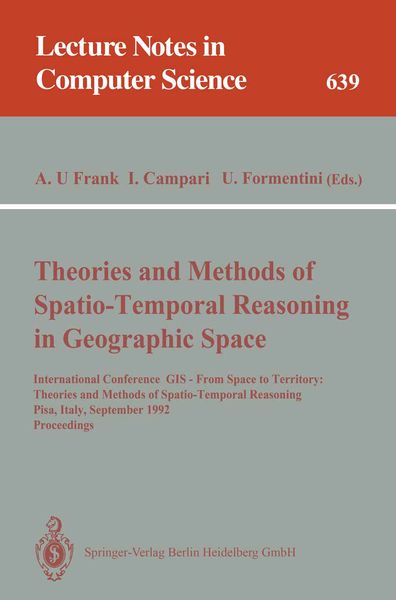
Theories and Methods of Spatio-Temporal Reasoning in Geographic Space International Conference GIS - From Space to Territory: Theories and Methods of Spatio-Temporal Reasoning. Pisa, Italy, September 21-23, 1992. Proceedings
-
- Englisch ausgewählt
49,99 €
inkl. gesetzl. MwSt.,
Beschreibung
Produktdetails
Einband
Taschenbuch
Erscheinungsdatum
09.09.1992
Herausgeber
Andrew U. Frank + weitereVerlag
Springer BerlinSeitenzahl
439
Maße (L/B/H)
23,5/15,5/2,4 cm
Gewicht
680 g
Auflage
1992
Sprache
Englisch
ISBN
978-3-540-55966-5
international conference dedicated to spatial and temporal
reasoning in geographic space, entitled "GIS: from space to
territory - theories and methods of spatio-temporal
reasoning".
Within the National Center for Geographic Information and
Analysis (NCGIA, one of the supporters of the conference)
the importance of spatial and temporal reasoning was
recognized several years ago. Initial research found that
spatial reasoning in geographic or large-scale space is
different from spatial reasoning in small-scale space, as
usually dealt with in robotics and expertsystems. Temporal
reasoning has attracted interest in the artificial
intelligence community.
The volume also includes two invited papers: "Do people
understand spatial concepts: the case of first-order
primtives" by R.G. Golledge, and "Temporal databases" by
R.T. Snodgrass.
Noch keine Bewertungen vorhanden
Verfassen Sie die erste Bewertung zu diesem Artikel
Helfen Sie anderen Kundinnen und Kunden durch Ihre Meinung.
Kurze Frage zu unserer Seite
Vielen Dank für Ihr Feedback
Wir nutzen Ihr Feedback, um unsere Produktseiten zu verbessern. Bitte haben Sie Verständnis, dass wir Ihnen keine Rückmeldung geben können. Falls Sie Kontakt mit uns aufnehmen möchten, können Sie sich aber gerne an unseren Kund*innenservice wenden.
zum Kundenservice