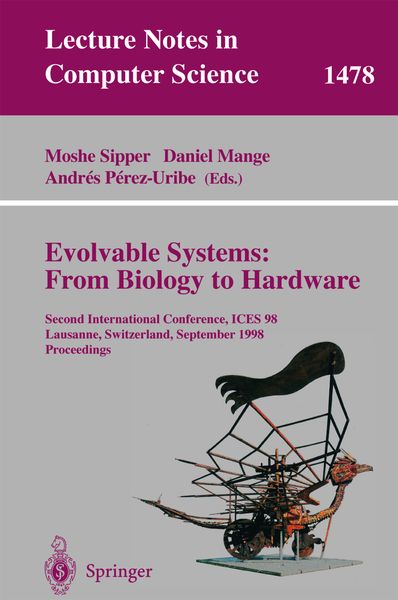
Produktbild: Evolvable Systems: From Biology to Hardware
Band 1478

Evolvable Systems: From Biology to Hardware Second International Conference, ICES 98 Lausanne, Switzerland, September 23–25, 1998 Proceedings

49,99 €

inkl. gesetzl. MwSt., Versandkostenfrei


Beschreibung

Produktdetails

Einband

Taschenbuch

Erscheinungsdatum

26.08.1998

Abbildungen

IX, 382 p. 139 illus.

Herausgeber

Moshe Sipper + weitere

Verlag

Springer Berlin

Seitenzahl

382

Maße (L/B/H)

23,5/15,5/2,2 cm

Gewicht

604 g

Auflage

1998

Sprache

Englisch

ISBN

978-3-540-64954-0

Beschreibung

Produktdetails

Einband

Taschenbuch

Erscheinungsdatum

26.08.1998

Abbildungen

IX, 382 p. 139 illus.

Herausgeber

Verlag

Springer Berlin

Seitenzahl

382

Maße (L/B/H)

23,5/15,5/2,2 cm

Gewicht

604 g

Auflage

1998

Sprache

Englisch

ISBN

978-3-540-64954-0

Herstelleradresse

Springer-Verlag KG
Sachsenplatz 4-6
1201 Wien
AT

Email: ProductSafety@springernature.com

Noch keine Bewertungen vorhanden

Verfassen Sie die erste Bewertung zu diesem Artikel

Helfen Sie anderen Kundinnen und Kunden durch Ihre Meinung.

Kundinnen und Kunden meinen

Bewertungen (0)

  • Produktbild: Evolvable Systems: From Biology to Hardware
  • A gate-level EHW chip: Implementing GA operations and reconfigurable hardware on a single LSI.- On the automatic design of robust electronics through artificial evolution.- Aspects of digital evolution: Geometry and learning.- Evolutionary design of hashing function circuits using an FPGA.- A new research tool for intrinsic hardware evolution.- A divide-and-conquer approach to Evolvable Hardware.- Evolution of astable multivibrators in silico.- Some aspects of an evolvable hardware approach for multiple-valued combinational circuit design.- Adaptation in co-evolving non-uniform cellular automata.- Synthesis of synchronous sequential logic circuits from partial input/output sequences.- Data compression for digital color electrophotographic printer with Evolvable Hardware.- Comparison of evolutionary methods for smoother evolution.- Automated analog circuit synthesis using a linear representation.- Analogue EHW chip for intermediate frequency filters.- Intrinsic circuit evolution using programmable analogue arrays.- Analog circuits evolution in extrinsic and intrinsic modes.- Evolvable hardware for space applications.- Embryonics: A macroscopic view of the cellular architecture.- Embryonics: A microscopic view of the molecular architecture.- Modeling cellular development using L-systems.- MUXTREE revisited: Embryonics as a reconfiguration strategy in fault-tolerant processor arrays.- Building complex systems using developmental process: An engineering approach.- Evolving batlike pinnae for target localisation by an echolocator.- A biologically inspired object tracking system.- The “modeling clay” approach to bio-inspired electronic hardware.- A “Spike Interval Information Coding” representation for ATR’s CAM-Brain Machine (CBM).- Learning in genetic algorithms.-Back-propagation learning of autonomous behavior: A mobile robot Khepera took a lesson from the future consequences.- SPIKE_4096: A neural integrated circuit for image segmentation.- Analysis of the scenery perceived by a real mobile robot Khepera.- Evolution of a control architecture for a mobile robot.- Field programmable processor arrays.- General purpose computer architecture based on fully programmable logic.- Palmo: Field programmable analogue and mixed-signal VLSI for evolvable hardware.- Feasible evolutionary and self-repairing hardware by means of the dynamic reconfiguration capabilities of the FIPSOC devices.- Fault tolerance of a large-scale MIMD architecture using a genetic algorithm.- Hardware evolution with a massively parallel dynamicaly reconfigurable computer: POLYP.- Molecular inference via unidirectional chemical reactions.