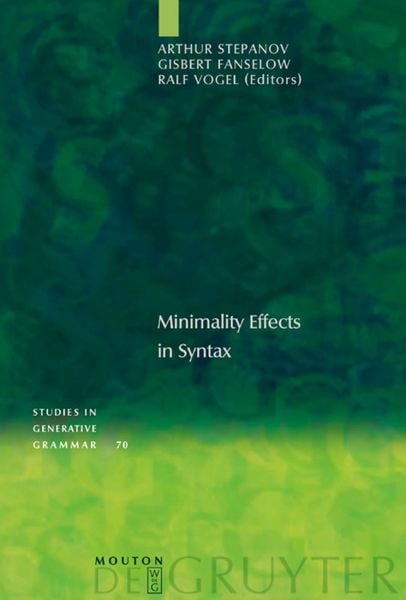
Minimality Effects in Syntax
-
- Deutsch, Englisch ausgewählt
227,99 €
inkl. gesetzl. MwSt.,
Beschreibung
Produktdetails
Einband
Gebundene Ausgabe
Erscheinungsdatum
25.10.2004
Herausgeber
Arthur Stepanov + weitereVerlag
De GruyterSeitenzahl
448
Maße (L/B/H)
23,6/16/2,9 cm
Gewicht
776 g
Auflage
1
Sprache
Deutsch, Englisch
ISBN
978-3-11-017961-3
The volume is a collection of 12 papers which focus on empirical and theoretical issues associated with syntactic phenomena falling under the rubric of Relativized Minimality (Rizzi 1990) or, in more recent terms, Minimal Link Condition (MLC, Chomsky 1995). The bulk of the papers are based on the ideas presented at the Workshop "Minimal Link Effects in Minimalist and Optimality Theoretic Syntax" which took place at the University of Potsdam on March 21-22, 2002.
All contributors are prominent specialists in the topic of syntactic Minimality. The empirical phenomena brought to bear on Minimality/MLC in the present volume include, but not limited to:
- Superiority effects in multiple wh-questions, including those with 'D-linked' wh-phrase(s) (Müller, Haida, Haider)
- Stylistic Fronting in Germanic and Romance (Fisher, Poole)
- Transitive sentences in Hindi-type ergative languages (Stepanov)
- Word order 'freezing' effects in double-nominative constructions in Korean (Lee)
- Double object constructions in Greek (Anagnostoupoulou)
- Remnant constituent displacement in German and Japanese (Hale and Legendre)
Nine of the proposed accounts are couched in the Minimalist framework (Chomsky 1995, 2000, 2001), three in the framework of Optimality Theory (Prince and Smolensky 1993). Thematically, the contributions divide into three groups addressing the following major questions:
How can apparent violations of syntactic Minimality/MLC be accounted for? (Haida, Stepanov, Poole, Fisher, Anagnostopoulou)
What is the status of MLC? Is it a primitive or a theorem in the grammar? (Müller, Fanselow, Lechner, Vogel, Lee, Haider)
Can Minimality phenomena shed decisive evidence in favor of a derivational (Minimalist type) or a representational (Optimality theory like) framework? (Hale and Legendre, Haider)
Kundinnen und Kunden meinen
Verfassen Sie die erste Bewertung zu diesem Artikel
Helfen Sie anderen Kund*innen durch Ihre Meinung
Kurze Frage zu unserer Seite
Vielen Dank für Ihr Feedback
Wir nutzen Ihr Feedback, um unsere Produktseiten zu verbessern. Bitte haben Sie Verständnis, dass wir Ihnen keine Rückmeldung geben können. Falls Sie Kontakt mit uns aufnehmen möchten, können Sie sich aber gerne an unseren Kund*innenservice wenden.
zum Kundenservice