
Band 63
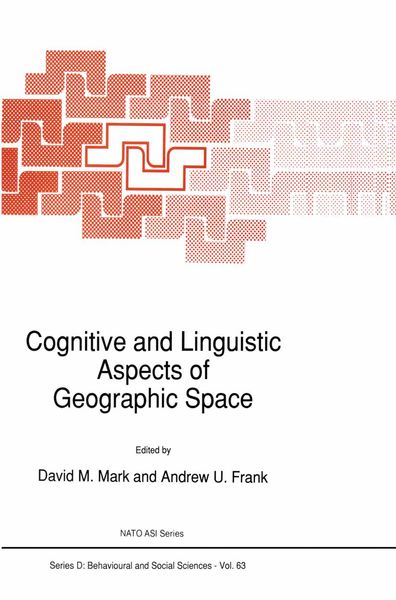
Cognitive and Linguistic Aspects of Geographic Space
Aus der Reihe
NATO Science Series D:
-
- Hardcover ausgewählt
- Taschenbuch
- eBook
-
Sprache:Englisch
-
Verlag:Springer Netherland
281,99 €
inkl. gesetzl. MwSt.,
Beschreibung
Produktdetails
Einband
Gebundene Ausgabe
Erscheinungsdatum
30.11.1991
Herausgeber
D.M. Mark + weitereVerlag
Springer NetherlandSeitenzahl
519
Maße (L/B/H)
24,1/16/3,3 cm
Gewicht
947 g
Auflage
1991
Sprache
Englisch
ISBN
978-0-7923-1537-7
This book contains twenty-eight papers by participants in the NATO Advanced Study Institute (ASI) on "Cognitive and Linguistic Aspects of Geographic Space," held in Las Navas del Maxques, Spain, July 8-20, 1990. The NATO ASI marked a stage in a two-year research project at the U. S. National Center for Geographic Infonnation and Analysis (NCOIA). In 1987, the U. S. National Science Foundation issued a solicitation for proposals to establish the NCGIA-and one element of that solicitation was a call for research on a "fundamental theory of spatial relations". We felt that such a fundamental theory could be searched for in mathematics (geometry, topology) or in cognitive science, but that a simultaneous search in these two seemingly disparate research areas might produce novel results. Thus, as part of the NCGIA proposal from a consortium consisting of the University of California at Santa Barbara, the State University of New York at Buffalo, and the University of Maine, we proposed that the second major Research Initiative (two year, multidisciplinary research project) of the NCOIA would address these issues, and would be called "Languages of Spatial Relations" The grant to establish the NCOIA was awarded to our consortium late in 1988.
Kundinnen und Kunden meinen
Verfassen Sie die erste Bewertung zu diesem Artikel
Helfen Sie anderen Kund*innen durch Ihre Meinung
Kurze Frage zu unserer Seite
Vielen Dank für Ihr Feedback
Wir nutzen Ihr Feedback, um unsere Produktseiten zu verbessern. Bitte haben Sie Verständnis, dass wir Ihnen keine Rückmeldung geben können. Falls Sie Kontakt mit uns aufnehmen möchten, können Sie sich aber gerne an unseren Kund*innenservice wenden.
zum Kundenservice