
Physical Design for Multichip Modules
-
- Hardcover ausgewählt
- Taschenbuch
-
Sprache:Englisch
139,99 €
UVP
160,49 €
inkl. gesetzl. MwSt.,
Beschreibung
Produktdetails
Einband
Gebundene Ausgabe
Erscheinungsdatum
31.03.1994
Abbildungen
XV, 197 p.
Verlag
Springer UsSeitenzahl
197
Maße (L/B/H)
24,1/16/1,7 cm
Gewicht
497 g
Auflage
1994
Sprache
Englisch
ISBN
978-0-7923-9450-1
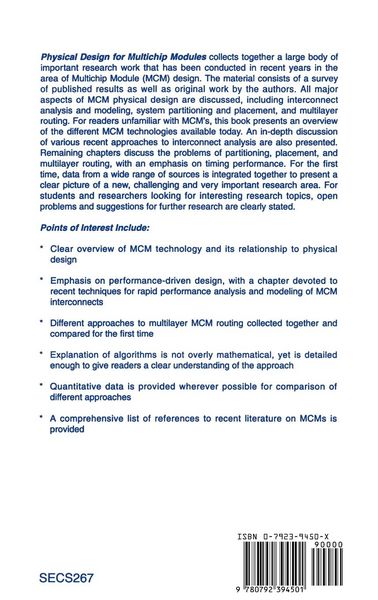
Points of interest include :
- Clear overview of MCM technology and its relationship to physical design;
- Emphasis on performance-driven design, with a chapter devoted to recent techniques for rapid performance analysis and modeling of MCM interconnects;
- Different approaches to multilayer MCM routing collected together and compared for the first time;
- Explanation of algorithms is not overly mathematical, yet is detailed enough to give readers a clear understanding of the approach;
- Quantitative data provided wherever possible for comparison of different approaches;
- A comprehensive list of references to recent literature on MCMs provided.
Noch keine Bewertungen vorhanden
Verfassen Sie die erste Bewertung zu diesem Artikel
Helfen Sie anderen Kundinnen und Kunden durch Ihre Meinung.
Kurze Frage zu unserer Seite
Vielen Dank für Ihr Feedback
Wir nutzen Ihr Feedback, um unsere Produktseiten zu verbessern. Bitte haben Sie Verständnis, dass wir Ihnen keine Rückmeldung geben können. Falls Sie Kontakt mit uns aufnehmen möchten, können Sie sich aber gerne an unseren Kund*innenservice wenden.
zum Kundenservice