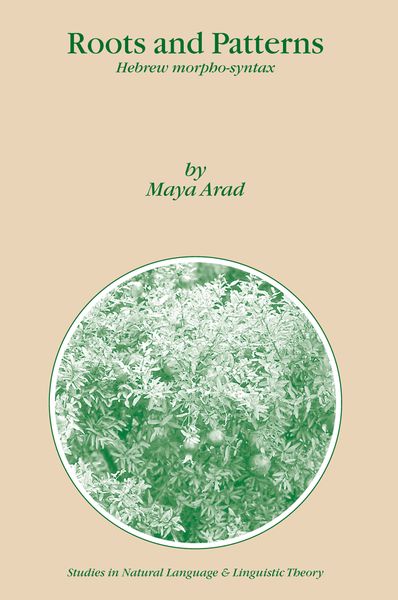
Roots and Patterns Hebrew Morpho-syntax
-
- Hardcover ausgewählt
- Taschenbuch
- eBook
-
Sprache:Englisch
92,99 €
UVP
106,99 €
inkl. gesetzl. MwSt.,
Beschreibung
Produktdetails
Einband
Gebundene Ausgabe
Erscheinungsdatum
15.07.2005
Verlag
Springer NetherlandSeitenzahl
286
Maße (L/B/H)
24,4/16,3/2 cm
Gewicht
599 g
Auflage
2005 edition
Sprache
Englisch
ISBN
978-1-4020-3243-1
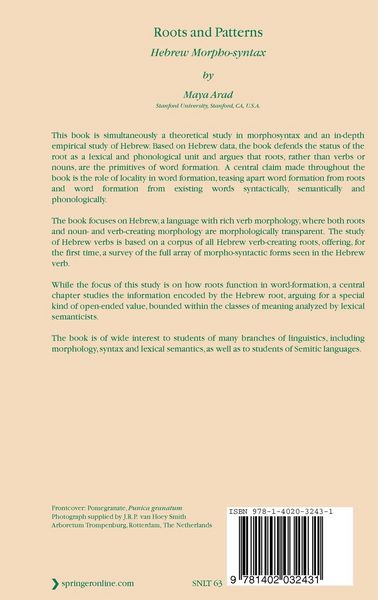
This book is simultaneously a theoretical study in morphosyntax and an in-depth empirical study of Hebrew. Based on Hebrew data, the book defends the status of the root as a lexical and phonological unit and argues that roots, rather than verbs or nouns, are the primitives of word formation. A central claim made throughout the book is the role of locality in word formation, teasing apart word formation from roots and word formation from existing words syntactically, semantically and phonologically.
The book focuses on Hebrew, a language with rich verb morphology, where both roots and noun- and verb-creating morphology are morphologically transparent. The study of Hebrew verbs is based on a corpus of all Hebrew verb-creating roots, offering, for the first time, a survey of the full array of morpho-syntactic forms seen in the Hebrew verb.
While the focus of this study is on how roots function in word-formation, a central chapter studies the information encoded by the Hebrew root, arguing for a special kind of open-ended value, bounded within the classes of meaning analyzed by lexical semanticists.
Kundinnen und Kunden meinen
Verfassen Sie die erste Bewertung zu diesem Artikel
Helfen Sie anderen Kund*innen durch Ihre Meinung
Kurze Frage zu unserer Seite
Vielen Dank für Ihr Feedback
Wir nutzen Ihr Feedback, um unsere Produktseiten zu verbessern. Bitte haben Sie Verständnis, dass wir Ihnen keine Rückmeldung geben können. Falls Sie Kontakt mit uns aufnehmen möchten, können Sie sich aber gerne an unseren Kund*innenservice wenden.
zum Kundenservice