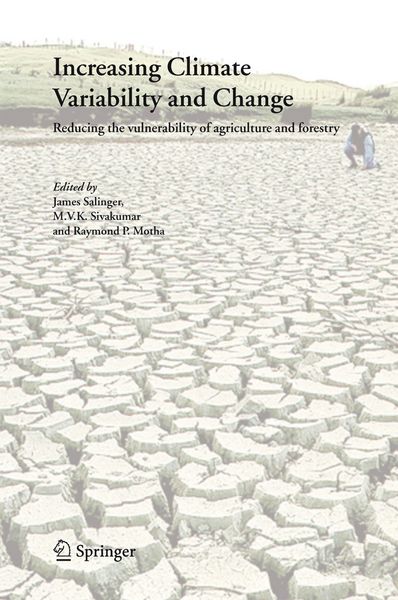
Increasing Climate Variability and Change Reducing the Vulnerability of Agriculture and Forestry
-
- Hardcover ausgewählt
- Taschenbuch
-
Sprache:Englisch
139,99 €
UVP
160,49 €
inkl. gesetzl. MwSt.,
Beschreibung
Produktdetails
Einband
Gebundene Ausgabe
Erscheinungsdatum
11.08.2005
Abbildungen
VI, 362 p.
Herausgeber
James Salinger + weitereVerlag
Springer NetherlandSeitenzahl
362
Maße (L/B/H)
24,1/16/2,8 cm
Gewicht
791 g
Auflage
Reprinted from Climatic Change, Vol. 70, Nos. 1-2
Sprache
Englisch
ISBN
978-1-4020-3354-4
One of the major challenges facing humankind is to provide an equitable standard of living for this and future generations: adequate food, water and energy, safe shelter and a healthy environment. Human-induced climate change, and increasing climate variability, as well as other global environmental issues such as land degradation and loss of biological diversity, threaten our ability to meet these basic human needs. It is undisputed that the last two decades have been the warmest this century, and likely to be the warmest for the last 1000 years, sea level is rising, rain and snowfall patterns are changing. Arctic sea ice is thinning and the frequency and intensity of El-Niño events appear to be increasing. In addition, the frequency of extreme events is rising and many parts of the world have recently suffered major heat-waves, floods and droughts leading to significant loss of life and economic costs. This requires the global community to give urgent attention to addressing key issues. The range of adaptation options for agriculture and forestry is generally increasing because of technological advances, thus reducing the vulnerability of these systems to climate change. However, some regions of the world, particularly developing countries, have limited access to these technologies. Agriculture and forestry are currently not optimally managed with respect to today’s natural climate variability. Decreasing the vulnerability of agriculture and forestry to increasing climatic variability will go a long way towards reducing the long-term vulnerability to climate change. This book represents a major step in assessing the science of climate variability and change, and their likely impacts on agriculture and forestry, with clear adaptation strategies required to reduce their vulnerability.
Noch keine Bewertungen vorhanden
Verfassen Sie die erste Bewertung zu diesem Artikel
Helfen Sie anderen Kundinnen und Kunden durch Ihre Meinung.
Kurze Frage zu unserer Seite
Vielen Dank für Ihr Feedback
Wir nutzen Ihr Feedback, um unsere Produktseiten zu verbessern. Bitte haben Sie Verständnis, dass wir Ihnen keine Rückmeldung geben können. Falls Sie Kontakt mit uns aufnehmen möchten, können Sie sich aber gerne an unseren Kund*innenservice wenden.
zum Kundenservice