Binary Rare Earth Oxides
-
- Hardcover ausgewählt
- Taschenbuch
- eBook
-
Sprache:Englisch
149,99 €
UVP
171,19 €
inkl. gesetzl. MwSt.,
Beschreibung
Produktdetails
Einband
Gebundene Ausgabe
Erscheinungsdatum
01.09.2004
Herausgeber
G. Adachi + weitereVerlag
Springer NetherlandSeitenzahl
257
Maße (L/B/H)
24,1/16/2 cm
Gewicht
576 g
Auflage
2004
Sprache
Englisch
ISBN
978-1-4020-2568-6
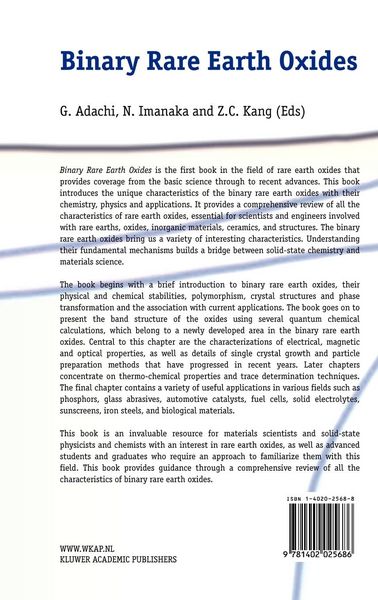
Binary Rare Earth Oxides is the first book in the field of rare earth oxides that provides coverage from the basic science through to recent advances. This book introduces the unique characteristics of the binary rare earth oxides with their chemistry, physics and applications. It provides a comprehensive review of all the characteristics of rare earth oxides, essential for scientists and engineers involved with rare earths, oxides, inorganic materials, ceramics, and structures. The binary rare earth oxides bring us a variety of interesting characteristics. Understanding their fundamental mechanisms builds a bridge between solid-state chemistry and materials science.
The book begins with a brief introduction to binary rare earth oxides, their physical and chemical stabilities, polymorphism, crystal structures and phase transformation and the association with current applications. The book goes on to present the band structure of the oxides using several quantum chemical calculations, which belong to a newly developed area in the binary rare earth oxides. Central to this chapter are the characterizations of electrical, magnetic and optical properties, as well as details of single crystal growth and particle preparation methods that have progressed in recent years. Later chapters concentrate on thermo-chemical properties and trace determination techniques. The final chapter contains a variety of useful applications in various fields such as phosphors, glass abrasives, automotive catalysts, fuel cells, solid electrolytes, sunscreens, iron steels, and biological materials.
This book is an invaluable resource for materials scientists and solid-state physicists and chemists with an interest in rare earth oxides, as well as advanced students and graduates who require an approach to familiarize them with this field. This book provides guidance through a comprehensive review of all the characteristics of binary rare earth oxides.
Noch keine Bewertungen vorhanden
Verfassen Sie die erste Bewertung zu diesem Artikel
Helfen Sie anderen Kundinnen und Kunden durch Ihre Meinung.
Kurze Frage zu unserer Seite
Vielen Dank für Ihr Feedback
Wir nutzen Ihr Feedback, um unsere Produktseiten zu verbessern. Bitte haben Sie Verständnis, dass wir Ihnen keine Rückmeldung geben können. Falls Sie Kontakt mit uns aufnehmen möchten, können Sie sich aber gerne an unseren Kund*innenservice wenden.
zum Kundenservice