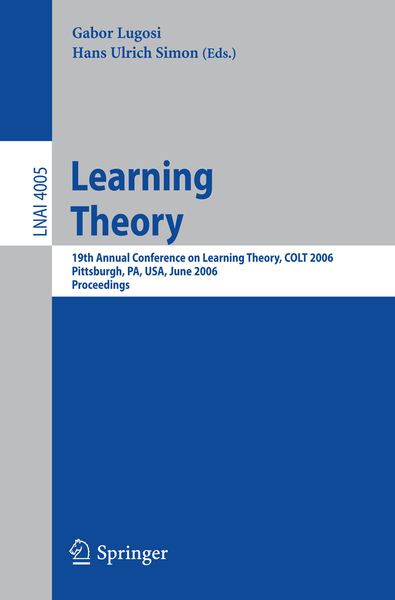
Learning Theory 19th Annual Conference on Learning Theory, COLT 2006, Pittsburgh, PA, USA, June 22-25, 2006, Proceedings
-
- Englisch ausgewählt
97,99 €
inkl. gesetzl. MwSt.,
Beschreibung
Produktdetails
Einband
Taschenbuch
Erscheinungsdatum
12.06.2006
Abbildungen
XII, 660 p.
Herausgeber
Hans Ulrich Simon + weitereVerlag
Springer BerlinSeitenzahl
660
Maße (L/B/H)
23,5/15,5/3,7 cm
Gewicht
1007 g
Auflage
2006
Sprache
Englisch
ISBN
978-3-540-35294-5
Invited Presentations.- Random Multivariate Search Trees.- On Learning and Logic.- Predictions as Statements and Decisions.- Clustering, Un-, and Semisupervised Learning.- A Sober Look at Clustering Stability.- PAC Learning Axis-Aligned Mixtures of Gaussians with No Separation Assumption.- Stable Transductive Learning.- Uniform Convergence of Adaptive Graph-Based Regularization.- Statistical Learning Theory.- The Rademacher Complexity of Linear Transformation Classes.- Function Classes That Approximate the Bayes Risk.- Functional Classification with Margin Conditions.- Significance and Recovery of Block Structures in Binary Matrices with Noise.- Regularized Learning and Kernel Methods.- Maximum Entropy Distribution Estimation with Generalized Regularization.- Unifying Divergence Minimization and Statistical Inference Via Convex Duality.- Mercer's Theorem, Feature Maps, and Smoothing.- Learning Bounds for Support Vector Machines with Learned Kernels.- Query Learning and Teaching.- On Optimal Learning Algorithms for Multiplicity Automata.- Exact Learning Composed Classes with a Small Number of Mistakes.- DNF Are Teachable in the Average Case.- Teaching Randomized Learners.- Inductive Inference.- Memory-Limited U-Shaped Learning.- On Learning Languages from Positive Data and a Limited Number of Short Counterexamples.- Learning Rational Stochastic Languages.- Parent Assignment Is Hard for the MDL, AIC, and NML Costs.- Learning Algorithms and Limitations on Learning.- Uniform-Distribution Learnability of Noisy Linear Threshold Functions with Restricted Focus of Attention.- Discriminative Learning Can Succeed Where Generative Learning Fails.- Improved Lower Bounds for Learning Intersections of Halfspaces.- Efficient Learning Algorithms Yield Circuit Lower Bounds.- OnlineAggregation.- Optimal Oracle Inequality for Aggregation of Classifiers Under Low Noise Condition.- Aggregation and Sparsity Via ?1 Penalized Least Squares.- A Randomized Online Learning Algorithm for Better Variance Control.- Online Prediction and Reinforcement Learning I.- Online Learning with Variable Stage Duration.- Online Learning Meets Optimization in the Dual.- Online Tracking of Linear Subspaces.- Online Multitask Learning.- Online Prediction and Reinforcement Learning II.- The Shortest Path Problem Under Partial Monitoring.- Tracking the Best Hyperplane with a Simple Budget Perceptron.- Logarithmic Regret Algorithms for Online Convex Optimization.- Online Variance Minimization.- Online Prediction and Reinforcement Learning III.- Online Learning with Constraints.- Continuous Experts and the Binning Algorithm.- Competing with Wild Prediction Rules.- Learning Near-Optimal Policies with Bellman-Residual Minimization Based Fitted Policy Iteration and a Single Sample Path.- Other Approaches.- Ranking with a P-Norm Push.- Subset Ranking Using Regression.- Active Sampling for Multiple Output Identification.- Improving Random Projections Using Marginal Information.- Open Problems.- Efficient Algorithms for General Active Learning.- Can Entropic Regularization Be Replaced by Squared Euclidean Distance Plus Additional Linear Constraints.
Noch keine Bewertungen vorhanden
Verfassen Sie die erste Bewertung zu diesem Artikel
Helfen Sie anderen Kundinnen und Kunden durch Ihre Meinung.
Kurze Frage zu unserer Seite
Vielen Dank für Ihr Feedback
Wir nutzen Ihr Feedback, um unsere Produktseiten zu verbessern. Bitte haben Sie Verständnis, dass wir Ihnen keine Rückmeldung geben können. Falls Sie Kontakt mit uns aufnehmen möchten, können Sie sich aber gerne an unseren Kund*innenservice wenden.
zum Kundenservice