Gutscheinbedingungen

Gültig bis 13.07.2026 | Gültig für Spielzeug (außer Tonieboxen & ausgewählte Tonies), Filme, Musik, Software, Games, Schreibwaren, Hörbücher und Hörbuch-Downloads (außer Abo & Shelfies), gebrauchte Bücher, nicht preisgebundene Bücher und Kalender | Einlösbar unter osiander.de und in der Osiander App | Click & Collect nur mit Online-Zahlung (Paypal/Kreditkarte) vorab | Einzelne Artikel können ausgeschlossen sein | Nicht kombinierbar mit anderen Gutscheinen oder Preisaktionen | Nur einmal pro Einkauf einlösbar | Gutschein wird auf max. 500€ Bestellwert angerechnet | Keine Barauszahlung | Digitale Hörbücher nur für Android | Nicht gültig für preisgebundene Artikel (aufgrund der Buchpreisbindung sind Gutscheine nicht auf Bücher, eBooks, Presse einlösbar), tolino eReader & Zubehör, Elektronik, Geschenke & Trends, Abonnements & Flatrates, Geschenkkarten, Versandkosten und Services

  • Produktbild: An Introduction to Diophantine Equations
  • Produktbild: An Introduction to Diophantine Equations
- 15%

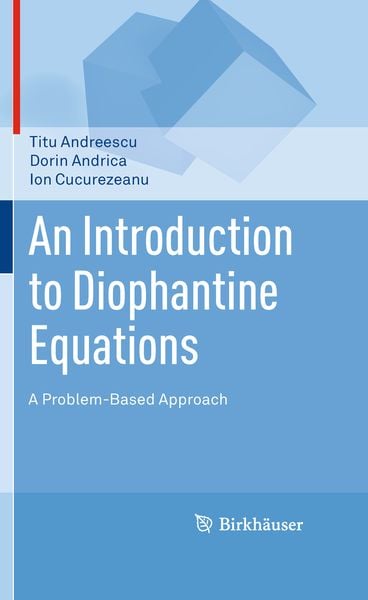
An Introduction to Diophantine Equations A Problem-Based Approach

15% sparen

71,99 € UVP 85,59 €

inkl. gesetzl. MwSt., Versandkostenfrei


Beschreibung

Produktdetails

Einband

Gebundene Ausgabe

Erscheinungsdatum

13.09.2010

Verlag

Birkhäuser Boston

Seitenzahl

345

Maße (L/B/H)

24,5/16,4/3 cm

Gewicht

688 g

Auflage

2010

Sprache

Englisch

ISBN

978-0-8176-4548-9

Beschreibung

Rezension

From the reviews:

“This book is devoted to problems from mathematical competitions involving diophantine equations. … Each chapter contains a large number of solved examples and presents the reader with problems whose solutions can be found in the book’s second part. This volume will be particularly interesting for participants in mathematical contests and their coaches. It will also give a lot of pleasure to everyone who likes to tackle elementary, yet nontrivial problems concerning diophantine equations.” (Ch. Baxa, Monatshefte für Mathematik, Vol. 167 (3-4), September, 2012)

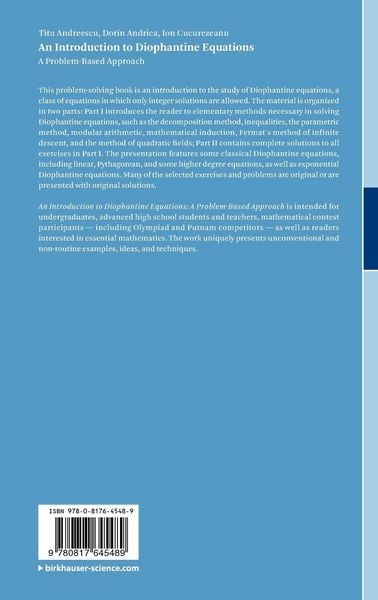
“This book explains methods for solving problems with Diophantine equations that often appear in mathematical competitions at various levels. … The book can be recommended to mathematical contest participants, but also to undergraduate students, advanced high school students and teachers.” (Andrej Dujella, Mathematical Reviews, Issue 2011 j)

“Diophantus’ Arithmetica is a collection of problems each followed by a solution...The book at hand is intended for high school students, undergraduates and math teachers. It is written in a language that everyone in these groups will be familiar with. The exposition is very lucid and the proofs are clear and instructive. The book will be an invaluable source for math contest participants and other math fans. It will be an excellent addition to any math library.” (Alex Bogomolny, The Mathematical Association of America, October, 2010)

“Diophantine analysis, the business of solving equations with integers, constitutes a subdiscipline within the larger field of number theory. One problem in this subject, Fermat's last theorem, till solved, topped most lists of the world's most celebrated unsolved mathematics problems, so the subject attracted much attention from mathematicians and even the larger public. Nevertheless, sophisticated 20th-century tools invented to attackDiophantine equations (algebraic number fields, automorphic forms, L-functions, adelic groups, etc.) have emerged as proper objects of study in their own right. So for a popular subject, modern lower-level works focused on the individual Diophantine equation (and not on big machines aimed generally at classes of such equations) are relatively rare. The present volume…fills this need...
Summing Up
: Recommended. Lower- and upper-division undergraduates and general readers.” (D.V. Feldman, Choice, July, 2010)
Zitat

From the reviews:
"Diophantus' Arithmetica is a collection of problems each followed by a solution...The book at hand is intended for high school students, undergraduates and math teachers. It is written in a language that everyone in these groups will be familiar with. The exposition is very lucid and the proofs are clear and instructive. The book will be an invaluable source for math contest participants and other math fans. It will be an excellent addition to any math library." (Alex Bogomolny, The Mathematical Association of America, October, 2010)
"Diophantine analysis, the business of solving equations with integers, constitutes a subdiscipline within the larger field of number theory. One problem in this subject, Fermat's last theorem, till solved, topped most lists of the world's most celebrated unsolved mathematics problems, so the subject attracted much attention from mathematicians and even the larger public. Nevertheless, sophisticated 20th-century tools invented to attack Diophantine equations (algebraic number fields, automorphic forms, L-functions, adelic groups, etc.) have emerged as proper objects of study in their own right. So for a popular subject, modern lower-level works focused on the individual Diophantine equation (and not on big machines aimed generally at classes of such equations) are relatively rare. The present volume...fills this need...Summing Up: Recommended. Lower- and upper-division undergraduates and general readers." (D.V. Feldman, Choice, July, 2010)
"This book explains methods for solving problems with Diophantine equations that often appear in mathematical competitions at various levels. ... The book can be recommended to mathematical contest participants, but also to undergraduate students, advanced high school students and teachers." (Andrej Dujella, Mathematical Reviews, Issue 2011 j)

Produktdetails

Einband

Gebundene Ausgabe

Erscheinungsdatum

13.09.2010

Verlag

Birkhäuser Boston

Seitenzahl

345

Maße (L/B/H)

24,5/16,4/3 cm

Gewicht

688 g

Auflage

2010

Sprache

Englisch

ISBN

978-0-8176-4548-9

Herstelleradresse

Libri GmbH
Europaallee 1
36244 Bad Hersfeld
DE

Email: GPSR Kontakt

Noch keine Bewertungen vorhanden

Verfassen Sie die erste Bewertung zu diesem Artikel

Helfen Sie anderen Kundinnen und Kunden durch Ihre Meinung.

Kundinnen und Kunden meinen

Bewertungen (0)

  • Produktbild: An Introduction to Diophantine Equations
  • Produktbild: An Introduction to Diophantine Equations
  • Preface.-Part 1: Diophantine Equations.-Elementary Methods for Solving Diophantine Equations.-The Decomposition Method.-Solving Diophantine Equations Using Inequalities.-The Parametric Method.-The Modular Arithmetic Method.-The Method of Mathematical Induction.-Fermat’s Method of Infinite Descent (FMID).-Miscellaneous Diophantine Equations.-Some Classical Diophantine Equation.-Linear Diophantine Equation.-Pythagorean Triples and Related Problems.-Other Remarkable Equations.-Pell’s-Type Equations.-Pell’s Equation: History and Motivation.-Solving Pell’s Equation by Elementary Methods.-The Equation ax^2-by^2=1.-The Negative Pell’s Equation.-Part 2: Solutions to Exercises and Problems.-Elementary Methods for Solving Diophantine Equations.-The Decomposition Method.-Solving Diophantine Equations Using Inequalities.-The Parametric Method.-The Modular Arithmetic Method.-The Method of Mathematical Induction.-Fermat’s Method of Infinite Descent (FMID).-Miscellaneous Diophantine Equations.-Some Classical Diophantine Equation.-Linear Diophantine Equation.-Pythagorean Triples and Related Problems.-Other Remarkable Equations.-Pell’s-Type Equations.-Solving Pell’s Equation by Elementary Methods.-The Equation ax^2-by^2=1.-The Negative Pell’s Equation.-References.-Index.