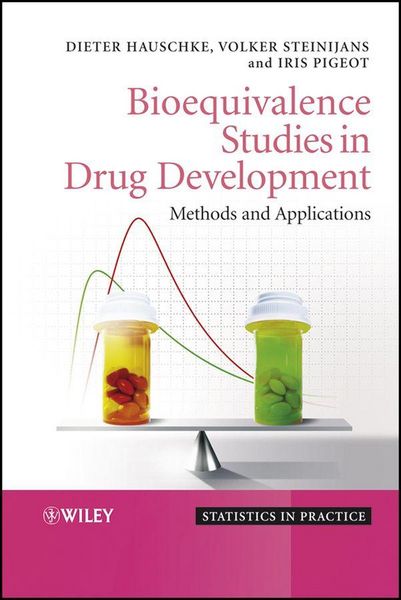
Bioequivalence Studies in Drug Development Methods and Applications
Aus der Reihe
Statistics in Practice
133,99 €
inkl. gesetzl. MwSt.,
Beschreibung
Produktdetails
Einband
Gebundene Ausgabe
Erscheinungsdatum
01.03.2007
Verlag
John Wiley & SonsSeitenzahl
304
Maße (L/B/H)
25,1/17,4/2,4 cm
Gewicht
709 g
Auflage
1. Auflage
Sprache
Englisch
ISBN
978-0-470-09475-4
Studies in bioequivalence are the commonly accepted method to demonstrate therapeutic equivalence between two medicinal products. Savings in time and cost are substantial when using bioequivalence as an established surrogate marker of therapeutic equivalence. For this reason the design, performance and evaluation of bioequivalence studies have received major attention from academia, the pharmaceutical industry and health authorities.
Bioequivalence Studies in Drug Development focuses on the planning, conducting, analysing and reporting of bioequivalence studies, covering all aspects required by regulatory authorities. This text presents the required statistical methods, and with an outstanding practical emphasis, demonstrates their applications through numerous examples using real data from drug development.
* Includes all the necessary pharmacokinetic background information.
* Presents parametric and nonparametric statistical techniques.
* Describes adequate methods for power and sample size determination.
* Includes appropriate presentation of results from bioequivalence studies.
* Provides a practical overview of the design and analysis of bioequivalence studies.
* Presents the recent developments in methodology, including population and individual bioequivalence.
* Reviews the regulatory guidelines for such studies, and the existing global discrepancies.
* Discusses the designs and analyses of drug-drug and food-drug interaction studies.
Bioequivalence Studies in Drug Development is written in an accessible style that makes it ideal for pharmaceutical scientists, clinical pharmacologists, and medical practitioners, as well as biometricians working in the pharmaceutical industry. It will also be of great value for professionals from regulatory bodies assessing bioequivalence studies.
Bioequivalence Studies in Drug Development focuses on the planning, conducting, analysing and reporting of bioequivalence studies, covering all aspects required by regulatory authorities. This text presents the required statistical methods, and with an outstanding practical emphasis, demonstrates their applications through numerous examples using real data from drug development.
* Includes all the necessary pharmacokinetic background information.
* Presents parametric and nonparametric statistical techniques.
* Describes adequate methods for power and sample size determination.
* Includes appropriate presentation of results from bioequivalence studies.
* Provides a practical overview of the design and analysis of bioequivalence studies.
* Presents the recent developments in methodology, including population and individual bioequivalence.
* Reviews the regulatory guidelines for such studies, and the existing global discrepancies.
* Discusses the designs and analyses of drug-drug and food-drug interaction studies.
Bioequivalence Studies in Drug Development is written in an accessible style that makes it ideal for pharmaceutical scientists, clinical pharmacologists, and medical practitioners, as well as biometricians working in the pharmaceutical industry. It will also be of great value for professionals from regulatory bodies assessing bioequivalence studies.
Kundinnen und Kunden meinen
Verfassen Sie die erste Bewertung zu diesem Artikel
Helfen Sie anderen Kund*innen durch Ihre Meinung
Kurze Frage zu unserer Seite
Vielen Dank für Ihr Feedback
Wir nutzen Ihr Feedback, um unsere Produktseiten zu verbessern. Bitte haben Sie Verständnis, dass wir Ihnen keine Rückmeldung geben können. Falls Sie Kontakt mit uns aufnehmen möchten, können Sie sich aber gerne an unseren Kund*innenservice wenden.
zum Kundenservice