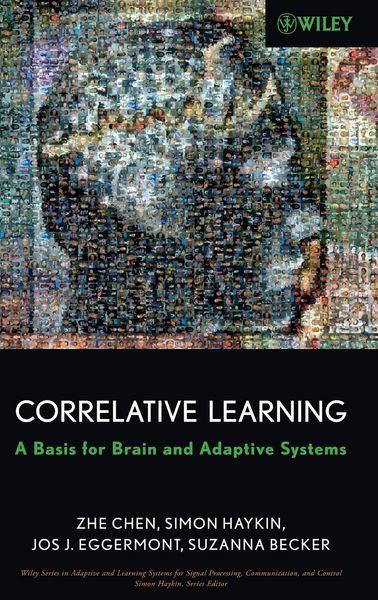
Produktbild: Correlative Learning
Band 1

Correlative Learning A Basis for Brain and Adaptive Systems

224,99 €

inkl. gesetzl. MwSt., Versandkostenfrei


Beschreibung

Produktdetails

Einband

Gebundene Ausgabe

Erscheinungsdatum

01.09.2007

Verlag

John Wiley & Sons Inc

Seitenzahl

480

Maße (L/B/H)

24/16,1/3 cm

Gewicht

877 g

Auflage

1. Auflage

Sprache

Englisch

ISBN

978-0-470-04488-9

Beschreibung

Produktdetails

Einband

Gebundene Ausgabe

Erscheinungsdatum

01.09.2007

Verlag

John Wiley & Sons Inc

Seitenzahl

480

Maße (L/B/H)

24/16,1/3 cm

Gewicht

877 g

Auflage

1. Auflage

Sprache

Englisch

ISBN

978-0-470-04488-9

Herstelleradresse

Libri GmbH
Europaallee 1
36244 Bad Hersfeld
DE

Email: GPSR Kontakt

Noch keine Bewertungen vorhanden

Verfassen Sie die erste Bewertung zu diesem Artikel

Helfen Sie anderen Kundinnen und Kunden durch Ihre Meinung.

Kundinnen und Kunden meinen

Bewertungen (0)

Die Leseprobe wird geladen.
  • Produktbild: Correlative Learning
  • Foreword.
     
    Preface.
     
    Acknowledgments.
     
    Acronyms.
     
    Introduction.
     
    1. The Correlative Brain.
     
    1.1 Background.
     
    1.2 Correlation Detection in Single Neurons.
     
    1.3 Correlation in Ensembles of Neurons: Synchrony and Population Coding.
     
    1.4 Correlation is the Basis of Novelty Detection and Learning.
     
    1.5 Correlation in Sensory Systems: Coding, Perception, and Development.
     
    1.6 Correlation in Memory Systems.
     
    1.7 Correlation in Sensory-Motor Learning.
     
    1.8 Correlation, Feature Binding, and Attention.
     
    1.9 Correlation and Cortical Map Changes after Peripheral Lesions and Brain Stimulation.
     
    1.10 Discussion.
     
    2. Correlation in Signal Processing.
     
    2.1 Correlation and Spectrum Analysis.
     
    2.2 Wiener Filter.
     
    2.3 Least-Mean-Square Filter.
     
    2.4 Recursive Least-Squares Filter.
     
    2.5 Matched Filter.
     
    2.6 Higher Order Correlation-Based Filtering.
     
    2.7 Correlation Detector.
     
    2.8 Correlation Method for Time-Delay Estimation.
     
    2.9 Correlation-Based Statistical Analysis.
     
    2.10 Discussion.
     
    Appendix: Eigenanalysis of Autocorrelation Function of Nonstationary Process.
     
    Appendix: Estimation of the Intensity and Correlation Functions of Stationary Random Point Process.
     
    Appendix: Derivation of Learning Rules with Quasi-Newton Method.
     
    3. Correlation-Based Neural Learning and Machine Learning.
     
    3.1 Correlation as a Mathematical Basis for Learning.
     
    3.2 Information-Theoretic Learning.
     
    3.3 Correlation-Based Computational Neural Models.
     
    Appendix: Mathematical Analysis of Hebbian Learning.
     
    Appendix: Necessity and Convergence of Anti-Hebbian Learning.
     
    Appendix: Link Between the Hebbian Rule and Gradient Descent.
     
    Appendix: Reconstruction Error in Linear and Quadratic PCA.
     
    4. Correlation-Based Kernel Learning.
     
    4.1 Background.
     
    4.2 Kernel PCA and Kernelized GHA.
     
    4.3 Kernel CCA and Kernel ICA.
     
    4.4 Kernel Principal Angles.
     
    4.5 Kernel Discriminant Analysis.
     
    4.6 KernelWiener Filter.
     
    4.7 Kernel-Based Correlation Analysis: Generalized Correlation Function and Correntropy.
     
    4.8 Kernel Matched Filter.
     
    4.9 Discussion.
     
    5. Correlative Learning in a Complex-Valued Domain.
     
    5.1 Preliminaries.
     
    5.2 Complex-Valued Extensions of Correlation-Based Learning.
     
    5.3 Kernel Methods for Complex-Valued Data.
     
    5.4 Discussion.
     
    6. ALOPEX: A Correlation-Based Learning Paradigm.
     
    6.1 Background.
     
    6.2 The Basic ALOPEX Rule.
     
    6.3 Variants of the ALOPEX Algorithm.
     
    6.4 Discussion.
     
    6.5 Monte Carlo Sampling-Based ALOPEX Algorithms.
     
    Appendix: Asymptotical Analysis of the ALOPEX Process.
     
    Appendix: Asymptotic Convergence Analysis of the 2t-ALOPEX Algorithm.
     
    7. Case Studies.
     
    7.1 Hebbian Competition as the Basis for Cortical Map Reorganization?
     
    7.2 Learning Neurocompensator: A Model-Based Hearing Compensation Strategy.
     
    7.3 Online Training of Artificial Neural Networks.
     
    7.4 Kalman Filtering in Computational Neural Modeling.
     
    8. Discussion.
     
    8.1 Summary: Why Correlation?
     
    8.2 Epilogue: What Next?
     
    Appendix A: Autocorrelation and Cross-correlation Functions.
     
    Appendix B: Stochastic Approximation.
     
    Appendix C: A Primer on Linear Algebra.
     
    Appendix D: Probability Density and Entropy Estimators.
     
    Appendix E: EM Algorithm.