• Produktbild: Architecture of Computing Systems - ARCS 2008
  • Produktbild: Architecture of Computing Systems - ARCS 2008

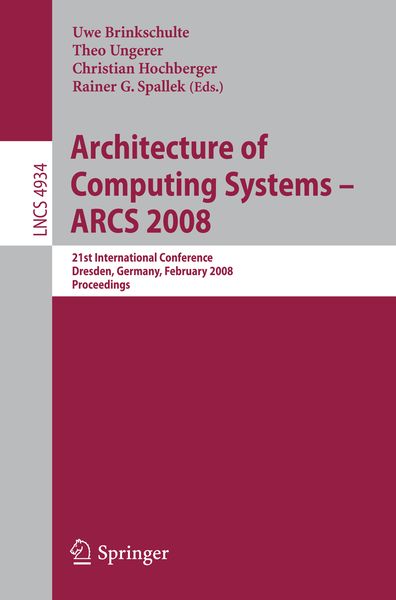
Architecture of Computing Systems - ARCS 2008 21st International Conference, Dresden, Germany, February 25-28, 2008, Proceedings

49,99 €

inkl. gesetzl. MwSt., Versandkostenfrei


Beschreibung

Produktdetails

Einband

Taschenbuch

Erscheinungsdatum

12.02.2008

Abbildungen

XI, 290 p.

Herausgeber

Theo Ungerer + weitere

Verlag

Springer Berlin

Seitenzahl

290

Maße (L/B/H)

23,5/15,5/1,7 cm

Gewicht

464 g

Auflage

2008

Sprache

Englisch

ISBN

978-3-540-78152-3

Beschreibung

Portrait

Prof. Dr. Theo Ungerer ist Professor für Systemnahe Informatik mit Schwerpunkt Kommunikationssysteme und Internet-Anwendungen am Institut für Informatik der Universität Augsburg. Zudem ist er wissenschaftlicher Direktor des Rechenzentrums und Mitglied des Lenkungsrates des IT-Servicezentrums der Universität Augsburg.
Seine wissenschaftlichen Interessen gelten den Gebieten der Prozessorarchitektur sowie der eingebetteten und ubiquitären Systeme. Theo Ungerer hat über 150 wissenschaftliche Publikationen und 6 Fachbücher veröffentlicht. Er ist Mitglied des Lenkungsrates und deutscher Koordinator des EU-Exzellenznetzwerkes HiPEAC- High Performance Embedded Architectures and Compilers

Produktdetails

Einband

Taschenbuch

Erscheinungsdatum

12.02.2008

Abbildungen

XI, 290 p.

Herausgeber

Verlag

Springer Berlin

Seitenzahl

290

Maße (L/B/H)

23,5/15,5/1,7 cm

Gewicht

464 g

Auflage

2008

Sprache

Englisch

ISBN

978-3-540-78152-3

Herstelleradresse

Springer-Verlag KG
Sachsenplatz 4-6
1201 Wien
AT

Email: ProductSafety@springernature.com

Noch keine Bewertungen vorhanden

Verfassen Sie die erste Bewertung zu diesem Artikel

Helfen Sie anderen Kundinnen und Kunden durch Ihre Meinung.

Kundinnen und Kunden meinen

Bewertungen (0)

  • Produktbild: Architecture of Computing Systems - ARCS 2008
  • Produktbild: Architecture of Computing Systems - ARCS 2008
  • Invited Program.- Keynote: Grand Challenges of Computer Engineering.- Keynote: The Impact of Operating Systems on Modern CPU Designs (and Vice Versa).- I Hardware Design.- System Level Simulation of Autonomic SoCs with TAPES.- Topology-Aware Replica Placement in Fault-Tolerant Embedded Networks.- Design of Gate Array Circuits Using Evolutionary Algorithms.- II Pervasive Computing.- Direct Backtracking: An Advanced Adaptation Algorithm for Pervasive Applications.- Intelligent Vehicle Handling: Steering and Body Postures While Cornering.- III Network Processors and Memory Management.- A Hardware Packet Re-Sequencer Unit for Network Processors.- Self-aware Memory: Managing Distributed Memory in an Autonomous Multi-master Environment.- IV Reconfigurable Hardware.- Dynamic Reconfiguration of FlexRay Schedules for Response Time Reduction in Asynchronous Fault-Tolerant Networks.- Synthesis of Multi-dimensional High-Speed FIFOs for Out-of-Order Communication.- A Novel Routing Architecture for Field-Programmable Gate-Arrays.- V Real-Time Architectures.- A Predictable Simultaneous Multithreading Scheme for Hard Real-Time.- Soft Real-Time Scheduling on SMT Processors with Explicit Resource Allocation.- A Hardware/Software Codesign of a Co-processor for Real-Time Hyperelliptic Curve Cryptography on a Spartan3 FPGA.- VI Organic Computing.- A Reference Architecture for Self-organizing Service-Oriented Computing.- Towards Self-organising Smart Camera Systems.- Using Organic Computing to Control Bunching Effects.- VII Computer Architecture.- A Generic Network Interface Architecture for a Networked Processor Array (NePA).- Constructing Optimal XOR-Functions to Minimize Cache Conflict Misses.- Potentials of Branch Predictors: From Entropy Viewpoints.