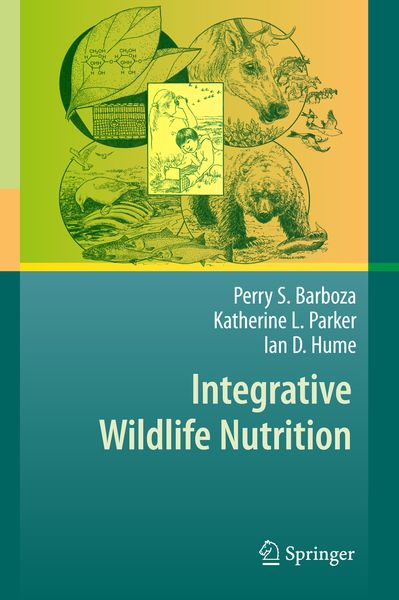
• Produktbild: Integrative Wildlife Nutrition
  • Produktbild: Integrative Wildlife Nutrition
- 13%

Integrative Wildlife Nutrition

13% sparen

156,99 € UVP 181,89 €

inkl. gesetzl. MwSt., Versandkostenfrei


Beschreibung

Produktdetails

Einband

Gebundene Ausgabe

Erscheinungsdatum

28.01.2009

Abbildungen

XVIII, 119 schwarzweisse Abbildungen, 36 Tabellen, 21 Abbildungenton-Abb., 98 schwarzweisse Zeichnungen 235 mm

Verlag

Springer Berlin

Seitenzahl

342

Maße (L/B/H)

24,1/16/2,4 cm

Gewicht

705 g

Auflage

2009

Sprache

Englisch

ISBN

978-3-540-87884-1

Beschreibung

Rezension

From the reviews:
“The combined insights and disciplinary specialties of Barboza (Univ. of Alaska), Parker … and Hume (Univ. of Sydney, Australia) successfully meld to provide this unique resource for the wildlife scientist. … The use of simple, standard-format tables for calculation examples throughout the text provides the reader a welcome tool as well as familiar continuity. … References throughout are comprehensive, the writing style is seamless, and figures, photos, and tables are appropriate in number. Summing Up: Recommended. Upper-division undergraduate through professional collections.” (E. S. Dierenfeld, Choice, Vol. 47 (3), November, 2009)

Produktdetails

Einband

Gebundene Ausgabe

Erscheinungsdatum

28.01.2009

Abbildungen

XVIII, 119 schwarzweisse Abbildungen, 36 Tabellen, 21 Abbildungenton-Abb., 98 schwarzweisse Zeichnungen 235 mm

Verlag

Springer Berlin

Seitenzahl

342

Maße (L/B/H)

24,1/16/2,4 cm

Gewicht

705 g

Auflage

2009

Sprache

Englisch

ISBN

978-3-540-87884-1

Herstelleradresse

Springer-Verlag KG
Sachsenplatz 4-6
1201 Wien
AT

Email: ProductSafety@springernature.com

Kundinnen und Kunden meinen

0 Bewertungen

Informationen zu Bewertungen

Zur Abgabe einer Bewertung ist eine Anmeldung im Konto notwendig. Die Authentizität der Bewertungen wird von uns nicht überprüft. Wir behalten uns vor, Bewertungstexte, die unseren Richtlinien widersprechen, entsprechend zu kürzen oder zu löschen.

Die Bewertungen sind nach Format, Anzahl Sterne und Datum sortiert.

Verfassen Sie die erste Bewertung zu diesem Artikel

Helfen Sie anderen Kund*innen durch Ihre Meinung

Kundinnen und Kunden meinen

0 Bewertungen filtern

Weitere Artikel finden Sie in

  • Produktbild: Integrative Wildlife Nutrition
  • Produktbild: Integrative Wildlife Nutrition
  • Contents

    1 Introduction: common themes across diverse taxa
    1.1 Resource supply and organismal demand
    1.2 Principal components of animals and plants
    1.3 Scaling body size and demands for energy and nutrients
    1.4 Dietary requirements and nutritional niche
    1.5 Summary: introduction

    Part I Functional Relationships
    2 Food and populations
    2.1 Population growth and animal density
    2.2 Individual demands and food limits
    2.3 Trophic relationships
    2.4 Environmental variation
    2.5 Summary: populations

    3 Feeding dynamics: functional and behavioral responses
    3.1 Functional response and diet breadth
    3.2 Predicting foraging behavior with models
    3.2.1 Optimal foraging time
    3.2.2 Risk-sensitive foraging
    3.3 Mechanics of foragingU
    3.4 Form and function of the mouth
    3.5 Mechanisms of foods
    3.5.1 Physical characteristics of foods
    3.5.2 Chemical characteristics of foods
    3.6 Summary: feeding dynamics

    4 Measuring food consumption
    4.1 UAdjustment and steady state
    4.2 Direct measures of intake
    4.2.1 Behavioral observations of food intake
    4.2.2 Food intake by mass balance
    4.2.3 Digestible and metabolizable food intake
    4.3 Indirect measures of intake
    4.3.1 Measuring intake with indigestible markers
    4.3.2 Measuring intake with digestible markers
    4.4 Summary: food consumption

    5 Digestive function
    5.1 Food intake, digestive efficiency and digestive tract capacity
    5..2 Reaction rates and retention time
    5.3 Common functions of digestive systems
    5.4 Digesta flow
    5.4.1 Digesta flow in the foregut of ruminants and kangaroos
    5.4.2 Digesta flow in the hindgut of herbivores
    5.5 Optimizing digestive systems
    5.6 Summary: digestive function

    Part II Substrates and Tissue Constituents
    6 Carbohydrates: sugars, fiber and fermentationU
    6.1 Complementary substrates for metabolism
    6.2 Functions of carbohydrates
    6.3 Functional chemistry of carbohydrates
    6.4 Digestion and absorption of non-structural carbohydrates
    6.5 Glucose metabolism and homeostasis
    6.6 Digestion of structural carbohydrates
    6.7 Microbial fermentation
    6.7.1 Host-microbe relationshipsU
    6.8 Summary: carbohydrates

    7 Lipids: fatty acids and adipose tissue
    7.1 Functional chemistry of fatty acids
    7.2 Classes of lipids
    7.3 Digestion and transport of lipids
    7.4 Fat synthesis and mobilization
    7.5 Summary: lipids

    8 Nitrogenous substrates: nucleic acids to amino excretion
    8.1 Amino acids and essentiality
    8.2 Proteins and digestion
    8.3 Intermediary metabolism of amino acids
    8.4 Nucleic acids and digestion
    8.5 Nitrogen metabolism
    8.5.1 Ammonia
    8.5.2 Urea
    8.5.3 Uric acid
    8.5.4 Creatinine
    8.6 Nitrogen balance and the requirement for N
    8.6.1 Endogenous urinary N
    8.6.2 Fecal N losses
    8.6.3 Protein quality
    8.7 Summary: nitrogen

    9 Metabolic constituents: water, minerals and vitamins
    9.1 Water and electrolytes
    9.1.1 Transport mechanisms
    9.1.2 Aquatic exchanges of water
    9.1.3 Terrestrial exchanges of water
    9.1.4 Water turnover and balance
    9.2 Minerals
    9.2.1 Sodium, chlorine, and potassium
    9.2.2 Calcium and phosphorus
    9.2.3 Magnesium and sulfurU
    9.2.4 Trace metals
    9.2.5 Iodine and selenium
    9.3 Vitamins
    9.3.1 Water-soluble vitamins
    9.3.1.1 B vitamins
    9.3.1.2 Vitamin C
    9.3.2 Fat-soluble vitamins
    9.3.2.1 Vitamin A
    9.3.2.2 Vitamin D
    9.3.2.3 Vitamin E
    9.3.2.4 Vitamin K
    9.4