• Produktbild: Adaptive Hypermedia and Adaptive Web-Based Systems
  • Produktbild: Adaptive Hypermedia and Adaptive Web-Based Systems
Band 1892

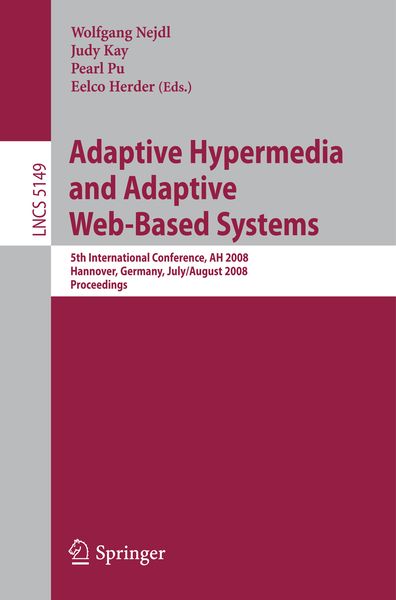
Adaptive Hypermedia and Adaptive Web-Based Systems 5th International Conference, AH 2008, Hannover, Germany, July 29 - August 1, 2008, Proceedings

49,99 €

inkl. gesetzl. MwSt., Versandkostenfrei


Beschreibung

Produktdetails

Einband

Taschenbuch

Erscheinungsdatum

18.07.2008

Herausgeber

Wolfgang Nejdl + weitere

Verlag

Springer Berlin

Seitenzahl

438

Maße (L/B/H)

23,5/15,5/2,5 cm

Gewicht

691 g

Auflage

2008

Sprache

Englisch

ISBN

978-3-540-70984-8

Beschreibung

Produktdetails

Einband

Taschenbuch

Erscheinungsdatum

18.07.2008

Herausgeber

Verlag

Springer Berlin

Seitenzahl

438

Maße (L/B/H)

23,5/15,5/2,5 cm

Gewicht

691 g

Auflage

2008

Sprache

Englisch

ISBN

978-3-540-70984-8

Herstelleradresse

Springer-Verlag KG
Sachsenplatz 4-6
1201 Wien
AT

Email: GPSR Kontakt

Noch keine Bewertungen vorhanden

Verfassen Sie die erste Bewertung zu diesem Artikel

Helfen Sie anderen Kundinnen und Kunden durch Ihre Meinung.

Kundinnen und Kunden meinen

Bewertungen (0)

  • Produktbild: Adaptive Hypermedia and Adaptive Web-Based Systems
  • Produktbild: Adaptive Hypermedia and Adaptive Web-Based Systems
  • Keynote Speakers.- Baroque Technology.- Adaptive Navigation Support for Open Corpus Hypermedia Systems.- Altruism, Selfishness, and Destructiveness on the Social Web.- Full Papers.- A Rule-Based Recommender System for Online Discussion Forums.- Locally Adaptive Neighborhood Selection for Collaborative Filtering Recommendations.- Adaptive Retrieval of Semi-structured Data.- Using Collaborative Models to Adaptively Predict Visitor Locations in Museums.- Supporting Users in Creating Pedagogically Sound Personalised Learning Objects.- Supporting Interaction Preferences and Recognition of Misconceptions with Independent Open Learner Models.- An Evidence-Based Approach to Handle Semantic Heterogeneity in Interoperable Distributed User Models.- Concept-Based Document Recommendations for CiteSeer Authors.- Social Information Access for the Rest of Us: An Exploration of Social YouTube.- (Web Search)shared: Social Aspects of a Collaborative, Community-Based Search Network.- Evaluation of ACTSim: A Composition Tool for Authoring Adaptive Soft Skill Simulations.- Modelling Semantic Relationships and Centrality to Facilitate Community Knowledge Sharing.- LS-Plan: An Effective Combination of Dynamic Courseware Generation and Learning Styles in Web-Based Education.- Pervasive Personalisation of Location Information: Personalised Context Ontology.- Using Decision Models for the Adaptive Generation of Learning Spaces.- Accuracy in Rating and Recommending Item Features.- Does ’Notice’ Prompt Noticing? Raising Awareness in Language Learning with an Open Learner Model.- Proactive Versus Multimodal Online Help: An Empirical Study.- Re-assessing the Value of Adaptive Navigation Support in E-Learning Context.- The Effectiveness of Personalized Movie Explanations: An Experiment Using Commercial Meta-data.- User-Centric Profiling on the Basis of Cognitive and Emotional Characteristics: An Empirical Study.- Towards Computerized Adaptive Assessment Based on Structured Tasks.- Adaptation of Elaborated Feedback in e-Learning.- Adaptive Link Annotation in Distributed Hypermedia Systems: The Evaluation of a Service-Based Approach.- Short Papers.- Do Students Trust Their Open Learner Models?.- A Framework for the Development of Distributed, Context-Aware Adaptive Hypermedia Applications.- Collection Browsing through Automatic Hierarchical Tagging.- Aspect-Based Personalized Text Summarization.- What Can I Watch on TV Tonight?.- Adaptive Navigation Support, Learner Control and Open Learner Models.- News@hand: A Semantic Web Approach to Recommending News.- A SOA-Based Framework to Support User Model Interoperability.- Integrated Speaker Classification for Mobile Shopping Applications.- The Authoring Tool of ADULT: Adaptive Understanding and Learning Text Environment.- Interoperability between MOT and Learning Management Systems: Converting CAF to IMS QTI and IMS CP.- Proactively Adapting Interfaces to Individual Users for Mobile Devices.- Reuse Patterns in Adaptation Languages: Creating a Meta-level for the LAG Adaptation Language.- Implementing a Multimodal Interface to a DITA User Assistance Repository.- Analysing High-Level Help-Seeking Behaviour in ITSs.- Data-Driven Prediction of the Necessity of Help Requests in ILEs.- A Dynamic Content Generator for Adaptation in Hypermedia Systems.- Automatic Generation of User Adapted Learning Designs: An AI-Planning Proposal.- Guaranteeing the Correctness of an Adaptive Tutoring System.- Designing a Personalized Semantic Web Browser.- Towards Inferring Sequential-Global Dimension of Learning Styles from Mouse Movement Patterns.- VUMA: A Visual User Modelling Approach for the Personalisation of Adaptive Systems.- Bookmark Category Web Page Classification Using Four Indexing and Clustering Approaches.- Personalization Using Ontologies and Rules.- RSS-Based Interoperability for User Adaptive Systems.- Assisting in Reuse of Adaptive Hypermedia Creator’s Models.- Demo Papers.- Convergence of Web and TV Broadcast Data for Adaptive Content Access and Navigation.- Recommending Background Information and Related Content in Web 2.0 Portals.- Adaptive Portals: Context Adaptive Navigation through Large Information Spaces.- Personalized Recommendations for the Web 3D.- Doctoral Consortium.- Adaptive User Modelling and Recommendation in Constrained Physical Environments.- Learning Style as a Parameter in a Unified e-Learning System Architecture: The Adaptive Diagnosis.- Facilitating Collaboration in Virtual Environments.- Learner Modelling in Exploratory Learning for Mathematical Generalisation.- GAF: Generic Adaptation Framework.- Engineering Information Systems towards Facilitating Scrutable and Configurable Adaptation.- Flexible Adaptivity in AEHS Using Policies.- A Validation Framework for Formal Models in Adaptive Work-Integrated Learning.- A Scrutable User Modelling Infrastructure for Enabling Life-Long User Modelling.- Merging Adaptive Hypermedia and Intelligent Tutoring Systems Using Knowledge Spaces.- SemWeB: A Semantic Web Browser for Supporting the Browsing of Users Using Semantic and Adaptive Links.