Produktbild: Intellectual Capital for Communities

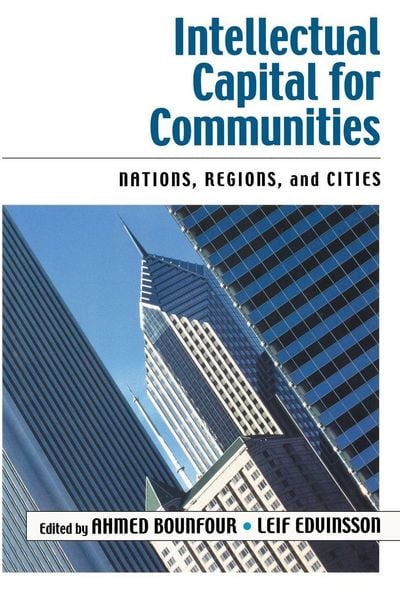
Intellectual Capital for Communities

119,99 €

inkl. gesetzl. MwSt., Versandkostenfrei


Beschreibung

Produktdetails

Einband

Taschenbuch

Erscheinungsdatum

21.01.2005

Herausgeber

Ahmed Bounfour + weitere

Verlag

Taylor & Francis

Seitenzahl

366

Maße (L/B/H)

23/15,1/2,2 cm

Gewicht

590 g

Sprache

Englisch

ISBN

978-0-7506-7773-8

Beschreibung

Rezension

"Bounfour and Edvinsson's extension of the burgeoning intellectual capital literature to communities/regions/nations is timely and very rewarding." (Baruch Lev, Philip Bardes Professor of Accounting and Finance, New York University)

"The study of intellectual capital has become a field of research in itself. It used to be restricted to the business sector: Thanks to the series of studies coordinated by Bounfour and Edvinsson, it covers now communities and public institutions. It was a necessary step, as knowledge is a public good, and that step gives rise to invaluable new insights." (Dominique Guellec, Chief economist, European Patent Office)

"With assets of many firms being primarily intangibles knowledge companies the question arises whether regions and nations are successfully pursuing similar paths. The authors have rewardingly set out to find answers on how intellectual capital is created in geographic entities and how it can be measured." (Jon Sigurdson, Professor (Research Policy)/Stockholm School of Economics)

"In the 20th century, industrial society achieved remarkable growth through the dissemination of an "integrated circuit", abbreviated to IC in every corner of industry. This book suggests that the knowledge-based society in the 21st century will be enriched through the spread of another IC, that is, "intellectual capital" in every corner of the society." (Teruyasu Murakami, Chief Counselor, Nomura Research Institute)

"This book is a welcome and timely overview of a new and vibrant IC frontier. IC started with a corporate focus but much of the exciting work is now being made in and for the public sector as well as on governmental and national levels. The articles are more than the usual boring collection of re-written old papers; they are fresh and topical. This is required reading!" (Karl-Erik Sveiby, Professor at Swedish School of Economics and Business Admininistration, Helsinki, Finland)
Produktdetails

Einband

Taschenbuch

Erscheinungsdatum

21.01.2005

Herausgeber

Verlag

Taylor & Francis

Seitenzahl

366

Maße (L/B/H)

23/15,1/2,2 cm

Gewicht

590 g

Sprache

Englisch

ISBN

978-0-7506-7773-8

Herstelleradresse

Libri GmbH
Europaallee 1
36244 Bad Hersfeld
DE

Email: gpsr@libri.de

Noch keine Bewertungen vorhanden

Verfassen Sie die erste Bewertung zu diesem Artikel

Helfen Sie anderen Kundinnen und Kunden durch Ihre Meinung.

Kundinnen und Kunden meinen

Bewertungen (0)

Die Leseprobe wird geladen.
  • Produktbild: Intellectual Capital for Communities
  • Introduction by Ahmed Bounfour and Leif Edvinsson

    Part One: Modelling and contextualising IC for Communities
    Chapter 1: Modelling Intangibles: Transaction Regime Versus Community regimes
    , Ahmed Bounfour
    Chapter 2: Regional Intellectual capital in waiting, Leif Edvinsson
    Part Two : IC for Nations
    Chapter 3: Estimating the Level of Investment in knowledge across OECD countries, Mosahid Khan
    Chapter 4: Knowledge Economies: a Global Perspective, Jean-Eric Aubert, World Bank Institute
    Chapter 5: Investing in Intangibles: Is a Trillion Dollars Missing from the GDP?
    Leonard Nakamura, Federal Reserve Bank of Philadelphia
    Chapter 6: Intangibles and Intellectual Capital in the European Investment Bank Project Appraisal, Jean-Jaques Mertens , European Investment Bank and Jacques Van der Meer
    Chapter 7 : Assessing Performance of European Innovations Systems: An Intellectual Capital Indexes Perspectives, Ahmed Bounfour,University of Marne La Vallee
    Chapter 8: National Intellectual Capital Index, The Benchmarking of Arab Countries
    Dr. Nick Bontis, DeGroote Business School, McMaster University
    Chapter 9 : The Intellectual Capital of The State of Israel, Dr. Edna Pasher and Sigal Shachar
    Chapter 10 : Rethinking leadership in the Knowledge Society, Learning from Others: How to Integrate Intellectual and Social Capital and Establish a New Balance of Value and Values, Bernhard Von Mutius, Germany
    Chapter 11: Japan and Other East Asian Economies under the Knowledge-Based Economy,
    Seiichi Masuyama, Nomura Research Institute, Japan and Asia
    Part Three : IC for Regions
    Chapter 12: Value Creation Efficiency at National and Regional Level - Case Study Croatia and EU, Ante Pulic
    Chapter 13: A European regional path to the knowledge economy: challenges and opportunities, Dr Dimitri Corpakis, Head of Sector
    European Commission DG Research
    Chapter 14: Intellectual Capital Creation in Regions : A Knowledge System Approach
    Anssi Smedlund and Aino Pöyhönen, M.Econ.Sc. Anssi Smedlund is a Research Assistant and PhD Candidate of Knowledge Management in the Department of Business Administration at Lappeenranta University of Technology
    Chapter 15: Ragusa or how to measure ignorance: The ignorance meter
    By Klaus North and Stefanie Kares, University of Applied Sciences, Wiesbaden, Germany
    Chapter 16: Can the state stimulate the creation of regional networks? - Experiences from the Virtual Marketplace Bavaria initiative,
    Hans-Joachim Heusler , Hans Schedl
    Chapter 17: The Region's Competence and Human Capital: Lessons from the Collaboration Between 3 European Regions on Competence Mapping and Intellectual Capital Management, Lars Karlssson and Paolo Martinez
    Part Four
    IC for Cities and Local Communities
    Chapter 18: Learning-by-Playing: Bridging the Knowing-Doing Gap in Urban Communities, Albert A Angehrn INSEAD, The European Institute of Business Administration
    Chapter 19: Cities' Intellectual Capital Benchmarking System (CICBS). A methodology and a framework for measuring and managing intellectual capital of cities: A practical application in the city of Mataró, by José María Viedma Marti Polytechnic University of Catalonia and
    President of Intellectual Capital Management Systems
    Chapter 20 IC for Communities, Research and Policy agenda, Ahmed Bounfour
    Index