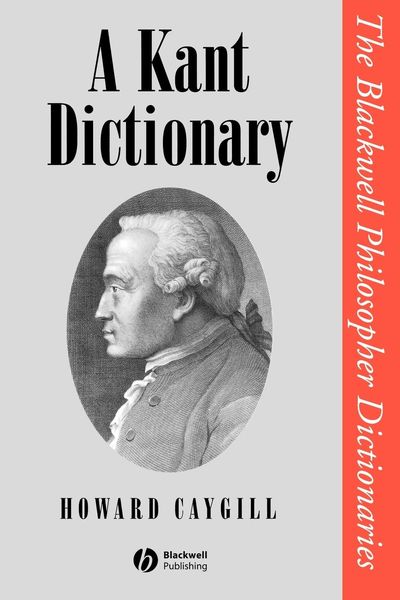
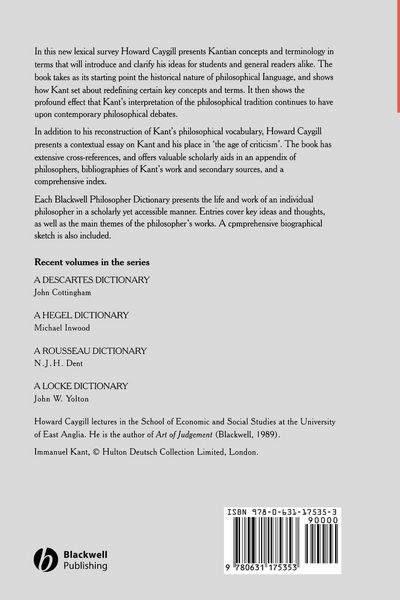
In this new lexical survey of Kant s works, Howard Caygill presents Kantian concepts and terminology in terms that will introduce and clarify his ideas for students and general readers alike.
Kundinnen und Kunden meinen
1.0/5.0
Bewertung
aus Berlin
1/5
12.12.2010
Buch (Gebundene Ausgabe)
An Acroamatic Disaster
In the introduction to his dictionary, Mr Caygill formulates his aim: to compose a dictionary which treats of the philosophical concepts in an acroamatic rather than in an axiomatic fashion. According to the acroamatic approach, heed must be taken of the fact that philosophical concepts are dynamic are rather than static, viz., they are, in Mr Caygill's own words, "the discursive outcome of an open-ended process of reflection upon philosophical problems" (p. 2). This peculiar approach may assuredly have its merits, so long as it does not defeat the purpose of a dictionary. In this regard it will prove worthwhile to compare Mr Caygill's dictionary with the Kant-Lexikon of Rudolf Eisler. For the sake of illustration, let us look at their respective treatment of "apperception". Eisler has two entries on apperception, i.e., empirical and transcendental apperception, cross-referenced to "inner sense", "consciousness", and "apprehension". Furthermore, Eisler always offers a definition of the concept in question at the very beginning of the entry, so that the gist of it is conveyed to one instantaneously. If you wish to acquire a deeper understanding of the issue, you can read the whole of the entry, but that is not a strict necessity. Now to Mr Caygill, who treats of both empirical and transcendental apperception in a single entry, and it is difficult to see where the one ends and the other begins. Moreover, Mr Caygill, in accordance with his acroamatic approach, does not initiate his entry with a definition but with historical digressions about how Leibniz and Descartes understood the concept in question. Only towards the middle of this nearly two pages long entry does Mr Caygill come to what should have been stated at the very beginning. While Eisler's cross-references make immediate sense, it is difficult to understand the whole of the acroamatic logic behind Mr Caygill's cross-references, whose entry on apperception is cross-referenced to "combination", "consciousness", "deduction", "identity", "I think", "knowledge", "paralogism", "psychology", "spontaneity", "subject", "synthesis", and "transcendental". While Eisler's cross-references are in agreement with the rules of strict relevance, Mr. Caygill tends to lump together concepts which are only remotely related. I am sure that such a strategy can be justified from acroamatic point of view, but from a pedagogical point of view it is anything but advisable. Lastly, it is a cause of great indignation to bear witness to Mr Caygill's deprecation of Rudolf Eisler's Kant-Lexikon as he attempts to promote his own dictionary. Eisler's dictionary, owing to its depth and breadth, is a tool of lasting value, whereas Mr. Caygill's dictionary is likely to be rendered superfluous after two months of engagement with the writings of Kant.
Kurze Frage zu unserer Seite
Vielen Dank für Ihr Feedback
Wir nutzen Ihr Feedback, um unsere Produktseiten zu verbessern. Bitte haben Sie Verständnis, dass wir Ihnen keine Rückmeldung geben können. Falls Sie Kontakt mit uns aufnehmen möchten, können Sie sich aber gerne an unseren Kund*innenservice wenden.