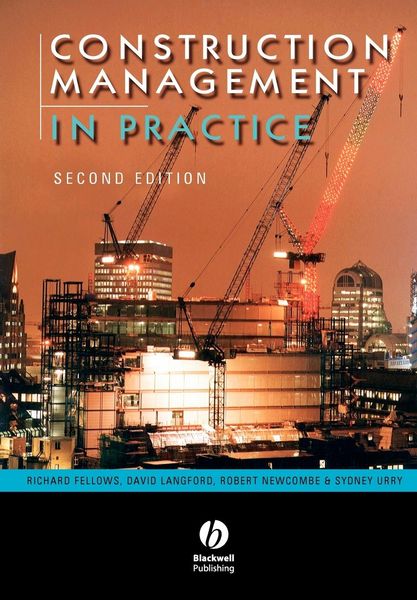
Produktbild: Construction Management Practice 2e

Construction Management Practice 2e

79,99 €

inkl. gesetzl. MwSt., Versandkostenfrei


Beschreibung

Produktdetails

Einband

Taschenbuch

Erscheinungsdatum

31.12.2001

Abbildungen

w. 30 ill.

Verlag

John Wiley & Sons

Seitenzahl

394

Maße (L/B/H)

24,4/17/2,1 cm

Gewicht

678 g

Auflage

2. Auflage

Sprache

Englisch

ISBN

978-0-632-06402-1

Beschreibung

Rezension

"In summing up, the Construction Management in Practice embodies the results of intensive research by the authors which, inmy opinion, is accurate, informative, brief, and forceful - for thesuccess of the construction management process. Finally, this bookis strongly recommended for both, construction management studentsand practitioners." ( Construction Manager , July 2002)
"Providing readers with an up to date and balanced view of theindustry....the comprehensive nature of the text provides asplendid response to the perennial question what exactly doconstruction mangaers do?
The authors are to be commended on the breadth of their coverage ofthe financial aspects of construction management, which includesdiscussion on value management, risk management and lifecyclecosting. Both management and financial fields are treatedrigorously and in depth .... It is particularly heartening to see astrong emphasis given to quantitative decision making andoperational research." ( Construction Management &Economics , Vol 20/5 5 July 2003)

Produktdetails

Einband

Taschenbuch

Erscheinungsdatum

31.12.2001

Abbildungen

w. 30 ill.

Verlag

John Wiley & Sons

Seitenzahl

394

Maße (L/B/H)

24,4/17/2,1 cm

Gewicht

678 g

Auflage

2. Auflage

Sprache

Englisch

ISBN

978-0-632-06402-1

Herstelleradresse

Libri GmbH
Europaallee 1
36244 Bad Hersfeld
DE

Email: gpsr@libri.de

Noch keine Bewertungen vorhanden

Verfassen Sie die erste Bewertung zu diesem Artikel

Helfen Sie anderen Kundinnen und Kunden durch Ihre Meinung.

Kundinnen und Kunden meinen

Bewertungen (0)

  • Produktbild: Construction Management Practice 2e
  • Preface.

    Authors' note.

    Acknowledgements.

    Abbreviations.

    1 Construction Management in Practice.

    1.1 Characteristics of the construction industry.

    1.2 Construction management in practice.

    1.3 Strategic management.

    1.4 Managing people.

    1.5 Managing money.

    1.6 Decision-making techniques.

    References and bibliography.

    2 Introduction to Strategic Management.

    2.1 Concepts and definitions.

    2.2 The evolution of strategic management.

    Summary.

    Questions.

    References and bibliography.

    3 Strategy Systems.

    3.1 Strategic planning.

    3.2 Strategic vision.

    3.3 Strategic learning.

    3.4 A hybrid approach.

    Summary.

    Questions.

    References and bibliography.

    4 Industrial Relations.

    4.1 The history and development of industrial relations.

    4.2 The role of employers' associations in construction.

    4.3 The structure of employers' associations.

    4.4 The role of the trade unions.

    4.5 Management responsibilities in industrial relations.

    4.6 Empowerment and worker participation.

    4.7 The industrial relations machinery.

    Summary.

    Questions.

    References and bibliography.

    5 Health and Safety in Construction.

    5.1 The magnitude of the problem.

    5.2 Health and safety legislation.

    5.3 The cost of safety.

    5.4 The role of the safety officer.

    5.5 Changing attitudes to safety.

    Summary.

    Questions.

    References and bibliography.

    6 Managing People.

    Part A Planning Human Resources.

    6.1 Objectives of human resource planning.

    6.2 Procedures for human resource planning.

    Part B Managing Human Resources.

    6.3 Recruitment to the industry.

    6.4 Recruitment to a trade or profession.

    6.5 Recruitment to the company.

    6.6 Training.

    6.7 Investors in People standards.

    Summary.

    Questions.

    References and bibliography.

    7 Financing Business Units.

    7.1 Types of business unit.

    7.2 Sources of capital.

    7.3 Capital structures.

    Summary.

    Questions.

    References and bibliography.

    8 Budgeting.

    8.1 Costs.

    8.2 Profit.

    8.3 Financial policy.

    8.4 Revenues.

    8.5 Monitoring and control.

    8.6 Clients.

    8.7 Consultants.

    8.8 Investment appraisal.

    Summary.

    Questions.

    References and bibliography.

    9 Financial Performance.

    9.1 Value management.

    9.2 Decisions.

    9.3 Financial reporting.

    9.4 Financial management.

    Summary.

    Questions.

    References and bibliography.

    10 Quantitative Decision-making.

    10.1 Cost models.

    10.2 Probability.

    10.3 Some statistical ideas.

    10.4 Linear regression.

    10.5 Stock control.

    10.6 Just-in-time.

    Summary.

    Questions.

    References and bibliography.

    11 Operational Research.

    11.1 Network analysis.

    11.2 Linear programming.

    11.3 Queueing.

    Summary.

    Questions.

    References and bibliography.

    Appendix A Discounted Cash Flow Tables.

    Appendix B Properties of the Normal Curve.

    Appendix C Use of Current Cost Accounting.

    Appendix D Recording Transactions.

    Index.