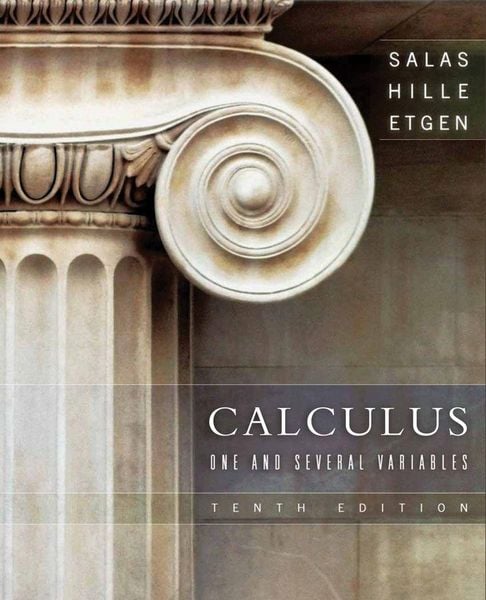
Produktbild: Calculus

Calculus One and Several Variables

477,99 €

inkl. gesetzl. MwSt., Versandkostenfrei


Beschreibung

Produktdetails

Einband

Gebundene Ausgabe

Erscheinungsdatum

29.11.2006

Verlag

John Wiley & Sons

Seitenzahl

1168

Maße (L/B/H)

27,5/22,5/4,2 cm

Gewicht

2202 g

Auflage

10th Edition

Sprache

Englisch

ISBN

978-0-471-69804-3

Beschreibung

Produktdetails

Einband

Gebundene Ausgabe

Erscheinungsdatum

29.11.2006

Verlag

John Wiley & Sons

Seitenzahl

1168

Maße (L/B/H)

27,5/22,5/4,2 cm

Gewicht

2202 g

Auflage

10th Edition

Sprache

Englisch

ISBN

978-0-471-69804-3

Herstelleradresse

Libri GmbH
Europaallee 1
36244 Bad Hersfeld
DE

Email: gpsr@libri.de

Kundinnen und Kunden meinen

0 Bewertungen

Informationen zu Bewertungen

Zur Abgabe einer Bewertung ist eine Anmeldung im Konto notwendig. Die Authentizität der Bewertungen wird von uns nicht überprüft. Wir behalten uns vor, Bewertungstexte, die unseren Richtlinien widersprechen, entsprechend zu kürzen oder zu löschen.

Die Bewertungen sind nach Format, Anzahl Sterne und Datum sortiert.

Verfassen Sie die erste Bewertung zu diesem Artikel

Helfen Sie anderen Kund*innen durch Ihre Meinung

Kundinnen und Kunden meinen

0 Bewertungen filtern

  • Produktbild: Calculus
  • Chapter 1. Precalculus Review.
    1.1 What is Calculus?
    1.2 Review of Elementary Mathematics.
    1.3 Review of Inequalities.
    1.4 Coordinate Plane; Analytic Geometry.
    1.5 Functions.
    1.6 The Elementary Functions.
    1.7 Combinations of Functions.
    1.8 A Note on Mathematical Proof; Mathematical Induction.
    Chapter 2. Limits and Continuity.
    2.1 The Limit Process (An Intuitive Introduction).
    2.2 Definition of Limit.
    2.3 Some Limit Theorems.
    2.4 Continuity.
    2.5 The Pinching Theorem; Trigonometric Limits.
    2.6 Two Basic Theorems.
    Chapter 3. The Derivative; The Process of Differentiation.
    3.1 The Derivative.
    3.2 Some Differentiation Formulas.
    3.3 The
    d/dx Notation; Derivatives of Higher Order.
    3.4 The Derivative as a Rate of Change.
    3.5 The Chain Rule.
    3.6 Differentiating the Trigonometric Functions.
    3.7 Implicit Differentiation; Rational Powers.
    Chapter 4. The Mean-Value Theorem; Applications of the First and Second Derivatives.
    4.1 The Mean-Value Theorem.
    4.2 Increasing and Decreasing Functions.
    4.3 Local Extreme Values.
    4.4 Endpoint Extreme Values; Absolute Extreme Values.
    4.5 Some Max-Min Problems.
    4.6 Concavity and Points of Inflection.
    4.7 Vertical and Horizontal Asymptotes; Vertical Tangents and Cusps.
    4.8 Some Curve Sketching.
    4.9 Velocity and Acceleration; Speed.
    4.10 Related Rates of Change Per Unit Time.
    4.11 Differentials.
    4.12 Newton-Raphson Approximations.
    Chapter 5. Integration.
    5.1 An Area Problem; A Speed-Distance Problem.
    5.2 The Definite Integral of a Continuous Function.
    5.3 The Function f(x) = Integral from a to x of f(t) dt.
    5.4 The Fundamental Theorem of Integral Calculus.
    5.5 Some Area Problems.
    5.6 Indefinite Integrals.
    5.7 Working Back from the Chain Rule; the
    u -Substitution.
    5.8 Additional Properties of the Definite Integral.
    5.9 Mean-Value Theorems for Integrals; Average Value of a Function.
    Chapter 6. Some Applications of the Integral.
    6.1 More on Area.
    6.2 Volume by Parallel Cross-Sections; Discs and Washers.
    6.3 Volume by the Shell Method.
    6.4 The Centroid of a Region; Pappus's Theorem on Volumes.
    6.5 The Notion of Work.
    6.6 Fluid Force.
    Chapter 7. The Transcendental Functions.
    7.1 One-to-One Functions; Inverse Functions.
    7.2 The Logarithm Function, Part I.
    7.3 The Logarithm Function, Part II.
    7.4 The Exponential Function.
    7.5 Arbitrary Powers; Other Bases.
    7.6 Exponential Growth and Decay.
    7.7 The Inverse Trigonometric Functions.
    7.8 The Hyperbolic Sine and Cosine.
    7.9 The Other Hyperbolic Functions.
    Chapter 8. Techniques of Integration.
    8.1 Integral Tables and Review.
    8.2 Integration by Parts.
    8.3 Powers and Products of Trigonometric Functions.
    8.4 Integrals Featuring Square Root of (a^2 - x^2), Square Root of (a^2 + x^2), and Square Root of (x^2 - a^2).
    8.5 Rational Functions; Partial Functions.
    8.6 Some Rationalizing Substitutions.
    8.7 Numerical Integration.
    Chapter 9. Differential Equations.
    9.1 First-Order Linear Equations.
    9.2 Integral Curves; Separable Equations.
    9.3 The Equation
    y +
    ay +
    by = 0.
    Chapter 10. The Conic Sections; Polar Coordinates; Parametric Equations.
    10.1 Geometry of Parabola, Ellipse, Hyperbola.
    10.2 Polar Coordinates.
    10.3 Graphing in Polar Coordinates.
    10.4 Area in Polar Coordinates.
    10.5 Curves Given Parametrically.
    10.6 Tangents to Curves Given Parametrically.
    10.7 Arc Length and Speed.
    10.8 The Area of a Surface of Revolution; Pappus's Theorem on Surface Area.
    Chapter 11. Sequences; Indeterminate Forms; Improper Integrals.
    11.1 The Least Upper Bound Axiom.
    11.2 Sequences of Real Numbers.
    11.3 The Limit of a Sequence.
    11.4 Some Important Limits.
    11.5 The Indeterminate Forms (0/0).
    11.6 The Indeterminate Form ( / ); Other Indeterminate Forms.
    11.7 Improper Integrals.
    Chapter 12. Infinite Series.
    12.1 Sigma Notation.
    12.2 Infinite Series.
    12.3 The Integral Test; Basic Comparison, Limit Comparison.
    12.4