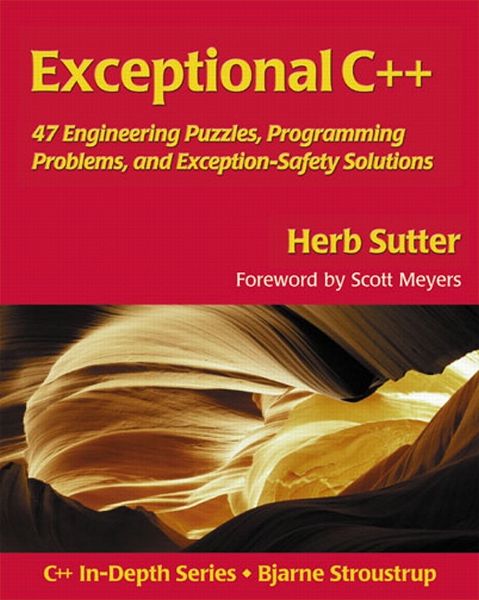
Exceptional C++ 47 Engineering Puzzles, Programming Problems, and Solutions
-
- Englisch ausgewählt
42,99 €
UVP
48,99 €
inkl. gesetzl. MwSt.,
Beschreibung
Produktdetails
Einband
Taschenbuch
Erscheinungsdatum
18.11.1999
Verlag
PearsonSeitenzahl
240
Maße (L/B/H)
23,7/18,7/1,7 cm
Gewicht
420 g
Auflage
1
Sprache
Englisch
ISBN
978-0-201-61562-3
Exceptional C++ shows by example how to go about sound software engineering in standard C++. Do you enjoy solving thorny C++ problems and puzzles? Do you relish writing robust and extensible code? Then take a few minutes and challenge yourself with some tough C++ design and programming problems.
The puzzles and problems in Exceptional C++ not only entertain, they will help you hone your skills to become the sharpest C++ programmer you can be. Many of these problems are culled from the famous Guru of the Week feature of the Internet newsgroup comp.lang.c++.moderated, expanded and updated to conform to the official ISO/ANSI C++ Standard.
Each problem is rated according to difficulty and is designed to illustrate subtle programming mistakes or design considerations. After you've had a chance to attempt a solution yourself, the book then dissects the code, illustrates what went wrong, and shows how the problem can be fixed. Covering a broad range of C++ topics, the problems and solutions address critical issues such as:
- Generic programming and how to write reusable templates
- Exception safety issues and techniques
- Robust class design and inheritance
- Compiler firewalls and the Pimpl Idiom
- Name lookup, namespaces, and the Interface Principle
- Memory management issues and techniques
- Traps, pitfalls, and anti-idioms
- Optimization
Try your skills against the C++ masters and come away with the insight and experience to create more efficient, effective, robust, and portable C++ code.
0201615622B04062001
Noch keine Bewertungen vorhanden
Verfassen Sie die erste Bewertung zu diesem Artikel
Helfen Sie anderen Kundinnen und Kunden durch Ihre Meinung.
Kurze Frage zu unserer Seite
Vielen Dank für Ihr Feedback
Wir nutzen Ihr Feedback, um unsere Produktseiten zu verbessern. Bitte haben Sie Verständnis, dass wir Ihnen keine Rückmeldung geben können. Falls Sie Kontakt mit uns aufnehmen möchten, können Sie sich aber gerne an unseren Kund*innenservice wenden.
zum Kundenservice