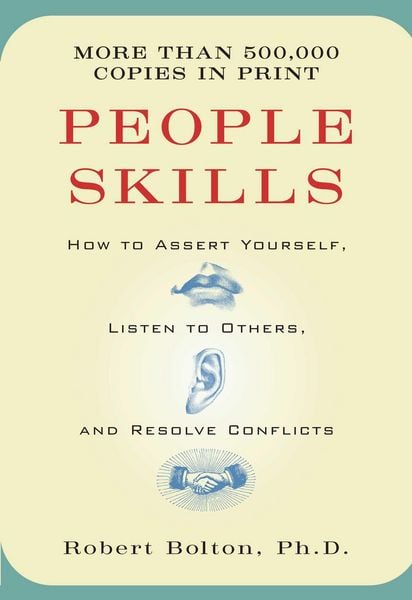
Produktbild: People Skills: How to Assert Yourself, Listen to Others, and Resolve Conflicts

People Skills: How to Assert Yourself, Listen to Others, and Resolve Conflicts How to Assert Yourself, Listen to Others, and Resolve Conflicts

16,99 €

inkl. gesetzl. MwSt., Versandkostenfrei


Beschreibung

Produktdetails

Einband

Taschenbuch

Erscheinungsdatum

01.06.1986

Verlag

GB

Seitenzahl

324

Maße (L/B/H)

20,5/14/2,2 cm

Gewicht

295 g

Sprache

Englisch

ISBN

978-0-671-62248-0

Beschreibung

Produktdetails

Einband

Taschenbuch

Erscheinungsdatum

01.06.1986

Verlag

GB

Seitenzahl

324

Maße (L/B/H)

20,5/14/2,2 cm

Gewicht

295 g

Sprache

Englisch

ISBN

978-0-671-62248-0

Herstelleradresse

Libri GmbH
Europaallee 1
36244 Bad Hersfeld
DE

Email: gpsr@libri.de

Kundinnen und Kunden meinen

0 Bewertungen

Informationen zu Bewertungen

Zur Abgabe einer Bewertung ist eine Anmeldung im Konto notwendig. Die Authentizität der Bewertungen wird von uns nicht überprüft. Wir behalten uns vor, Bewertungstexte, die unseren Richtlinien widersprechen, entsprechend zu kürzen oder zu löschen.

Die Bewertungen sind nach Format, Anzahl Sterne und Datum sortiert.

Verfassen Sie die erste Bewertung zu diesem Artikel

Helfen Sie anderen Kund*innen durch Ihre Meinung

Kundinnen und Kunden meinen

0 Bewertungen filtern

Die Leseprobe wird geladen.
  • Produktbild: People Skills: How to Assert Yourself, Listen to Others, and Resolve Conflicts

  • Contents

    Preface

    PART ONE

    Introduction

    CHAPTER ONE

    Skills for Bridging the Interpersonal Gap


    Communication: Humanity's Supreme Achievement

    The Ineffectiveness of Most Communication

    The Ache of Loneliness

    So Much Lost Love

    A Key to Success at Work

    A Life-or-Death Matter

    You Can Change

    You Will Change!

    Managing Your Resistance to Learning

    Five Sets of Skills

    Summary

    CHAPTER TWO

    Barriers to Communication


    Common Communication Spoilers

    Why Roadblocks Are High-Risk Responses

    Judging: the Major Roadblock

    Roadblock

    Sending Solutions Can Be a Problem!

    Avoiding the Other's Concerns

    Roadblock Number Thirteen

    Summary

    PART TWO

    Listening Skills

    CHAPTER THREE

    Listening Is More Than Merely Hearing


    The Importance of Listening

    Listening Defined

    Listening Skill Clusters

    Attending Skills

    Following Skills

    Summary

    CHAPTER FOUR

    Four Skills of Reflective Listening


    Reflective Responses Provide a Mirror to the Speaker

    Paraphrasing

    Reflecting Feelings

    Reflecting Meanings

    Summary

    CHAPTER FIVE

    Why Reflective Responses Work


    Style and Structure in Listening

    Six Peculiarities of Human Communication

    Skepticism Is Best Dissolved by Action

    Summary

    CHAPTER SIX

    Reading Body language


    The Importance of Body Language

    Nonverbals: The Language of Feelings

    The "Leakage" of Masked Feelings

    Guidelines for Reading Body Language

    Reflect the Feelings Back to the Sender

    A Clear But Confusing Language

    Summary

    CHAPTER SEVEN

    Improving Your Reflecting Skills


    Guidelines for Improved Listening

    Beyond Reflective Listening

    When to Listen Reflectively

    When Not to Listen Reflectively

    The Good News and the Bad News

    Summary

    PART THREE

    Assertion Skills

    CHAPTER EIGHT

    Three Approaches to Relationships


    Listening and Assertion: The Yin and Yang of Communication

    Methods for Developing Assertiveness

    The Need to Protect One's Personal Space

    Impacting

    The Submission-Assertion-Aggression Continuum

    Payoffs and Penalties of Three Ways of Relating

    Choose for Yourself

    Summary

    CHAPTER NINE

    Developing Three-Part Assertion Messages


    Verbal Assertion: The Third Option

    Three-Part Assertion Messages

    Effective and Ineffective Ways of Confrontation

    Writing Three-Part Assertion Messages

    A Voyage of Self-Discovery and Growth

    Summary

    CHAPTER TEN

    Handling the Push-Push Back Phenomenon


    Surprise Attack

    The Human Tendency to Be Defensive

    The Upward Spiral of Increasing Defensiveness

    A Six-Step Assertion Process

    Summary

    CHAPTER ELEVEN

    Increasing Your Assertive Options


    Many Varieties of Assertive Behavior

    "Natural" Assertions

    Self-Disclosure

    Descriptive Recognition

    Relationship Assertions

    Selective Inattention

    Withdrawal

    The Spectrum Response

    Options

    Natural and Logical Consequences

    Stop the Action; Accept the Feelings

    Say "No!,"

    Modify the Environment

    The Danger of Going Overboard

    The Aura of Assertiveness

    Summary

    PART FOUR

    Conflict Management Skills

    CHAPTER TWELVE

    Conflict Prevention and Control


    Conflict Is Unavoidable

    Conflict Is Disruptive and/or Destructive

    The Benefits of Conflict

    Realistic and Nonrealistic Conflict

    Personal Conflict Prevention and Control Methods

    Group/Organizational Prevention and Control Methods

    The Dangers of Conflict Prevention and Control

    Summary

    CHAPTER THIRTEEN

    Handling the Emotional Components of Conflict


    Focus on the Emotions First

    The Conflict Resolution Method

    The Conflict Resolution Method in Action

    Four Ways to Use the Conflict Resolution Method

    Preparation for the Encounter

    Evaluating the Conflict

    Expected Outcomes of the Conflict Resolution Method

    Summary

    CHAPTER FOURTEEN

    Collaborative Problem Solving: Seeking an Elegant Solution


    Three Kinds of Conflict

    Alternatives to Collaborative Problem Solving

    Seeking an Elegant Solution Through Collaborative Problem Solving

    Six Steps of the Collaborative Problem-Solving Method

    What This Problem-Solving Method Communicates

    Collaborative Problem-Solving in Action

    Handling the Crucial Preliminaries

    What Do I Do When Collaborative Problem Solving Doesn't Work?

    Applications of Collaborative Problem Solving

    Summary

    CHAPTER FIFTEEN

    Three Essentials for Effective Communication


    In Communication, Skills Alone Are Insufficient

    Genuineness

    Non-possessive Love

    Empathy

    Implementation of the Core Attitudes

    AFTERWORD

    Four Steps to Improved Communication


    A Quantified Commitment to Use the Skills

    Select Appropriate Situations

    Undaunted by Occasional Failure

    Prepare Others for the Change

    Skill Training

    Notes

    Index