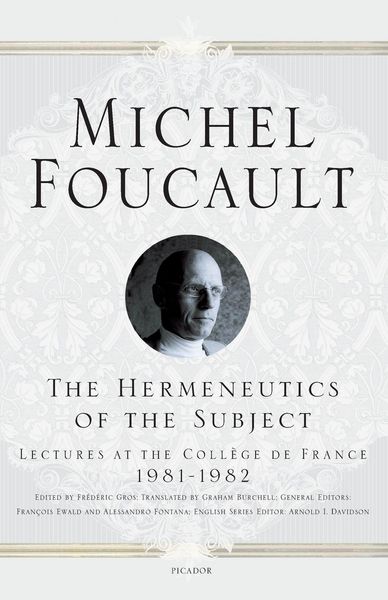
Foreword: François Ewald and Alessandro Fontana
Introduction: Arnold I. Davidson
Translator's Note
One: 6 January 1982: First Hour
Reminder of the general problematic: subjectivity and truth. - New theoretical point of departure: the care of the self. - Interpretations of the Delphic precept "know yourself." - Socrates as man of care of the self: analysis of three extracts from The Apology. - Care of the self as precept of ancient philosophical and moral life. - Care of the self in the first Christian texts. - Care of the self as general standpoint, relationship to the self and set practices. - Reasons for the modern elimination of care of the self in favor of self-knowledge: modern morality; the Cartesian moment. - The Gnostic exception. - Philosophy and spirituality.
Two: 6 January 1982: Second Hour
Presence of conflicting requirements of spirituality: science and theology before Descartes; classical and modern philosophy; Marxism and psychoanalysis. - Analysis of a Lacedaemonian maxim: the care of the self as statutory privilege. - First analysis of Plato's Alcibiades. - Alcibiades' political expectations and Socrates' intervention. - The education of Alcibiades compared with that of young Spartans and Persian Princes. - Contextualization of the first appearance of the requirement of care of the self in Alcibiades: political expectation and pedagogical deficiency; critical age; absence of political knowledge (savior). - The indeterminate nature of the self and its political implications.
Three: 13 January 1982: First Hour
Contexts of appearance of the Socratic requirement of care of the self: the political ability of young men from good families; the (academic and erotic) limits of Athenian pedagogy; the ignorance of which one is unaware. - Practices of transformation of the self in archaic Greece. - Preparation for dreaming and testing techniques in Pythagoreanism. - Techniques of the self in Plato's Phaedo. - Their importance in Hellenistic philosophy. - The question of the being of the self one must take care of in the Abcibiades. - Definition of the self as soul. - Definition of the soul as subject of action. - The care of the self in relation to dietetics, economics, and erotics. - The need for a master of the care.
Four: 13 January 1982: Second Hour
Determination of care of the self as self-knowledge in the Alcibiades: conflict between the two requirements in Plato's work. - The metaphor of the eye: source of vision and divine element. - End of the dialogue: the concern for justice. - Problems of the dialogue's authenticity and its general relation to Platonism. - Care of the self in the Alcibiades in its relation to political action, pedagogy, and the erotics of boys. - Anticipation in the Alcibiades of the fate of care of the self in Platonism. - Neo-Platonist descendants of Alcibiades. - The paradox of Platonism.
Five: 20 January 1982: First Hour
The care of the self from Alcibiades to the first two centuries A.D.: general evolution. - Lexical study around the epimeleia. - A constellation of expressions. - Generalizations of the care of the self: that it is coextensive with the whole of life. - Reading of texts: Epicurus, Musonius Rufus, Seneca, Epictetus, Philo of Alexandria, Lucian. - Ethical consequences of this generalization: care of self as axis of training and correction; convergence of medical and philosophical activity (common concepts and therapeutic objective).
Six: 20 January 1982: Second Hour
The privileged status of old age (positive goal and ideal point of existence). - Generalization of the principle of care of the self (with universal vocation) and connection with sectarian phenomena. - Social spectrum involved: from the popular religious milieu to Roman aristocratic networks of friendship. - Two other examples: Epicurean circles and the Therapeutae group. - Rejection of the paradigm of the law. - Structural principle of double articulation: universality of appeal and rarity of election. - The form of salvation.
Seven: 27 January 1982: First Hour
Reminder of the general characteristics of practices of the self in the first and second centuries. - The question of the Other: three types of mastership in Plato's dialogues. - Hellenistic and Roman period: the mastership of subjectivation. - Analysis of stultitia in Seneca. - The figure of the philosopher as master of subjectivation. - The Hellenic institutional form: the Epicurean school and the Stoic meeting. - The Roman institutional form: the private counselor of life.
Eight: 27 January 1982: Second Hour
The professional philosopher of the first and second centuries and his political choices. - Euphrates in Pliny's Letters: an anti-Cynic. - Philosophy as social practice outside the school: the example of Seneca. - The correspondence between Fronto and Marcus Aurelius: systematization of dietetics, economics, and erotics in the guidance of existence. - Examination of conscience.
Nine: 3 February 1982: First Hour
Neo-Platonist commentaries on the Alcibiades: Proclus and Olympiodorus. - The Neo-Platonist separation of the political and the cathartic. - Study of the link between care of the self and care for others in Plato: purpose, reciprocity, and essential implication. - Situation in the first and second centuries: self finalization of the self. - Consequences: a philosophical art of living according to the principle of conversion; the development of a culture of the self. - Religious meaning of the idea of salvation. - Meanings of soteria and of salus.
Ten: 3 February 1982: Second Hour
Questions from the public concerning subjectivity and truth. - Care of the self and care of others: a reversal of relationships. - The Epicurean conception of friendship. - The Stoic conception of man as a communal being. - The false exception of the Prince.
Eleven: 10 February 1982: First Hour
Reminder of the double opening up of care of the self with regard to pedagogy and political activity. - The metaphors of the self-finalization of the self. - The invention of a practical schema: conversion to the self. - Platonic epistrophe and its relation to conversion to the self. - Christian metanoia and its relation to conversion to the self. - The classical Greek meaning of metanoia. - Defense of a third way, between Platonic epistrophe curiosity. - Athletic concentration.
Twelve: 10 February 1982: Second Hour
General theoretical framework: veridiction and subjectivation. - Knowledge (savoir) of the world and practice of the self in the Cynics: the example of Demetrius. - Description of useful knowledge (connaissances) in Demetrius. - Ethopoetic knowledge (savoir). - Physiological knowledge (connaissance) in Epicurus. - The parrhesia of Epicurean physiologists.
Thirteen 17 February 1982: First Hour
Conversion to self as successfully accomplished form of care of the self. - The metaphor of navigation. - The pilot's technique as paradigm of governmentality. - The idea of an ethic of return to the self: Christian refusal and abortive attempts of the modem epoch. - Conversion to self without the principle of a knowledge of the self. - Two eclipsing models: Platonic recollection and Christian exegesis. - The hidden model: Hellenistic conversion to self. - Knowledge of the world and self-knowledge in Stoic thought. - The example of Seneca: criticism of culture in Seneca's Letters to Lucilius; the movement of the gaze in Natural Questions.
Fourteen: 17 February 1982: Second Hour
End of the analysis of the preface to the third part of Natural Questions. - Study of the preface to the first part. - The movement of the knowing soul in Seneca: description; general characteristic; after-effect. - Conclusions: essential implication of knowledge of the self and knowledge (connaissance) of the world; liberating effect of knowledge (savoir) of the world; irreducibility to the Platonic model. - The view from above.
Fifteen 24 February 1982: First Hour
The spiritual of knowledge (savoir) in Marcus Aurelius: the work of analyzing representations; defining and describing; seeing and naming; evaluating and testing; gaining access to the grandeur of the soul. - Examples of spiritual exercises in Epictetus. - Christian exegesis and Stoic analysis of representations. - Return to Marcus Aurelius: exercises of the decomposition of the object in time; exercises of the analysis of the object into its material components; exercises of the reductive description of the object. - Conceptual structure of spiritual knowledge (savior). - Faust.
Sixteen: 24 February 1982: Second Hour
Virtue and its relation to askesis. - The absence of reference to objective knowledge of the subject in mathesis. - The absence of reference to law in askesis. - Objective and means of askesis. - Characterization of the paraskeue: discourse-action. - Mode of being of these discourses: the prokheiron. - Askesis as practice of the incorporation of truth-telling in the subject.
Seventeen: 3 march 1982: First Hour
Conceptual separation of Christian from philosophical ascesis. - Practices of subjectivation: the importance of listening exercises. - The ambiguous nature of listening, between passivity and activity: Plutarch's Peri tou akouein; Seneca's letter CVIII; Epictetus' discourse II.23. - Listening in the absence of tekhne. - The ascetic rules of listening: silence; precise non-verbal communication, and general demeanor of the good listener; attention (attachment to the referent of the discourse and subjectivation of the discourse through immediate memorization).
Eighteen: 3 March 1982: Second Hour
The practical rules of correct listening and its assigned end: mediation. - The ancient meaning of melete / meditation as exercise performed by thought on the subject. - Writing as physical exercise of the incorporation of discourse. - Correspondence as circle of subjectivation / veridiction. - The art of speaking in Christian spirituality: the forms of the spiritual director's true discourse; the confession (l'aveu) of the person being directed; telling the truth about oneself as condition of salvation. - The Greco-Roman practice of guidance: constitution of a subject of truth through the attentive silence of the person being guided; the obligation of parrhesia in the master's discourse.
Nineteen: 10 March 1982: First Hour
Parrhesia as ethical attitude and technical procedure in the master's discourse. - The adversaries of parrhesia: flattery and rhetoric. - The importance of the themes of flattery and anger in the new system of power. - An example: the preface to the fourth book of Seneca's Natural Questions (exercise of power, relationship to oneself, dangers of flattery). - The Prince's fragile wisdom. - The points of opposition between parrhesia and rhetoric: the division between truth and lie; the status of technique; the effects of subjectivation. - Positive conceptualization of parrhesia: the Peri parrhesias of Philodemus.
Twenty: 10 March 1982: Second Hour
Continuation of the analysis of parrhesia: Galen's On the Passions and Errors of the Soul. - Characteristics of libertas according to Seneca: refusal of popular and bombastic eloquence; transparency and rigor; incorporation of useful discourses; an art of conjecture. - Structure of libertas: perfect transmission of thought and the subject's commitment in his discourse. - Pedagogy and psychagogy: relationship and evolution in Greco-Roman philosophy and in Christianity.
Twenty-one: 17 March 1982: First Hour
Supplementary remarks on the meaning of the Pythagorean rules of silence. - Defintion of "ascetics." -Appraisal of the historical ethnology of Greek ascetics. - Reminder of the Alcibiades: withdrawal of ascetics into self-knowledge as mirror of the divine. - Ascetics of the first and second centuries: a double decoupling (with regard to the principle of self-knowledge and with regard to the principle of recognition in the divine). - Explanation of the Christian fate of Hellenistic and Roman ascetics: rejection of the gnosis. - Life's work. - Techniques of existence, exposition of two levels: mental exercise; training in real life. - Exercises of abstinence: the athletic body in Plato and the hardy body in Musonius Rufus. - The practice of tests and its characteristics.
Twenty-two: 17 March 1982: Second Hour
Life itself as a test. - Seneca's De Providentia: the test of existing and its discriminating function. - Epictetus and the philosophy-scout. - The transfiguration of evils: from old Stoicism to Epictetus. - The test in Greek tragedy. - Comments on the indifference of the Hellenistic preparation of existence to Christian dogmas on immortality and salvation. - The art of living and care of the self: a reversal of relationship. - Sign of this reversal: the theme of virginity in the Greek novel.
Twenty-three: 24 March 1982: First Hour
Reminder of results of previous lecture. - The grasp of self by the self in Plato's Alcibiades and in the philosophical texts of the first and second centuries A.D.: comparative study. - The three major forms of Western reflexivity: recollection, mediation, and method. - The illusion of contemporary Western philosophical historiography. - The two meditative series: the test of the content of truth and the test of the subject of truth. - The Greek disqualification of projection into the future: the primacy of memory; the ontological-ethical void of the future. - The Stoic exercise of presuming of evils: the possible, the certain, and the imminent. - Presumption of evils as sealing off the future and reduction of reality.
Twenty-four: 24 March 1982: Second Hour
The meditation on death: a sagittal and retrospective gaze. - Examination of conscience in Seneca and Epictetus. - Philosophical ascesis. - Bio-technique, test of the self, objectification of the world: the challenges of Western philosophy.
Course Summary
Course Context: Frédéric Gros
Index of Names
Index of Notions and Concepts