
Foundations of Human Sociality Economic Experiments and Ethnographic Evidence from Fifteen Small-Scale Societies
-
- Hardcover ausgewählt
- Taschenbuch
-
Sprache:Englisch
278,99 €
inkl. gesetzl. MwSt.,
Beschreibung
Produktdetails
Einband
Gebundene Ausgabe
Erscheinungsdatum
08.04.2004
Abbildungen
numerous line drawings and tables
Herausgeber
Henrich Joseph + weitereVerlag
Oxford AcademicSeitenzahl
472
Maße (L/B/H)
24/16,1/3 cm
Gewicht
869 g
Sprache
Englisch
ISBN
978-0-19-926204-5
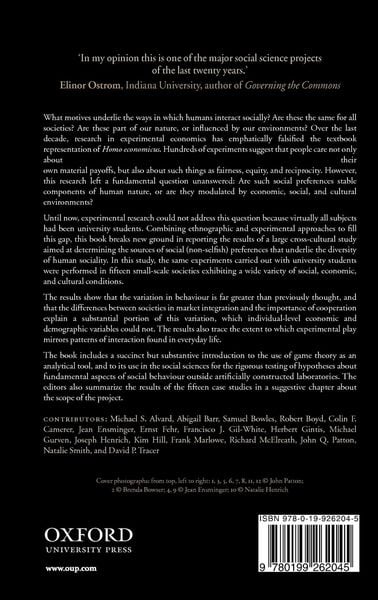
What motives underlie the ways humans interact socially? Are these the same for all societies? Are these part of our nature, or influenced by our environments? Over the last decade, research in experimental economics has emphatically falsified the textbook representation of Homo economicus. Hundreds of experiments suggest that people care not only about their own material payoffs, but also about such things as fairness, equity, and reciprocity. However, this research left fundamental questions unanswered: Are such social preferences stable components of human nature, or are they modulated by economic, social, and cultural environments? Until now, experimental research could not address this question because virtually all subjects had been university students. Combining ethnographic and experimental approaches to fill this gap, this book breaks new ground in reporting the results of a large cross-cultural study aimed at determining the sources of social (non-selfish) preferences that underlie the diversity of human sociality. In this study, the same experiments carried out with university students were performed in fifteen small-scale societies exhibiting a wide variety of social, economic, and cultural conditions. The results show that the variation in behaviour is far greater than previously thought, and that the differences between societies in market integration and the importance of cooperation explain a substantial portion of this variation, which individual-level economic and demographic variables could not. The results also trace the extent to which experimental play mirrors patterns of interaction found in everyday life. The book includes a succinct but substantive introduction to the use of game theory as an analytical tool, and to its use in the social sciences for the rigorous testing of hypotheses about fundamental aspects of social behaviour outside artificially constructed laboratories. The editors also summarize the results of the fifteen case studies in a suggestive chapter about the scope of the project.
Noch keine Bewertungen vorhanden
Verfassen Sie die erste Bewertung zu diesem Artikel
Helfen Sie anderen Kundinnen und Kunden durch Ihre Meinung.
Kurze Frage zu unserer Seite
Vielen Dank für Ihr Feedback
Wir nutzen Ihr Feedback, um unsere Produktseiten zu verbessern. Bitte haben Sie Verständnis, dass wir Ihnen keine Rückmeldung geben können. Falls Sie Kontakt mit uns aufnehmen möchten, können Sie sich aber gerne an unseren Kund*innenservice wenden.
zum Kundenservice