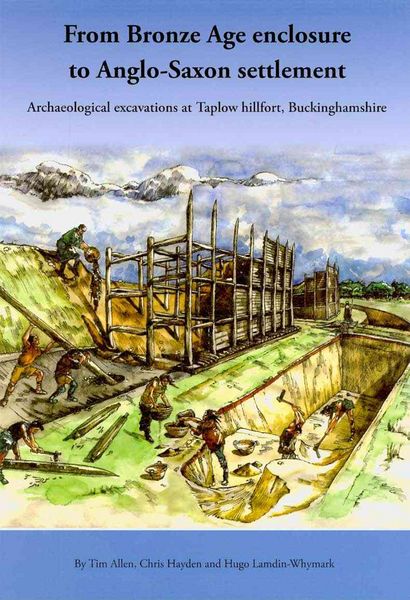
From Bronze Age Enclosure to Saxon Settlement: Archaeological Excavations at Taplow Hillfort, Buckinghamshire, 1999-2005
-
- Englisch ausgewählt
28,99 €
inkl. gesetzl. MwSt.,
Beschreibung
Produktdetails
Einband
Gebundene Ausgabe
Erscheinungsdatum
01.12.2009
Verlag
Oxford University School of ArchaeologySeitenzahl
222
Maße (L/B/H)
30,8/21,7/2 cm
Gewicht
1198 g
Sprache
Englisch
ISBN
978-1-905905-09-6
Recent excavations at Taplow Court have revealed a long sequence of activity stretching from the Mesolithic to the Anglo-Saxon period. Mesolithic struck flints and charred hazelnuts, and early Neolithic flints, were found in a small number of tree-throw holes. A group of inter-cutting hollows or shallow pits of Early Bronze Age date included sherds of Collared Urn and worked flint, rare evidence of domestic activity of this period. There were also finds of the middle Bronze Age, although no features of that phase were confirmed. In the late Bronze Age, a defensible hilltop enclosure about 1.2 ha was constructed on the site. The enclosure, probably first established in the 11th century cal BC, had a complex sequence of defences including a pair of post-rows possibly indicating a timber palisade backed by a raised walkway, a trench-built palisade, a ditch and rampart and further posthole-lines outside the ditch. Only a limited area of the interior was examined, but includes a series of parallel fence lines, one probable roundhouse and up to five possible four-post structures, with occupation extending into the 9th century cal BC. Following a probable hiatus in activity represented by a standstill deposit in the upper part of the ditch, a larger U-profiled hillfort ditch was constructed in the Early Iron Age, probably in the 5th century cal BC, the spoil being dumped over the previous ditch to form a timber-laced rampart, which was soon after destroyed in places by fire. The remains of the charred timbers within the rampart have revealed some details of its construction. The ditch however remained open into the Saxon period, and another internal roundhouse may be Middle Iron Age. A third and even larger V-profiled ditch was found outside the second ditch. Although the date of construction of this outer ditch is uncertain, it too remained open into the Saxon period, suggesting that the hillfort had many ditches its later stages. Price is approximate.
Noch keine Bewertungen vorhanden
Verfassen Sie die erste Bewertung zu diesem Artikel
Helfen Sie anderen Kundinnen und Kunden durch Ihre Meinung.
Kurze Frage zu unserer Seite
Vielen Dank für Ihr Feedback
Wir nutzen Ihr Feedback, um unsere Produktseiten zu verbessern. Bitte haben Sie Verständnis, dass wir Ihnen keine Rückmeldung geben können. Falls Sie Kontakt mit uns aufnehmen möchten, können Sie sich aber gerne an unseren Kund*innenservice wenden.
zum Kundenservice