• Produktbild: Gendering the Knowledge Economy
  • Produktbild: Gendering the Knowledge Economy

Gendering the Knowledge Economy Comparative Perspectives

92,99 €

inkl. gesetzl. MwSt., Versandkostenfrei


Beschreibung

Produktdetails

Einband

Gebundene Ausgabe

Erscheinungsdatum

06.12.2006

Herausgeber

S. Walby + weitere

Verlag

Palgrave Macmillan UK

Seitenzahl

322

Maße (L/B/H)

21,6/14/2,2 cm

Gewicht

581 g

Auflage

2007

Sprache

Englisch

ISBN

978-1-4039-9457-8

Beschreibung

Rezension

'...the book is meticulously detailed, providing empirically grounded analysis, and will appeal to a specialist audience of researchers and policy makers with a particular interest in gender, work/employment, economics and social policy.'


- Carrie Purcell, Sociological Research Online

Portrait

SUSAN DURBIN Senior Lecturer in Human Resource Management, Bristol Business School and member of the Employment Studies Research Unit (ESRU), University of the West of England, UK
HEIDI GOTTFRIED Professor of Sociology and Director of the MA in Industrial Relations Program, Wayne State University, USA
KARIN GOTTSCHALL Professor of Sociology, Head of the Gender Policy in the Welfare State Unit at the Centre for Social Policy Research and Director of the Graduate School of Social Sciences, University of Bremen, Germany
URSULA HOLTGREWE Senior Researcher at The Working Life Research Centre (FORBA) and member of the co-ordinating team of the Global Call Center Industry Project, Austria
DANIELE KROOS Junior Research Fellow, Graduate School of Scoial Sciences, University of Bremen, Germany
ILSE LENZ Professor of Scoial Structure and Gender Studies, Ruhr University Bochum, Germany
MAKIKO NISHIKAWA Associate Professor, Faculty of Business Administration, Hosei University and Hosei Management School, Japan
MARI OSAWA Professor of Social Policy at the Institute of Social Science, University of Tokyo and member of the Science Council, Japan
GLENDA S. ROBERTS Professor, Graduate School of Asia-Pacific Studies, Waseda University, Tokyo, Japan
DIANE PERRONS Director of the Gender Institute, London School of Economics and Political Science, UK
KAREN SHIRE Professor of Comparative Sociology, Institute of Sociology and Institute of East Asian Studies, University of Duisburg-Essen, Germany
KAZUKO TANAKA Professor of Sociology, International Studies Division, Director of the Center for Gender Studies and Coordinator of the Program in Gender and Sexuality Studies, International Christian University, Japan
SYLVIA WALBY Professor, Department of Sociology, University of Lancaster, UK

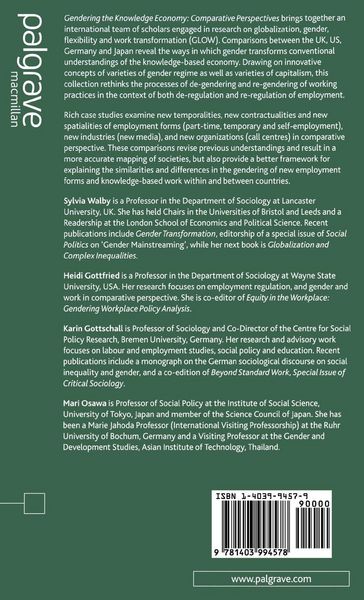
Produktdetails

Einband

Gebundene Ausgabe

Erscheinungsdatum

06.12.2006

Herausgeber

Verlag

Palgrave Macmillan UK

Seitenzahl

322

Maße (L/B/H)

21,6/14/2,2 cm

Gewicht

581 g

Auflage

2007

Sprache

Englisch

ISBN

978-1-4039-9457-8

Herstelleradresse

Libri GmbH
Europaallee 1
36244 Bad Hersfeld
DE

Email: GPSR Kontakt

Noch keine Bewertungen vorhanden

Verfassen Sie die erste Bewertung zu diesem Artikel

Helfen Sie anderen Kundinnen und Kunden durch Ihre Meinung.

Kundinnen und Kunden meinen

Bewertungen (0)

  • Produktbild: Gendering the Knowledge Economy
  • Produktbild: Gendering the Knowledge Economy
  • List of figures List of tables Preface Notes on Editors PART ONE: RE-CONCEPTUALIZING THE KNOWLEDGE ECONOMY, GENDER AND REGULATION Introduction: Theorizing the Gendering of the New Economy: Comparative Approaches; S.Walby Gender and the Conceptualization of the Knowledge Economy in Comparison; K.Shire PART TWO: COMPARATIVE REGULATION Comparative Livelihood Security Systems from a Gender Perspective, with a Focus on Japan; M.Osawa Varieties of Gender Regimes and Regulating Gender Equality at Work in the Global Context; I.Lenz Similar Outcomes, Different Paths: The Cross-National Transfer of Gendered Regulations of Employment; G.S.Roberts PART THREE: GENDERING NEW EMPLOYMENT FORMS Self-Employment in Comparative Perspective: General Trends and the Case of New Media; K.Gottschall & D.Kroos Living and Working in the New Economy: New Opportunities and Old Social Divisions in the Cases of the New Media and Carework; D.Perrons Are Care Workers Knowledge Workers?; M.Nishikawa & K.Tanaka Who Gets to be a Knowledge Worker? The Case of UK Call Centres; S.Durbin Restructuring Gendered Flexibility in Organizations: A Comparative Analysis of Call Centres in Germany; U.Holtgrewe Appendix I Bibliography