• Produktbild: Psychiatric Power
  • Produktbild: Psychiatric Power

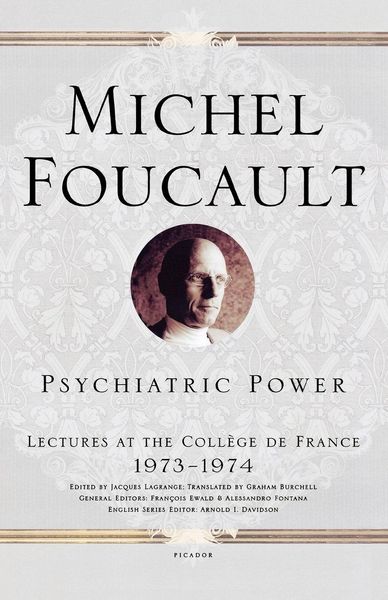
Psychiatric Power Lectures at the College De France, 1973--1974

24,99 €

inkl. gesetzl. MwSt., Versandkostenfrei


Beschreibung

Produktdetails

Einband

Taschenbuch

Erscheinungsdatum

24.06.2008

Verlag

St. Martins Press-3PL

Seitenzahl

412

Maße (L/B/H)

21,6/14/2,5 cm

Gewicht

579 g

Sprache

Englisch

ISBN

978-0-312-20331-3

Beschreibung

Produktdetails

Einband

Taschenbuch

Erscheinungsdatum

24.06.2008

Verlag

St. Martins Press-3PL

Seitenzahl

412

Maße (L/B/H)

21,6/14/2,5 cm

Gewicht

579 g

Sprache

Englisch

ISBN

978-0-312-20331-3

Herstelleradresse

Libri GmbH
Europaallee 1
36244 Bad Hersfeld
DE

Email: gpsr@libri.de

Kundinnen und Kunden meinen

0 Bewertungen

Informationen zu Bewertungen

Zur Abgabe einer Bewertung ist eine Anmeldung im Konto notwendig. Die Authentizität der Bewertungen wird von uns nicht überprüft. Wir behalten uns vor, Bewertungstexte, die unseren Richtlinien widersprechen, entsprechend zu kürzen oder zu löschen.

Die Bewertungen sind nach Format, Anzahl Sterne und Datum sortiert.

Verfassen Sie die erste Bewertung zu diesem Artikel

Helfen Sie anderen Kund*innen durch Ihre Meinung

Kundinnen und Kunden meinen

0 Bewertungen filtern

  • Produktbild: Psychiatric Power
  • Produktbild: Psychiatric Power
  • Foreword: François Ewald and Alessandro Montana

    Introduction: Arnold I. Davidson

    Translator's Note

    One: 7 November 1973
    The space of the asylum and disciplinary order. - Therapeutic process and "moral treatment."- Scenes of curing. - Changes made by the course from the approach of Histoire de la folie; 1. From an analysis of "representations" to an "analytics of power"; 2. From "violence" to the "microphysics of power"; 3. From "institutional regularities" to the "arrangements" of power.

    Two: 14 November 1973
    Scene of a cure: George III. From the "macrophysics of sovereignty" to the "microphysics of disciplinary power." The new figure of the madman. - Little encyclopedia of scenes of cures. - The practice of hypnosis and hysteria. - The psychoanalytic scene; the antipsychiatric scene. - Mary Barnes at Kingsley Hall. - Manipulation of madness and stratagem of truth: Mason Cox.

    Three: 21 November 1973
    Genealogy of "disciplinary power." The "power of sovereignty." The subject-function in disciplinary power and in the power of sovereignty. - Forms of disciplinary power: army, police, apprenticeship, workshop, school. -Disciplinary power as "normalizing agency." - Technology of disciplinary power and constitution of the "individual." - Emergence of the human sciences.

    Four: 28 November 1973
    Elements for a history of disciplinary apparatuses: religious communities in the Middle Ages; pedagogical colonization of youth; the Jesuit missions to Paraguay; the army; workshops; workers' cities. - The formalization of these apparatuses in Jeremy Bentham's model of the Panopticon. - The family institution and emergence of the Psy-function.

    Five: 5 December 1973
    The asylum and the family. From interdiction to confinement. The break between the asylum and the family. - The asylum; a curing machine. - Typology of "corporal apparatuses (appareils corporels)". - The madman and the child. - Clinics (maisons de santé). - Disciplinary apparatuses and family power.

    Six: 12 December 1973
    Constitution of the child as target of psychiatric intervention. - A family-asylum utopia: the Clermont-en-Oise asylum. - From psychiatry as "ambiguous master" of reality and truth in proto-psychiatric practices to psychiatry as "agent of intensification" of reality. - Psychiatric power and discourse of truth. - The problem of simulation and the insurrection of the hysterics. - The question of the birth of psychoanalysis.

    Seven: 19 December 1973
    Psychiatric power. - A treatment by François Leuret and its strategic elements: 1-creating an imbalance of power; 2-the ruse of language; 3-the management of needs; 4-the statement of truth. - The pleasure of illness. - The asylum apparatus (dispositif).

    Eight: 9 January 1974
    Psychiatric power and the practice of "direction". - The game of "reality" in the asylum. - The asylum, a medically demarcated space and the question of its medical or administrative direction. - The tokens of psychiatric knowledge: ( a ) the technique of questioning; ( b ) the interplay of medication and punishment; ( c ) the clinical presentation. -Asylum "microphysics of power." - Emergence of the Psy-function and of neuropathology. - The triple destiny of psychiatric power.

    Nine: 16 January 1974
    The modes of generalization of psychiatric power and the psychiatrization of childhood. - 1. The theoretical specification of idiocy. The criterion of development. - Emergence of a psychopathology of idiocy and mental retardation. - Édouard Seguin: instinct and abnormality. - 2. The institutional annexation of idiocy by psychiatric power. - T he "moral treatment" of idiots: Seguin. - The process of confinement and the stigmatization of the dangerousness of idiots. - Recourse to the notion of degeneration.

    Ten: 23 January 1974
    Psychiatric power and the question of truth: questioning and confession; magnetism and hypnosis; drugs. - Elements for a history of truth: 1. The truth-event and its forms: judicial, alchemical and medical practices. - Transition to a technology of demonstrative truth. Its elements: ( a ) procedures of inquiry; ( b ) institution of a subject of knowledge; ( c ) ruling out the crisis in medicine and psychiatry and its supports: the disciplinary space of the asylum, recourse to pathological anatomy; relationships between madness and crime. - Psychiatric power and hysterical resistance.

    Eleven: 30 January 1974
    The problem of diagnosis in medicine and psychiatry. - The place of the body in psychiatric nosology: the model of general paralysis. - The fate of the notion of crisis in medicine and psychiatry. - The test of reality in psychiatry and its forms: 1. Psychiatric questioning (l'interrogatoire) and the confession. The ritual of clinical presentation. Note on "pathological heredity" and degeneration. - 2. Drugs. Moreau de Tours and hasish. Madness and dreams. - 3. Magnetism and hypnosis. The discovery of the "neurological body."

    Twelve: 6 February 1974
    The emergence of the neurological body: Broca and Duchenne de Boulogne. - Illnesses of differential diagnosis and illnesses of absolute diagnosis. - The model of "general paralysis" and the neuroses. - The battle of hysteria: 1. The organization of a "symptomatological scenario." - 2. The maneuver of the "functional mannequin" and hypnosis. The question of simulation. - 3. Neurosis and trauma. The irruption of the sexual body.

    Course Summary

    Course Context

    Index of Names

    Index of Notions

    Index of Places