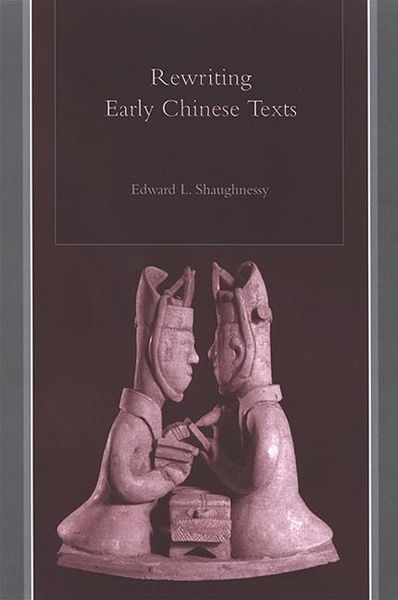
Rewriting Early Chinese Texts
-
- Hardcover
- Taschenbuch ausgewählt
- eBook
-
Sprache:Englisch
39,99 €
inkl. gesetzl. MwSt.,
Beschreibung
Produktdetails
Einband
Taschenbuch
Erscheinungsdatum
24.02.2006
Verlag
Ingram Publishers ServicesSeitenzahl
287
Maße (L/B/H)
22,9/15,4/1,8 cm
Gewicht
408 g
Sprache
Englisch
ISBN
978-0-7914-6644-5
Explores the rewriting of early Chinese texts in the wake of new archaeological evidence.
Rewriting Early Chinese Texts examines the problems of reconstituting and editing ancient manuscripts that will revise-indeed "rewrite"-Chinese history. It is now generally recognized that the extensive archaeological discoveries made in China over the last three decades necessitate such a rewriting and will keep an army of scholars busy for years to come. However, this is by no means the first time China's historical record has needed rewriting. In this book, author Edward L. Shaughnessy explores the issues involved in editing manuscripts, rewriting them, both today and in the past.
The book begins with a discussion of the difficulties encountered by modern archaeologists and paleographers working with manuscripts discovered in ancient tombs. The challenges are considerable: these texts are usually written in archaic script on bamboo strips and are typically fragmentary and in disarray. It is not surprising that their new editions often meet with criticism from other scholars. Shaughnessy then moves back in time to consider efforts to reconstitute similar bamboo-strip manuscripts found in the late third century in a tomb in Jixian, Henan. He shows that editors at the time encountered many of the same difficulties faced by modern archaeologists and paleographers, and that the first editions produced by a court-appointed team of editors quickly prompted criticism from other scholars of the time. Shaughnessy concludes with a detailed study of the editing of one of these texts, the Bamboo Annals (Zhushu jinian), arguably the most important manuscript ever discovered in China. Showing how at least two different, competing editions of this text were produced by different editors, and how the differences between them led later scholars to regard the original edition-the only one still extant-as a forgery, Shaughnessy argues for this text's place in the rewriting of early Chinese history.
Kundinnen und Kunden meinen
Verfassen Sie die erste Bewertung zu diesem Artikel
Helfen Sie anderen Kund*innen durch Ihre Meinung
Kurze Frage zu unserer Seite
Vielen Dank für Ihr Feedback
Wir nutzen Ihr Feedback, um unsere Produktseiten zu verbessern. Bitte haben Sie Verständnis, dass wir Ihnen keine Rückmeldung geben können. Falls Sie Kontakt mit uns aufnehmen möchten, können Sie sich aber gerne an unseren Kund*innenservice wenden.
zum Kundenservice