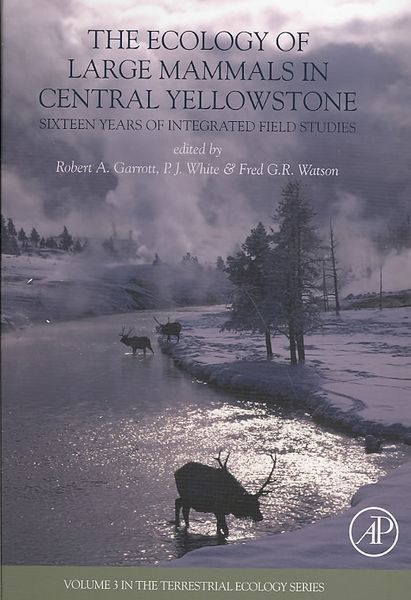
Produktbild: The Ecology of Large Mammals in Central Yellowstone
- 29%

The Ecology of Large Mammals in Central Yellowstone Sixteen Years of Integrated Field Studies

29% sparen

83,99 € UVP 119,50 €

inkl. gesetzl. MwSt., Versandkostenfrei


Beschreibung

Produktdetails

Einband

Gebundene Ausgabe

Erscheinungsdatum

01.10.2008

Herausgeber

Robert A. Garrott + weitere

Verlag

Elsevier Science & Technology

Seitenzahl

712

Maße (L/B/H)

26,7/19,5/4,5 cm

Gewicht

1880 g

Sprache

Englisch

ISBN

978-0-12-374174-5

Beschreibung

Rezension

"A comprehensive synthesis of extensive and interrelated research conducted to understand the influences of climate and landscape on the dynamics of the mammals in the interior of the world's first and most famous national park.. Contributing authors include detailed descriptions of the central Yellowstone environment and present results of intensive field sampling, remote sensing, and modeling of important ecosystem components. These results are merged with extensive demographic, spatial, and behavioral databases from the resident elk, migratory bison, and reintroduced wolf populations to address population-level ecological process."--Yellowstone Science

Produktdetails

Einband

Gebundene Ausgabe

Erscheinungsdatum

01.10.2008

Herausgeber

Verlag

Elsevier Science & Technology

Seitenzahl

712

Maße (L/B/H)

26,7/19,5/4,5 cm

Gewicht

1880 g

Sprache

Englisch

ISBN

978-0-12-374174-5

Herstelleradresse

Libri GmbH
Europaallee 1
36244 Bad Hersfeld
DE

Email: gpsr@libri.de

Noch keine Bewertungen vorhanden

Verfassen Sie die erste Bewertung zu diesem Artikel

Helfen Sie anderen Kundinnen und Kunden durch Ihre Meinung.

Kundinnen und Kunden meinen

Bewertungen (0)

Die Leseprobe wird geladen.
  • Produktbild: The Ecology of Large Mammals in Central Yellowstone
  • INTRODUCTION
    Chapter 1 Integrated science in the central Yellowstone ecosystem
    LANDSCAPE AND CLIMATE
    Chapter 2 The central Yellowstone landscape: geology, terrain, vegetation
    Chapter 3 Climate: good years, bad years, and long-term change
    Chapter 4 Quantifying and mapping Yellowstone's unique geothermal landscape
    Chapter 5 Snowpack dynamics: processes and models
    Chapter 6 Meadow dynamics: a remote sensing approach
    UNGULATE SPATIAL AND POPULATION DYNAMICS PRIOR TO WOLVES
    Chapter 7 Elk population dynamics before wolves: A bottom-up system
    Chapter 8 Elk spatial dynamics and resource use patterns: adaptation to a unique environment
    Chapter 9 The Recovery of Yellowstone's Bison: a Century of Population Dynamics
    Chapter 10 Bison range expansion: affected by the same mechanisms influencing migratory behavior?
    WOLVES REESTABLISHMENT AND PREDATION
    Chapter 11 Recolonization dynamics of a new wolf population
    Chapter 12 Wolf movement patterns in relation to prey and kill sites
    Chapter 13 Wolf prey selection in an elk-bison system: choice or circumstance?
    Chapter 14 Estimation of predator kill rates using imperfect data
    Chapter 15 Factors driving wolf predation rates: predictably variable?
    WOLF-UNGULATE DYNAMICS
    Chapter 16 Alterations in elk group size to varying temporal and spatial wolf predation risks
    Chapter 17 Alterations in elk winter foraging time: consequences of living in a risky environment
    Chapter 18 Elk landscape use and winter movements: influenced by the environment or driven by fear?
    Chapter 19 Characterizing elk resource selection responses to wolf predation risks
    Chapter 20 Post-wolf elk population dynamics: strong top-down regulation?
    Chapter 21 Alternative models of wolf-ungulate dynamics
    Chapter 22 Comparison of wolf effects on ungulates in the Greater Yellowstone Area
    HUMAN-WILDLIFE INTERACTIONS
    Chapter 23 The winter recreation controversy
    Chapter 24 Wildlife responses to park visitors in winter
    Chapter 25 Bison winter road travel: facilitated by road grooming or a manifestation of natural trends?
    Chapter 26 Aggregate effects of topography, habitat, snowpack, and roads on bison travel patterns
    Chapter 27 Resolution of the winter recreation issue
    COMMUNICATING ECOLOGICAL KNOWLEDGE AND CONTRIBUTING TO NATURAL
    RESOURCE MANAGEMENT
    Chapter 28 Communicating ecological knowledge to students and the public
    Chapter 29 Science in National Parks: expectations, limitations, and contributions