Gutscheinbedingungen

Gültig bis 19.08.2026 | Gültig für Spielzeug, Filme, Musik, Software, Games, Elektronik, Geschenke & Trends, Schreibwaren, Hörbücher und Hörbuch-Downloads (außer Abo & Shelfies), gebrauchte Bücher, nicht preisgebundene Bücher und Kalender | Einlösbar unter osiander.de und in der Osiander App | Click & Collect nur mit Online-Zahlung (Paypal/Kreditkarte) vorab | Einzelne Artikel können ausgeschlossen sein | Nicht kombinierbar mit anderen Gutscheinen oder Preisaktionen | Nur einmal pro Einkauf einlösbar | Gutschein wird auf max. 500€ Bestellwert angerechnet | Keine Barauszahlung | Digitale Hörbücher nur für Android  | Nicht gültig für preisgebundene Artikel (aufgrund der Buchpreisbindung sind Gutscheine nicht auf Bücher, eBooks, Presse einlösbar), tolino eReader & Zubehör, Abonnements & Flatrates, Geschenkkarten, Versandkosten und Services

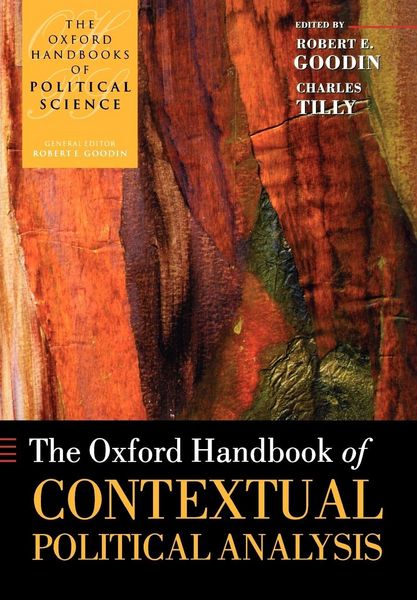
  • Produktbild: The Oxford Handbook of Contextual Political Analysis
  • Produktbild: The Oxford Handbook of Contextual Political Analysis

The Oxford Handbook of Contextual Political Analysis

95,99 €

inkl. gesetzl. MwSt., Versandkostenfrei


Produktdetails

Einband

Taschenbuch

Erscheinungsdatum

19.06.2008

Herausgeber

Goodin Robert E. + weitere

Verlag

Oxford University Press

Seitenzahl

882

Maße (L/B/H)

24,4/17/4,7 cm

Gewicht

1489 g

Sprache

Englisch

ISBN

978-0-19-954844-6

Produktdetails

Einband

Taschenbuch

Erscheinungsdatum

19.06.2008

Herausgeber

Verlag

Oxford University Press

Seitenzahl

882

Maße (L/B/H)

24,4/17/4,7 cm

Gewicht

1489 g

Sprache

Englisch

ISBN

978-0-19-954844-6

Herstelleradresse

Libri GmbH
Europaallee 1
36244 Bad Hersfeld
DE

Email: gpsr@libri.de

Noch keine Bewertungen vorhanden

Verfassen Sie die erste Bewertung zu diesem Artikel

Helfen Sie anderen Kundinnen und Kunden durch Ihre Meinung.

Kundinnen und Kunden meinen

Bewertungen (0)

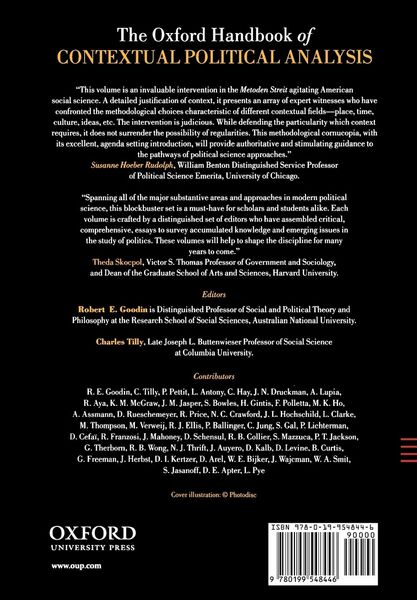
  • Produktbild: The Oxford Handbook of Contextual Political Analysis
  • Produktbild: The Oxford Handbook of Contextual Political Analysis

    • Part I. Introduction


    • 1: Charles Tilly and Robert E. Goodin: It Depends


    • Part II. Philosophy Matters


    • 2: Philip Pettit: Why and How Philosophy Matters


    • 3: Louise Antony: The Socialization of Epistemology


    • 4: Colin Hay: Political Ontology


    • 5: James N. Druckman and Arthur Lupia: Mind, Will, and Choice


    • 6: Rod Aya: Theory, Fact, Logic


    • Part III. Psychology Matters


    • 7: Kathleen M. McGraw: Why and How Psychology Matters


    • 8: James M. Jasper: Motivation and Emotion


    • 9: Samuel Bowles and Herbert Gintis: Social Preferences, Homo Economicus, and Zoon Politikon


    • 10: Francesca Polletta and M. Kai Ho: Frames and Their Consequences


    • 11: Aleida Assmann: Memory, Individual and Collective


    • Part IV. Ideas Matter


    • 12: Dietrich Rueschemeyer: Why and How Ideas Matter


    • 13: Richard Price: Detecting Ideas and Their Effects


    • 14: Neta C. Crawford: How Previous Ideas Affect Later Ideas


    • 15: Jennifer L. Hochschild: How Ideas Affect Actions


    • 16: Lee Clarke: Mistaken Ideas and Their Effects


    • Part V. Culture Matters


    • 17: Michael Thompson, Marco Verweij, and Richard J. Ellis: Why And How Culture Matters


    • 18: Pamela Ballinger: How to Detect Culture and its Effects


    • 19: Courtney Jung: Race, Ethnicity, Religion


    • 20: Susan Gal: Language, Its Stakes and Its Effects


    • 21: Paul Lichterman and Daniel Cefaï: The Idea of Political Culture


    • Part VI. History Matters


    • 22: Charles Tilly: Why and How History Matters


    • 23: Roberto Franzosi: Historical Knowledge and Evidence


    • 24: James Mahoney and Daniel Schensul: Historical Context and Path Dependence


    • 25: Ruth Berins Collier and Sebastián Mazzuca: Does History Repeat?


    • 26: Patrick Thaddeus Jackson: The Present as History


    • Part VII. Place Matters


    • 27: Göran Therborn: Why and How Place Matters


    • 28: R. Bin Wong: Detecting the Significance of Place


    • 29: Nigel J. Thrift: Space, Place, and Time


    • 30: Javier Auyero: Spaces and Places as Sites and Objects of Politics


    • 31: Don Kalb: Uses of Local Knowledge


    • Part VIII. Population Matters


    • 32: David Levine: Why and How Population Matters


    • 33: Bruce Curtis: The Politics of Demography


    • 34: Gary P. Freeman: Politics and Mass Immigration


    • 35: Jeffrey Herbst: Population Change, Urbanization, and Political Consolidation


    • 36: David I. Kertzer and Dominique Arel: Population Composition as an Object of Political Struggle


    • Part IX. Technology Matters


    • 37: Wiebe E. Bijker: Why and How Technology Matters


    • 38: Judy Wacjman: The Gendered Politics of Technology


    • 39: Wim A. Smit: Military Technologies and Politics


    • 40: Sheila Jasanoff: Technology as a Site and Object of Politics


    • Part X. Old and New


    • 41: David E. Apter: Duchamp's Urinal: Who Says What's Rational When Things Get Tough?


    • 42: Lucian Pye: The Behavioral Revolution and the Remaking of Comparative Politics