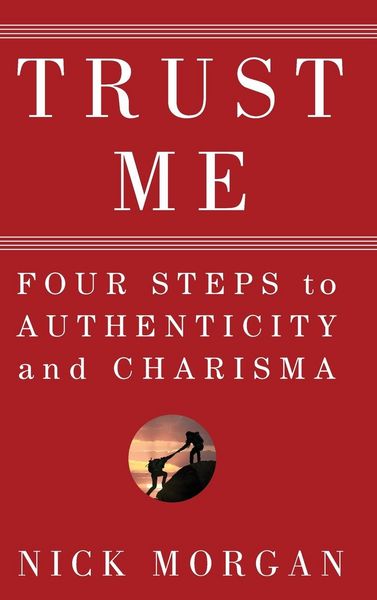
Produktbild: Trust Me

Trust Me Four Steps to Authenticity and Charisma

26,99 €

inkl. gesetzl. MwSt., Versandkostenfrei


Beschreibung

Produktdetails

Einband

Gebundene Ausgabe

Erscheinungsdatum

01.12.2008

Verlag

Wiley

Seitenzahl

224

Maße (L/B/H)

23,5/15,7/1,7 cm

Gewicht

481 g

Sprache

Englisch

ISBN

978-0-470-40435-5

Beschreibung

Produktdetails

Einband

Gebundene Ausgabe

Erscheinungsdatum

01.12.2008

Verlag

Wiley

Seitenzahl

224

Maße (L/B/H)

23,5/15,7/1,7 cm

Gewicht

481 g

Sprache

Englisch

ISBN

978-0-470-40435-5

Herstelleradresse

Libri GmbH
Europaallee 1
36244 Bad Hersfeld
DE

Email: gpsr@libri.de

Kundinnen und Kunden meinen

0 Bewertungen

Informationen zu Bewertungen

Zur Abgabe einer Bewertung ist eine Anmeldung im Konto notwendig. Die Authentizität der Bewertungen wird von uns nicht überprüft. Wir behalten uns vor, Bewertungstexte, die unseren Richtlinien widersprechen, entsprechend zu kürzen oder zu löschen.

Die Bewertungen sind nach Format, Anzahl Sterne und Datum sortiert.

Verfassen Sie die erste Bewertung zu diesem Artikel

Helfen Sie anderen Kund*innen durch Ihre Meinung

Kundinnen und Kunden meinen

0 Bewertungen filtern

Die Leseprobe wird geladen.
  • Produktbild: Trust Me
  • Introduction 1

    Every communication is both a verbal and a nonverbal conversation

    We are all unconscious experts in each other's body language

    1 Leaders Need Both Charisma and Authenticity 7

    You need charisma and authenticity to lead effectively

    Gesture can convey meaning independent of words

    Our most important dialogues with others take place nonverbally

    2 Aligning the Two Conversations Will Make You a Powerful Communicator 21

    Communications that align both the content and the nonverbal conversations can be powerful

    We unconsciously ascribe intent to the gestures we see

    The paradox of leadership today is that you have to practice to look spontaneous

    3 Being Open, Part One: How to Master the Verbal Conversation 35

    The verbal aspect of openness involves clarity of intent

    The content of an open communication begins with clear framing

    To conclude an open communication, reach agreement about what has been said

    4 Being Open, Part Two: How to Master the Nonverbal Conversation 43

    Trust is the essential goal of an open, nonverbal conversation

    When you communicate, you create a persona that other people unconsciously decode

    If you work on the conscious control of intention, your gestures take care of themselves

    5 Being Connected, Part One: How to Master the Verbal Connection 59

    Connected communication deals with the audience's concerns

    Connected communication is direct and simple

    Connected communication is reciprocal

    6 Being Connected, Part Two: How to Master the Nonverbal Connection 71

    Connection is first and foremost about closeness

    Everything significant between people happens in personal space or intimate space

    You can signal your intent with your posture

    7 How to Be Passionate with Content 79

    Label the emotion

    Tell an uncomfortable truth

    Verbal restraint can be a more powerful indicator of depth of feeling than excess

    8 How to Be Passionate Nonverbally 93

    The first place people look to find passion is in the voice

    A good voice needs resonance and presence

    Focus on your emotional attitude toward your meeting, topic, or event

    9 Listening, Part One: How to Listen Verbally - and Charismatically 101

    At its most basic, good listening offers feedback

    The most powerful kind of listening is empathic and analytical

    Identify the emotion and state its underlying causes without trying to solve the problem

    10 Listening, Part Two: How to Listen Nonverbally - and Charismatically 111

    Listen with your whole body

    Listening is at the heart of real charisma

    You must learn to read others' emotions consciously

    11 How to Read Others 121

    Openness is expressed through the face and torso

    Your unconscious evaluation will be more accurate than your conscious one (at fi rst)

    Look for overall body orientation to determine the state of your alliances

    12 Principles of Persuasive Content 143

    Phrase your arguments so that your listeners can hear them

    Persuasive rhetoric has a clear goal in mind and is usually transparent about it

    Authenticity and charisma in content require self-revelation in a confessional age

    13 Principles of Persuasive Nonverbal Communication 161

    If the two conversations are aligned, you can be an effective communicator

    Decision making is largely an emotional, and therefore a nonverbal, process

    Authenticity and charisma derive from becoming open, connected, passionate, and listening with and to your audience

    14 Conclusion: Leadership Is Communication 173

    Control your body language by controlling your intent

    Watch for unconscious betrayals through your body language

    Repetition is the key to the unconscious

    Notes 189

    Acknowledgments 197

    The Author 199

    Index 201