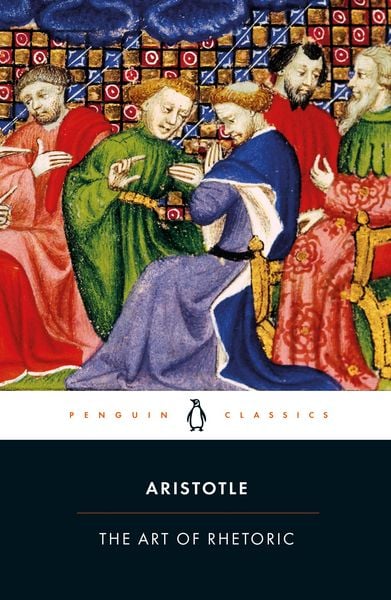
Produktbild: The Art of Rhetoric

The Art of Rhetoric

15,89 €

inkl. gesetzl. MwSt., Versandkostenfrei


Beschreibung

Produktdetails

Einband

Taschenbuch

Erscheinungsdatum

31.10.1991

Verlag

Penguin Books UK

Seitenzahl

304

Maße (L/B/H)

20/12,8/2 cm

Gewicht

226 g

Sprache

Englisch

ISBN

978-0-14-044510-7

Beschreibung

Produktdetails

Einband

Taschenbuch

Erscheinungsdatum

31.10.1991

Verlag

Penguin Books UK

Seitenzahl

304

Maße (L/B/H)

20/12,8/2 cm

Gewicht

226 g

Sprache

Englisch

ISBN

978-0-14-044510-7

Herstelleradresse

Libri GmbH
Europaallee 1
36244 Bad Hersfeld
DE

Email: gpsr@libri.de

Kundinnen und Kunden meinen

0 Bewertungen

Informationen zu Bewertungen

Zur Abgabe einer Bewertung ist eine Anmeldung im Konto notwendig. Die Authentizität der Bewertungen wird von uns nicht überprüft. Wir behalten uns vor, Bewertungstexte, die unseren Richtlinien widersprechen, entsprechend zu kürzen oder zu löschen.

Die Bewertungen sind nach Format, Anzahl Sterne und Datum sortiert.

Verfassen Sie die erste Bewertung zu diesem Artikel

Helfen Sie anderen Kund*innen durch Ihre Meinung

Kundinnen und Kunden meinen

0 Bewertungen filtern

Die Leseprobe wird geladen.
  • Produktbild: The Art of Rhetoric
  • The Art of Rhetoric - Aristotle Translated with an Introduction and Notes by Hugh Lawson-Tancred

    Preface
    Introduction:
    1. The Importance of Ancient Rhetoric
    2. The Historical Background to the Rhetoric
    3. Rhetoric as Techne
    4. Psychology in the Rhetoric
    5. Style and Composition
    6. The Rhetorical Legacy of Aristotle
    7. The Translation

    THE ART OF RHETORICSection One: Introductory
    Chapter 1.1. The Nature of Rhetoric
    PART ONE: DEMONSTRATIONSection Two: The Genres of Oratory
    Chapter 1.2. The Definition of Rhetoric
    Chapter 1.3. The Genres
    Section Three: Deliberation
    Chapter 1.4. The Province of Deliberation
    Chapter 1.5. Happiness
    Chapter 1.6. The Good and the Expedient
    Chapter 1.7. Relative Expediency
    Chapter 1.8. Constitutions
    Section Four: Display
    Chapter 1.9. Display Oratory
    Section Five: Litigation
    Chapter 1.10. Injustice
    Chapter 1.11. Pleasure
    Chapter 1.12. The Criminal Mind
    Chapter 1.13. Crime and Punishment
    Chapter 1.14. Relatively Serious Crimes
    Chapter 1.15. Non-technical Proofs
    PART TWO: EMOTION AND CHARACTERSection Six: Emotion
    Chapter 2.1. The Role of Emotion and Character
    Chapter 2.2. Anger
    Chapter 2.3. Calm
    Chapter 2.4. Friendship and Enmity
    Chapter 2.5. Fear and Confidence
    Chapter 2.6. Shame
    Chapter 2.7. Favour
    Chapter 2.8. Pity
    Chapter 2.9. Indignation
    Chapter 2.10. Envy
    Chapter 2.11. Jealousy
    Section Seven: Character
    Chapter 2.12. Youth
    Chapter 2.13. Old Age
    Chapter 2.14. Prime
    Chapter 2.15. Birth
    Chapter 2.16. Wealth
    Chapter 2.17. Power
    PART THREE: UNIVERSAL ASPECTSSection Eight: Common Topics
    Chapter 2.18. The Role of Common Topics
    Chapter 2.19. The Topics of Possibility
    Chapter 2.20. Example
    Chapter 2.21. Maxim
    Chapter 2.22. Enthymeme
    Chapter 2.23. Demonstrative Common Topics
    Chapter 2.24. Illusory Topics
    Chapter 2.25. Refutation
    Chapter 2.26. Amplification
    Section Nine: Style
    Chapter 3.1. Historical Preliminary
    Chapter 3.2. Clarity
    Chapter 3.3. Frigidity
    Chapter 3.4. Simile
    Chapter 3.5. Purity
    Chapter 3.6. Amplitude
    Chapter 3.7. Propriety
    Chapter 3.8. Rhythm
    Chapter 3.9. Syntax
    Chapter 3.10. Wit and Metaphor
    Chapter 3.11. Vividness
    Chapter 3.12. Suitability to Genre
    Section Ten: Composition
    Chapter 3.13. Narration and Proof
    Chapter 3.14. The Introduction
    Chapter 3.15. Prejudice
    Chapter 3.16. Narration
    Chapter 3.17. Proof and Refutation
    Chapter 3.18. Altercation
    Chapter 3.19. The Epilogue
    Notes
    Bibliography