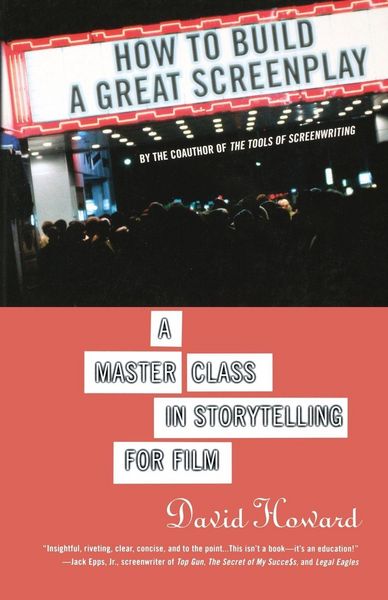
Produktbild: How to Build a Great Screenplay

How to Build a Great Screenplay A Master Class in Storytelling for Film

25,99 €

inkl. gesetzl. MwSt., Versandkostenfrei


Beschreibung

Produktdetails

Einband

Taschenbuch

Erscheinungsdatum

05.09.2000

Verlag

St. Martins Press-3PL

Seitenzahl

464

Maße (L/B/H)

21,6/14/2,8 cm

Gewicht

650 g

Sprache

Englisch

ISBN

978-0-312-35262-2

Beschreibung

Produktdetails

Einband

Taschenbuch

Erscheinungsdatum

05.09.2000

Verlag

St. Martins Press-3PL

Seitenzahl

464

Maße (L/B/H)

21,6/14/2,8 cm

Gewicht

650 g

Sprache

Englisch

ISBN

978-0-312-35262-2

Herstelleradresse

Libri GmbH
Europaallee 1
36244 Bad Hersfeld
DE

Email: gpsr@libri.de

Noch keine Bewertungen vorhanden

Verfassen Sie die erste Bewertung zu diesem Artikel

Helfen Sie anderen Kundinnen und Kunden durch Ihre Meinung.

Kundinnen und Kunden meinen

Bewertungen (0)

Die Leseprobe wird geladen.
  • Produktbild: How to Build a Great Screenplay
  • Acknowledgments

    Preface

    Story and Storytelling
    The Story
    The Chronology of Events
    A Crucial Paradox
    Life Is What Happens
    The World of the Story
    Collisions
    Where's the Antagonist
    Characters' Baggage and Unfinished Business
    Lightening, Decisions, and Protagonists
    Character Arc
    What If This Story Were a Fairy Tale or Myth?
    The Audience's Fragile Involvement

    The Telling of the Story
    The Seamless Dream
    The Intended Impact
    Camera as Storyteller
    Genre, Style, and Tone
    Separation of Experience and Knowledge
    Hope Versus Fear
    The "Game" of Storytelling

    Building Stories
    The Creation of Drama
    Main Character or Ensemble Story?
    Protagonist and the Creation of Story
    Worthy Antagonist
    Supportive and Reflective Characters
    Tension from First to Last
    Actions and Goals
    Character Arc
    Pivotal Decisions
    Time Compression and Intensity
    The Possible and the Impossible

    Foundations
    Building from the Ground Up
    Main Character's Passion
    Objective and Subjective Drama
    Theme
    Backstory
    What's at Stake?
    Six Types of Characters

    Carpentry and Craftsmanship
    Creating the Audience's Experience
    Immediacy and the Sense of Here and Now
    Exposition
    Rising Action
    Point of No Return
    Willing Suspension of Disbelief
    Demonstration versus Explanation
    Number of Clearly Defined Characters
    Character Motivations
    Subtext
    Recapitulations
    Dealing with Coincidence
    Creating Living Characters
    Inner Life and Character Attitude
    Protagonist and Antagonist
    Secondary Characters
    Underlying Motives

    Time and Storytelling
    Screen Time and Drama
    Time and Complexity
    Action Time
    Amount of Story and Screen time
    Real Time versus Screen Time versus Time Frame
    The Simplest Use of Time
    Why Alter Simple Chronology?
    Time and the Lives of the Characters
    Objective Time and Subjective Time

    Basic Dramatic Structure
    What is Drama?

    The Three Acts
    The Beginning: Engaging the Audience
    The Middle: Elaborating and Extending the Engagement
    The End: Releasing the Engagement
    The Writer's Relationship to the Acts

    Sequences
    From Acts to Sequences
    The Elements of a Sequence
    Special Needs of the First Sequence
    Pretitle Sequences and Codas

    Crucial Moments
    Crucial Moments in the Main Character's Life
    Crucial Moments in the Telling of the Story

    Subplots
    The Role of Subplots
    Subplots Characters
    Beginning, Middle, and End
    Resolution of Subplots and Main Plot
    How to Weave in Subplots

    The Classical Screenplay Structure
    Main Character's Undisturbed Status Quo
    Creating the Dilemma
    Elaborating on the Dilemma and the World of the Story
    First Potential Breakthrough
    Main Subplot and Main Character
    Greatest Exertion
    False Resolution
    Final Test of Character and True Resolution
    Typical Placements and Proportions
    Relationships of Midpoint, Culmination, and Resolution
    Where Does "Climax" Fit In?

    Beyond Classical Dramatic Structure
    The Single Unbreakable Rule of Drama

    Anything But Classical Screenplay Structure
    Being Different
    Breaking the Form
    Storyteller Intentions and Priorities

    The Limits of Classical, the Beginnings of Revolutionary
    Are All "Revolutionary" Films Revolutionary?
    Mainstream Experiments in Storytelling
    A Few Lessons from Past Experiments
    Storytelling Myths, Legends, and Lies

    How to Shake Up Classical Structure-and Why
    Why Some Stories Can't Be Classically Told
    The Physics of Drama
    How to Stir the Pot
    Cost-Benefit Analyses with Rule-Breaking
    Using the Rules to Break the Rules
    Clarity and Obscurity

    Writing and Work Strategies
    Before the First Draft
    What Keeps the Audience in Their Seats
    Consider the Audience's Position

    The First Draft
    The Sequence Breakdown
    The Step Outline
    Writing the First Draft

    After the First Draft
    Clarifying Your Theme
    Rewriting
    Know Your Long Suit and Short Suit
    Dramatic Instincts

    A Final Note

    Index

    About the Author