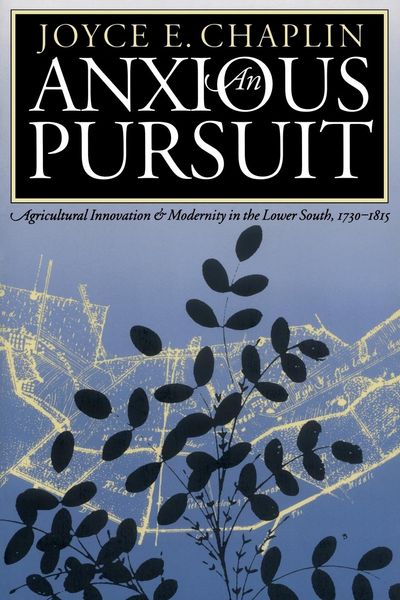
An Anxious Pursuit Agricultural Innovation and Modernity in the Lower South, 1730-1815
-
- Taschenbuch ausgewählt
- eBook
-
Sprache:Englisch
57,99 €
inkl. gesetzl. MwSt.,
Beschreibung
Produktdetails
Einband
Taschenbuch
Erscheinungsdatum
09.09.1996
Verlag
Omohundro Institute and UNC PressSeitenzahl
430
Maße (L/B/H)
23,4/15,6/2,5 cm
Gewicht
728 g
Sprache
Englisch
ISBN
978-0-8078-4613-1
In An Anxious Pursuit, Joyce Chaplin examines the impact of the Enlightenment ideas of progress on the lives and minds of American planters in the colonial Lower South. She focuses particularly on the influence of Scottish notions of progress, tracing the extent to which planters in South Carolina, Georgia, and British East Florida perceived themselves as a modern, improving people. She reads developments in agricultural practice as indices of planters' desire for progress, and she demonstrates the central role played by slavery in their pursuit of modern life. By linking behavior and ideas, Chaplin has produced a work of cultural history that unites intellectual, social, and economic history. Using public records as well as planters' and farmers' private papers, Chaplin examines innovations in rice, indigo, and cotton cultivation as a window through which to see planters' pursuit of a modern future. She demonstrates that planters actively sought to improve their society and economy even as they suffered a pervasive anxiety about the corrupting impact of progress and commerce. The basis for their accomplishments and the root of their anxieties, according the Chaplin, were the same: race-based chattel slavery. Slaves provied the labor necessary to attain planters' vision of the modern, but the institution ultimately limited the Lower South's ability to compete in the contemporary world. Indeed, whites continued to wonder whether their innovations, some of them defied by slaves, truly improved the region. Chaplin argues that these apprehensions prefigured the antimodern stance of the antebellum period, but she contends that they were as much a reflection of the doubt inherent in theories of progress as an outright rejection of those ideas.
Noch keine Bewertungen vorhanden
Verfassen Sie die erste Bewertung zu diesem Artikel
Helfen Sie anderen Kundinnen und Kunden durch Ihre Meinung.
Kurze Frage zu unserer Seite
Vielen Dank für Ihr Feedback
Wir nutzen Ihr Feedback, um unsere Produktseiten zu verbessern. Bitte haben Sie Verständnis, dass wir Ihnen keine Rückmeldung geben können. Falls Sie Kontakt mit uns aufnehmen möchten, können Sie sich aber gerne an unseren Kund*innenservice wenden.
zum Kundenservice