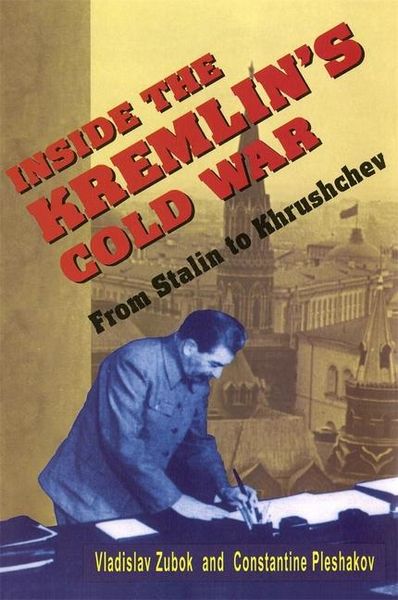
Inside the Kremlin's Cold War From Stalin to Khrushchev
-
- Englisch ausgewählt
37,99 €
inkl. gesetzl. MwSt.,
Beschreibung
Produktdetails
Einband
Taschenbuch
Erscheinungsdatum
25.04.1997
Verlag
Harvard University PressSeitenzahl
382
Maße (L/B/H)
23,3/15,6/2,6 cm
Gewicht
499 g
Sprache
Englisch
ISBN
978-0-674-45532-0
Using recently uncovered archival materials, personal interviews, and a broad familiarity with Russian history and culture, two young Russian historians have written a major interpretation of the Cold War as seen from the Soviet shore. Covering the volatile period from 1945 to 1962, Zubok and Pleshakov explore the personalities and motivations of the key people who directed Soviet political life and shaped Soviet foreign policy. They begin with the fearsome figure of Joseph Stalin, who was driven by the dual dream of a Communist revolution and a global empire. They reveal the scope and limits of Stalin's ambitions by taking us into the world of his closest subordinates, the ruthless and unimaginative foreign minister Molotov and the Party's chief propagandist, Zhdanov, a man brimming with hubris and missionary zeal. The authors expose the machinations of the much-feared secret police chief Beria and the party cadre manager Malenkov, who tried but failed to set Soviet policies on a different course after Stalin's death. Finally, they document the motives and actions of the self-made and self-confident Nikita Khrushchev, full of Russian pride and party dogma, who overturned many of Stalin's policies with bold strategizing on a global scale. The authors show how, despite such attempts to change Soviet diplomacy, Stalin's legacy continued to divide Germany and Europe, and led the Soviets to the split with Maoist China and to the Cuban missile crisis. Zubok and Pleshakov's groundbreaking work reveals how Soviet statesmen conceived and conducted their rivalry with the West within the context of their own domestic and global concerns and aspirations. The authors persuasively demonstrate thatthe Soviet leaders did not seek a conflict with the United States, yet failed to prevent it or bring it to conclusion. They also document why and how Kremlin policy-makers, cautious and scheming as they were, triggered the gravest crises of the Cold War in Korea, Berlin, and Cuba.
Kundinnen und Kunden meinen
Verfassen Sie die erste Bewertung zu diesem Artikel
Helfen Sie anderen Kund*innen durch Ihre Meinung
Kurze Frage zu unserer Seite
Vielen Dank für Ihr Feedback
Wir nutzen Ihr Feedback, um unsere Produktseiten zu verbessern. Bitte haben Sie Verständnis, dass wir Ihnen keine Rückmeldung geben können. Falls Sie Kontakt mit uns aufnehmen möchten, können Sie sich aber gerne an unseren Kund*innenservice wenden.
zum Kundenservice