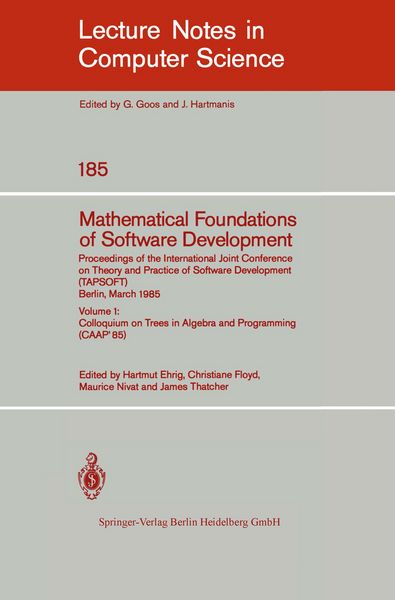
Mathematical Foundations of Software Development. Proceedings of the International Joint Conference on Theory and Practice of Software Development (TAPSOFT), Berlin, March 25-29, 1985 Volume 1: Colloquium on Trees in Algebra and Programming (CAAP'85)
-
- Englisch ausgewählt
39,99 €
inkl. gesetzl. MwSt.,
Beschreibung
Produktdetails
Einband
Taschenbuch
Erscheinungsdatum
01.03.1985
Abbildungen
XVIII, 422 p.
Herausgeber
Hartmut Ehrig + weitereVerlag
Springer BerlinSeitenzahl
422
Maße (L/B/H)
23,5/15,5/2,4 cm
Gewicht
657 g
Auflage
1985
Sprache
Englisch
ISBN
978-3-540-15198-2
Specification and top down design of distributed systems.- Specification languages for distributed systems.- Semantically based programming tools (Summary).- From function level semantics to program transformation and optimization.- Inductively defined functions.- Three approaches to type structure.- On the maximum size of random trees.- Fast searching in a real algebraic manifold with applications to geometric complexity.- Typed categorical combinatory logic.- A path ordering for proving termination of term rewriting systems.- A rewrite rule based approach for synthesizing abstract data types.- "Delayability" in proofs of strong normalizability in the typed lambda Calculus.- Bisimulations and abstraction homomorphisms.- A metric characterization of fair computations in CCS.- A complete modal proof system for a subset of SCCS.- Amalgamation of graph transformations with applications to synchronization.- Decompilation of control structures by means of graph transformations.- Synchronized bottom-up tree automata and L-systems.- On observational equivalence and algebraic specification.- Parameter preserving data type specifications.- On the parameterized algebraic specification of concurrent systems.- The semantics of shared submodules specifications.- Why Horn formulas matter in computer science: Initial structures and generic examples.- On the implementation of abstract data types by programming language constructs.- A LISP compiler for FP language and its proof via algebraic semantics.
Noch keine Bewertungen vorhanden
Verfassen Sie die erste Bewertung zu diesem Artikel
Helfen Sie anderen Kundinnen und Kunden durch Ihre Meinung.
Kurze Frage zu unserer Seite
Vielen Dank für Ihr Feedback
Wir nutzen Ihr Feedback, um unsere Produktseiten zu verbessern. Bitte haben Sie Verständnis, dass wir Ihnen keine Rückmeldung geben können. Falls Sie Kontakt mit uns aufnehmen möchten, können Sie sich aber gerne an unseren Kund*innenservice wenden.
zum Kundenservice