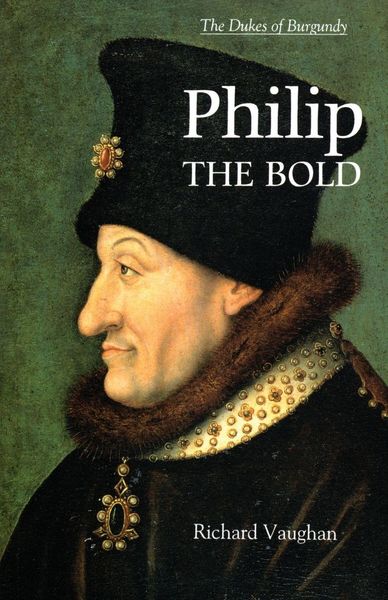
Philip the Bold The Formation of the Burgundian State (Revised)
-
- Englisch ausgewählt
44,99 €
inkl. gesetzl. MwSt.,
Beschreibung
Produktdetails
Einband
Taschenbuch
Erscheinungsdatum
01.02.2011
Abbildungen
4 line.
Verlag
Boydell & Brewer LtdSeitenzahl
320
Maße (L/B/H)
21,6/14/1,7 cm
Gewicht
405 g
Sprache
Englisch
ISBN
978-0-85115-915-7
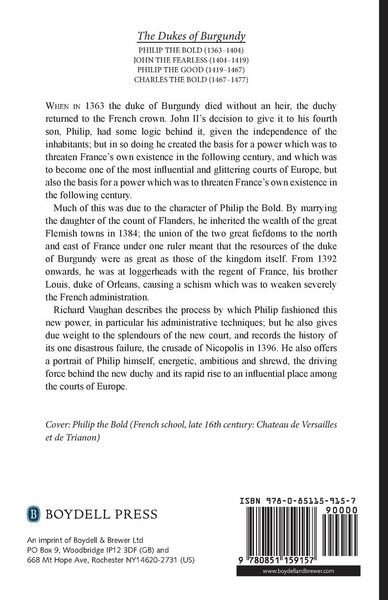
Boydell & Brewer does a major service by the simultaneous reissue of Richard Vaughan's studies of the Valois Dukes of Burgundy. Four distinguished scholars add extra value by contributing an introductory chapter for each ducal reign, surveying its historiography since the original publication... The story, which Vaughan tells with verve, has its full share of dramatic turns(: ) this is much more, though, than simply a narrative history; Vaughan's meticulous explorations of the administrative and financial structures that underpinned ducal authority, and of the court and its culture, are integral to his exposition (...) His achievement remains monumental. There are no comparable, modern, in-depth studies of these four larger-than-life players on the late medieval European stage, in English or in any other language. They are, besides, eminently readable. Maurice Keen, TIMES LITERARY SUPPLEMENT When in 1363 the duke of Burgundy died without an heir, the duchy returned to the French crown. John II's decision to give it to his fourth son, Philip, had some logic behind it, given the independence of the inhabitants; but in so doing he created the basis for a power which was to threaten France's own existence in the following century, and which was to become one of the most influential and glittering courts of Europe. Much of this was due to the character of Philip the Bold; by marrying the daughter of the count of Flanders, he inherited the wealth of the great Flemish towns in 1384, and the union of the two great fiefdoms to the north and east of France under one ruler meant that the resources of the duke of Burgundy were as great as those of the kingdom itself. From 1392 onwards, he was at loggerheads with the regent of France, his brother Louis, duke of Orleans, and this schism was to prove fatal to the kingdom, weakening the administration and leading to the French defeat by Henry V in 1415. Richard Vaughan describes the process by which Philip fashioned this new power, in particular his administrative techniques; but he also gives due weight to the splendours of the new court, in the sphere of the arts, and records the history of its one disastrous failure, the crusade of Nicopolis in 1396. He also offers a portrait of Philip himself, energetic, ambitious and shrewd, the driving force behind the new duchy and its rapid rise to an influential place among the courts of Europe.
Noch keine Bewertungen vorhanden
Verfassen Sie die erste Bewertung zu diesem Artikel
Helfen Sie anderen Kundinnen und Kunden durch Ihre Meinung.
Kurze Frage zu unserer Seite
Vielen Dank für Ihr Feedback
Wir nutzen Ihr Feedback, um unsere Produktseiten zu verbessern. Bitte haben Sie Verständnis, dass wir Ihnen keine Rückmeldung geben können. Falls Sie Kontakt mit uns aufnehmen möchten, können Sie sich aber gerne an unseren Kund*innenservice wenden.
zum Kundenservice