• Produktbild: Does It Take A Village?
  • Produktbild: Does It Take A Village?

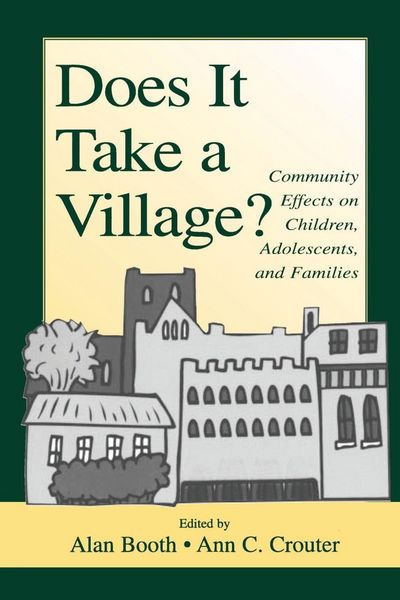
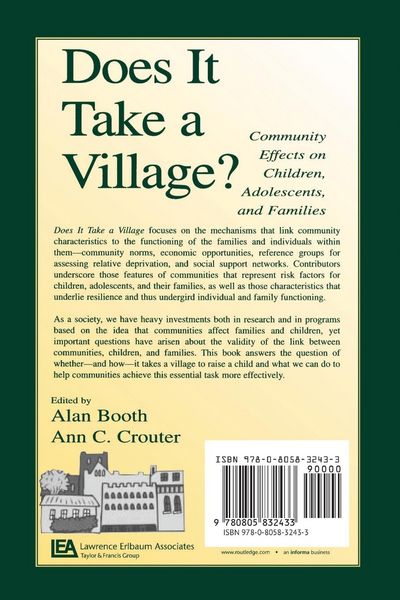
Does It Take A Village? Community Effects on Children, Adolescents, and Families

87,99 €

inkl. gesetzl. MwSt., Versandkostenfrei


Beschreibung

Produktdetails

Einband

Taschenbuch

Erscheinungsdatum

01.01.2001

Herausgeber

Alan Booth + weitere

Verlag

Psychology Press

Seitenzahl

278

Maße (L/B/H)

22,9/15,2/1,5 cm

Gewicht

407 g

Sprache

Englisch

ISBN

978-0-8058-3243-3

Beschreibung

Produktdetails

Einband

Taschenbuch

Erscheinungsdatum

01.01.2001

Herausgeber

Verlag

Psychology Press

Seitenzahl

278

Maße (L/B/H)

22,9/15,2/1,5 cm

Gewicht

407 g

Sprache

Englisch

ISBN

978-0-8058-3243-3

Herstelleradresse

Produktsicherheitsverantwortliche/r
Europaallee 1
36244 Bad Hersfeld
DE

Email: gpsr@libri.de

Kundinnen und Kunden meinen

0 Bewertungen

Informationen zu Bewertungen

Zur Abgabe einer Bewertung ist eine Anmeldung im Konto notwendig. Die Authentizität der Bewertungen wird von uns nicht überprüft. Wir behalten uns vor, Bewertungstexte, die unseren Richtlinien widersprechen, entsprechend zu kürzen oder zu löschen.

Die Bewertungen sind nach Format, Anzahl Sterne und Datum sortiert.

Verfassen Sie die erste Bewertung zu diesem Artikel

Helfen Sie anderen Kund*innen durch Ihre Meinung

Kundinnen und Kunden meinen

0 Bewertungen filtern

Die Leseprobe wird geladen.
  • Produktbild: Does It Take A Village?
  • Produktbild: Does It Take A Village?
  • Contents: Preface. Part I: How Do Communities Undergird or Undermine Human Development? What Are the Relevant Contexts and What Mechanisms Are at Work?R.J. Sampson, How Do Communities Undergird or Undermine Human Development? Relevant Contexts and Social Mechanisms B.A. Lee, Taking Neighborhoods Seriously. D. Massey, The Prodigal Paradigm Returns: Ecology Comes Back to Sociology. Part II: How Do Neighborhoods Enhance or Interfere With Families' Abilities to Raise Children?M.B. Spencer, Resiliency and Fragility Factors Associated With the Contextual Experiences of Low-Resource Urban African-American Male Youth and Families. J.E. Korbin, Context and Meaning in Neighborhood Studies of Children and Families. S.J. South, Issues in the Analysis of Neighborhoods, Families, and Children. M.L. Sullivan, Hyperghettos and Hypermasculinity: The Phenomenology of Exclusion. Part III: How Do Neighborhoods Affect the Development of Adolescent Problem Behavior?G.J. Duncan, S.W. Raudenbush, Neighborhoods and Adolescent Development: How Can We Determine the Links? J.O.G. Billy, Better Ways to Do Contextual Analysis: Lessons From Duncan and Raudenbush. L.M. Burton, One Step Forward and Two Steps Back: Neighborhoods, Adolescent Development, and Unmeasured Variables. S. Small, A. Supple, Communities as Systems: Is a Community More Than the Sum of Its Parts? Part IV: What Policies Can Strengthen Neighborhoods as Contexts for Child and Adolescent Well-Being?J.P. Connell, A.C. Kubisch, Community Approaches to Improving Outcomes for Urban Children, Youth, and Families: Current Trends and Future Directions. R.B. Taylor, On Mount and Fayette: Implications for Comprehensive Youth Development Approaches. M. Greenberg, Developmental and Ecological Considerations in Implementing Community Action Strategies for Children and Youth. D.A. Blyth, Community Approaches to Improving Outcomes for Urban Children, Youth, and Families. F. Avenilla, S. Singley, Neighborhood Effects on Child and Adolescent Development: Assessing Today's Knowledge for Tomorrow's Village.