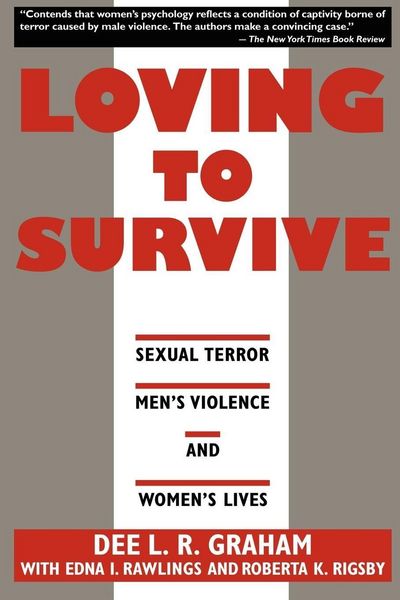
Loving to Survive Sexual Terror, Men's Violence, and Women's Lives
-
- Hardcover ausgewählt
- Taschenbuch
- eBook
-
Sprache:Englisch
117,99 €
inkl. gesetzl. MwSt.,
Beschreibung
Produktdetails
Einband
Gebundene Ausgabe
Erscheinungsdatum
01.07.1994
Verlag
NYU Press - IPSSeitenzahl
346
Maße (L/B/H)
24,3/16,4/2,9 cm
Gewicht
653 g
Sprache
Englisch
ISBN
978-0-8147-3058-4
In 1973, three women and one man were held hostage in one of the largest banks in Stockholm by two ex-convicts. These two men threatened their lives, but also showed them kindness. Over the course of the long ordeal, the hostages came to identify with their captors, developing an emotional bond with them. They began to perceive the police, their prospective liberators, as their enemies, and their captors as their friends and a source of security. This seemingly bizarre reaction to captivity, in which the hostages and captors mutually bond to one another, has been documented in other cases as well, and has become widely known as Stockholm Syndrome. Dee Graham and her coauthors take this syndrome as their starting point to develop a new way of looking at male-female relationships. Loving to Survive considers men's violence against women as crucial to understanding women's current psychology. Men's violence creates ever present, and therefore often unrecognized, terror in women. This terror is often experienced as a fear - for any woman - of rape by any man or as a fear of making a man - any man - angry. They propose that women's current psychology is actually a psychology of women under conditions of captivity - that is, under conditions of terror caused by male violence against women. Therefore, women's responses to men, and to male violence, resemble hostages' responses to captors. Loving to Survive proposes that, like hostages who work to placate their captors lest they kill them, women work to please men, and from this springs women's femininity. Femininity describes a set of behaviors that please men because they communicate a woman's acceptance of her subordinate status. Thus, feminine behaviors are, in essence, survival strategies. Like hostages who bond to their captors, women bond to men in an effort to survive. This is a book that will forever change the way we look at male-female relationships and women's lives.
Noch keine Bewertungen vorhanden
Verfassen Sie die erste Bewertung zu diesem Artikel
Helfen Sie anderen Kundinnen und Kunden durch Ihre Meinung.
Kurze Frage zu unserer Seite
Vielen Dank für Ihr Feedback
Wir nutzen Ihr Feedback, um unsere Produktseiten zu verbessern. Bitte haben Sie Verständnis, dass wir Ihnen keine Rückmeldung geben können. Falls Sie Kontakt mit uns aufnehmen möchten, können Sie sich aber gerne an unseren Kund*innenservice wenden.
zum Kundenservice